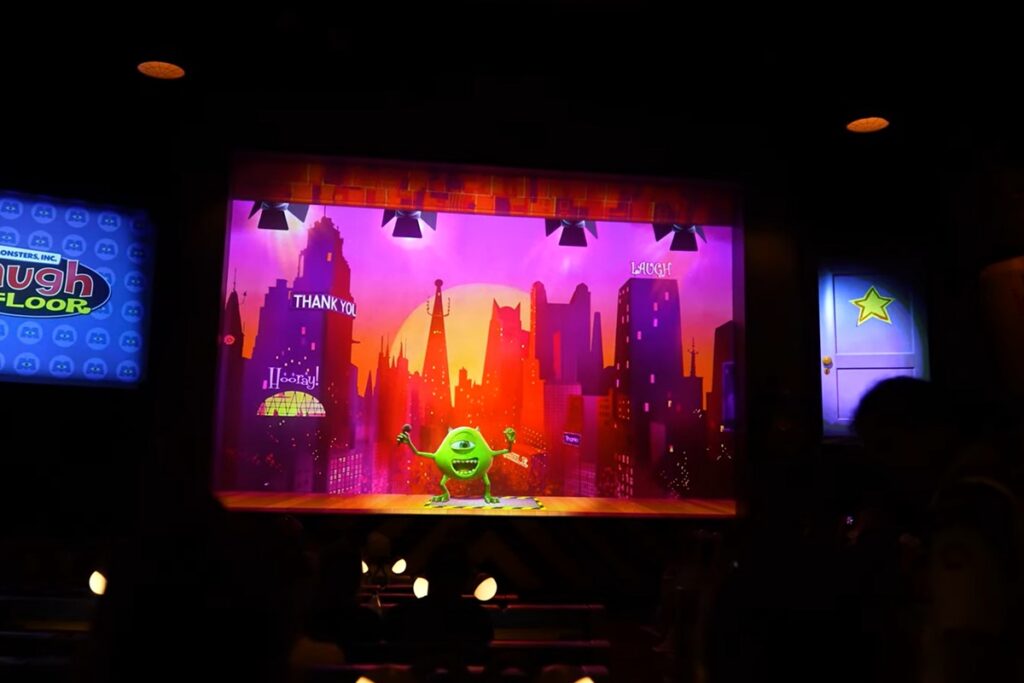
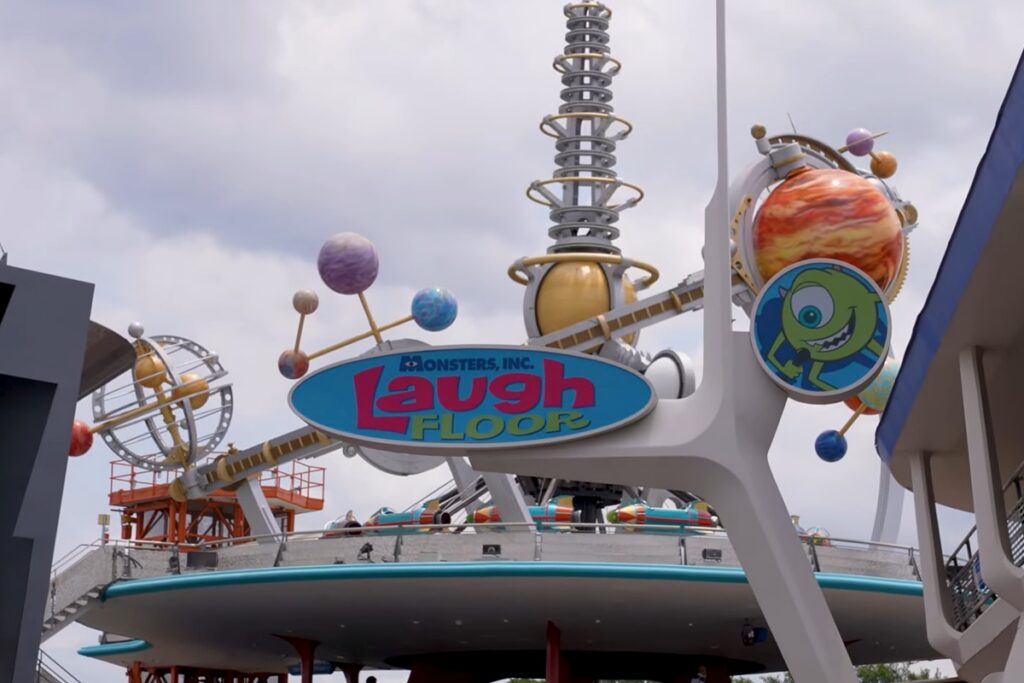
Monsters, Inc. Laugh Floor is an interactive comedy show in Tomorrowland at Magic Kingdom that allows animated Pixar characters to converse with real guests in real time. Officially opened on April 2, 2007, the attraction continues the story of Monsters, Inc. by imagining what happened after Mike Wazowski and James P. Sullivan discovered that children’s laughter generates far more energy than their screams. Monstropolis has moved into the laughter business, and Mike has turned part of the Monsters, Inc. factory into a comedy club where human visitors provide the power.
The basic objective is intentionally simple: make the audience laugh enough to fill a laugh canister.
Mike Wazowski serves as the club’s self-appointed “Monster of Ceremonies,” introducing a rotating series of monster comedians while cameras scan the audience for potential participants. Rather than watching a completely prerecorded film, guests become part of the performance. The monsters can ask someone their name, comment on what they are wearing, respond to an unexpected answer, improvise a joke, or repeatedly return to the same unfortunate audience member throughout the show.
That interactivity is what separates Laugh Floor from most theater attractions at Walt Disney World.
The experience begins before guests enter the main auditorium. The Tomorrowland entrance is presented as a doorway between the human world and Monstropolis, allowing visitors to enter the monster world’s converted laugh factory. Inside the preshow area, industrial details, Monsters, Inc. logos, pipes, equipment, and comic signs reinforce the idea that the old scream-processing operation has been hastily converted for a much friendlier form of energy production.
Guests are also invited to contribute to the show themselves.
Before entering the theater, instructions explain how visitors can text a joke for possible inclusion in the performance. The material may be corny, obvious, or familiar-that is very much part of the attraction’s style. If a submitted joke is selected, one of the monster comedians may deliver it during the show while crediting the guest who sent it.
Once inside, the audience sits in rows facing a large digital performance area. The theater holds several hundred people, yet cameras and live performers can isolate individual visitors almost instantly.
The attraction’s most important technological achievement is its use of digital puppetry.
Behind the scenes, human performers control animated monsters and provide their voices while observing the audience through cameras. Sophisticated real-time animation systems translate the performer’s actions into a digital character that appears on the large screen as though it is genuinely standing in Monstropolis.
The performer can hear a guest’s response and react immediately.
If a child gives an unexpected answer, the monster can acknowledge it. If someone misunderstands a question, the comedian can improvise around the mistake. If an audience member makes an especially expressive face, the character may comment on it.
The illusion is effective because the animation is not simply branching between a few prerecorded responses. Much of the performance is genuinely live.
The technology evolved from Walt Disney Imagineering’s experiments with interactive animated characters, particularly the work that made Turtle Talk with Crush possible. Laugh Floor expanded that concept from a relatively intimate conversation into a large-scale comedy show involving hundreds of guests.
Disney was promoting the technology before the attraction even opened, describing it as a way for guests to “laugh, joke and match wits” with animated Monsters, Inc. characters in real time.
The show begins with Mike explaining the challenge. Monstropolis needs laughter, and the audience must generate enough of it to fill the large canister beside the stage.
Cameras immediately establish that no one in the theater is entirely safe.
Guests may suddenly appear on the large screens accompanied by captions identifying them as people who supposedly forgot where they parked, are planning to buy everyone snacks, have no idea they are currently on camera, or possess some other ridiculous characteristic.
One particular audience member frequently receives the show’s most famous unofficial honor: “That Guy.”
Once selected, “That Guy” becomes a recurring punchline. Comedians may refer back to him repeatedly, even when he has absolutely nothing to do with the current joke. The humor depends heavily on the participant being a good sport as the camera keeps returning to the same increasingly recognizable face.
Traditionally, the guest receives an “I Was That Guy” sticker afterward, turning mild public embarrassment into one of the attraction’s most coveted souvenirs.
Mike introduces several comedy acts during the performance.
The exact material and even some performers can vary, which is one reason repeat visits do not necessarily produce identical shows. A two-headed monster act has appeared under names including Sam and Ella and Mac and Jeeves, using deliberately terrible wordplay while testing its questionable understanding of the human world.
A typical routine may involve asking a guest to name a country so the monster can identify its capital. Rather than displaying impressive geographical knowledge, the answer usually depends on a painfully literal joke-for example, identifying the “capital” of a word as its first letter.
Another longstanding performer is Marty Wazowski, Mike’s smaller orange nephew. Marty frequently works directly with younger members of the audience and has also been used to deliver jokes submitted by guests.
Following the release of Monsters University in 2013, Marty’s segment received visual references to the university, allowing the attraction to acknowledge the expanding Monsters franchise without rebuilding the entire show.
Mike remains the connective tissue between the individual acts.
He desperately wants the comedy club to succeed, partly because he expects to receive credit for saving Monstropolis. Unfortunately for Mike, Roz remains involved.
Just as she did in Monsters, Inc., Roz has little patience for Mike’s ego.
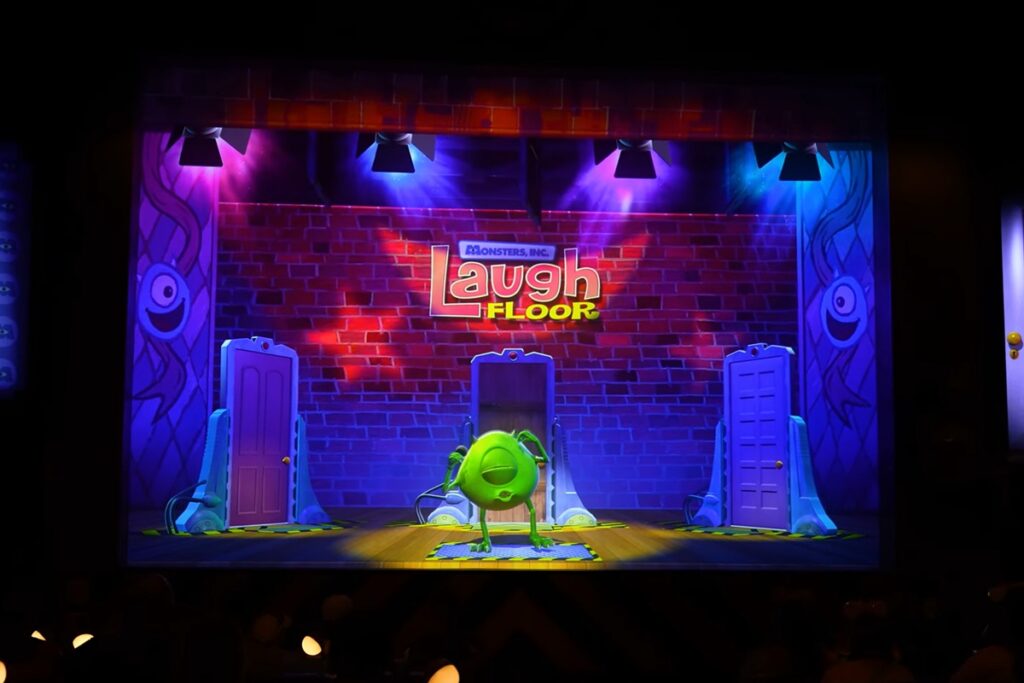
After enough laughter has theoretically filled the canister, Mike expects congratulations. The attraction instead usually finds a way to undercut him, frequently giving someone in the human audience the real credit. “That Guy,” after serving as a running joke throughout the performance, can end up being celebrated as the person responsible for generating the power.
The structure gives the show a recognizable beginning and conclusion while leaving substantial room for improvisation in the middle.
That balance is important.
A fully scripted production would become predictable after several visits. A completely improvised show would risk losing its pacing and storyline. Laugh Floor operates between the two: key beats remain consistent, while the live performers change jokes, audience interactions, and reactions within that framework.
As a result, the audience can dramatically affect how entertaining a particular performance becomes.
A child who enthusiastically talks with Marty, an adult who refuses to understand the joke, or a particularly expressive “That Guy” may give the performers material they could never have scripted in advance.
The attraction’s location has an interesting history of its own.
Before Monsters, Inc. moved in, the building was home to Magic Kingdom’s Circle-Vision 360 theater. Beginning shortly after Walt Disney World’s 1971 opening, the space presented large-format panoramic travel films including America the Beautiful, Magic Carpet ‘Round the World, and eventually American Journeys.
Circle-Vision surrounded standing guests with nine synchronized screens, creating an immersive panoramic image decades before modern projection environments became commonplace.
American Journeys closed on January 9, 1994, and Disney converted the theater into The Timekeeper, which officially opened on November 21 of that year.
The Timekeeper combined Circle-Vision film with Audio-Animatronics characters and a science-fiction time-travel story. Robin Williams voiced the eccentric Timekeeper, while Rhea Perlman voiced the nine-eyed robotic camera known as 9-Eye.
Although remembered fondly by many enthusiasts, The Timekeeper struggled with attendance and eventually moved to seasonal operation. Disney permanently retired it in 2006, clearing the way for the Monsters, Inc. project.
Rather than demolishing the theater, Imagineering substantially reused it.
The former standing Circle-Vision auditorium was converted into a seated comedy venue accommodating roughly 400 guests. Portions of the earlier building infrastructure remained concealed beneath the new attraction, and some architectural elements in the queue reflected the space’s previous Tomorrowland identities.
Monsters, Inc. Laugh Floor therefore represents another chapter in a building that has continuously adapted to changing ideas about futuristic entertainment.
That reuse is especially appropriate because Laugh Floor itself represented a different vision of Tomorrowland.
Earlier attractions in the building presented travel, panoramic filmmaking, robotics, and speculative time travel. Laugh Floor shifted toward character-based science fiction, but its real technological showcase is largely invisible. The “future” is found not in Mike Wazowski himself but in the ability of a computer-animated character to recognize, address, and improvise with a real person sitting hundreds of feet away.
When Laugh Floor debuted, that interaction was considerably more novel than it may appear today.
The attraction began public previews in late 2006 while Disney continued refining the show, characters, animation, and pacing. Its official April 2007 opening placed it during a period when Imagineering was experimenting heavily with experiences in which animated characters seemed to escape the boundary between prerecorded film and the physical park.
That experimentation has aged particularly well.
Even as projection quality and home computer animation have advanced dramatically, the surprise of hearing an animated monster respond specifically to something a guest just said remains effective because the appeal is social rather than purely technological.
Laugh Floor also occupies an unusual place among Tomorrowland attractions because it is entirely dependent on human performers despite appearing to be a digital show.
Without skilled performers backstage, the technology alone would provide little entertainment. Comic timing, improvisation, crowd reading, voice performance, and the ability to recover when an audience member gives an unexpected answer are essential to making the illusion work.
That became especially apparent during the COVID-19 era.
Monsters, Inc. Laugh Floor closed with the rest of Walt Disney World in March 2020. When Magic Kingdom reopened that July, many live entertainment experiences remained unavailable, and Laugh Floor stayed dark for more than a year.
The attraction finally welcomed guests again on August 5, 2021, restoring both its live performers and its guest-submitted joke system.
As of 2026, Monsters, Inc. Laugh Floor remains an operating Magic Kingdom attraction. Walt Disney World continues to advertise it as an interactive indoor comedy show open to guests of any height, with Mike Wazowski hosting the proceedings and audience members potentially becoming part of the act.
Its continued operation is noteworthy because the Monsters, Inc. franchise is also gaining a much larger Walt Disney World presence.
A full Monstropolis area is under development at Disney’s Hollywood Studios, with Disney announcing attractions, dining, shops, and a suspended coaster based on the film’s famous door vault. Disney currently expects that land to open in 2027.
That project has not displaced Laugh Floor. As of late 2026, Mike’s Tomorrowland comedy club continues operating independently at Magic Kingdom.
The two experiences also serve very different purposes. Monstropolis at Hollywood Studios is designed to physically immerse visitors in the city from the films. Laugh Floor is fundamentally a live comedy experiment-part attraction, part improv show, and part technological magic trick.
Its physical environment is comparatively simple, and there are no ride vehicles or elaborate Audio-Animatronics figures.
Instead, its defining moment can be as small as an animated monster asking a child a question and then responding to an answer that nobody backstage could have predicted.
That is the attraction’s enduring strength.
Many theme-park experiences become more predictable with repetition. Monsters, Inc. Laugh Floor can actually become more interesting because repeat visitors understand the structure well enough to notice how differently the performers handle each audience.