
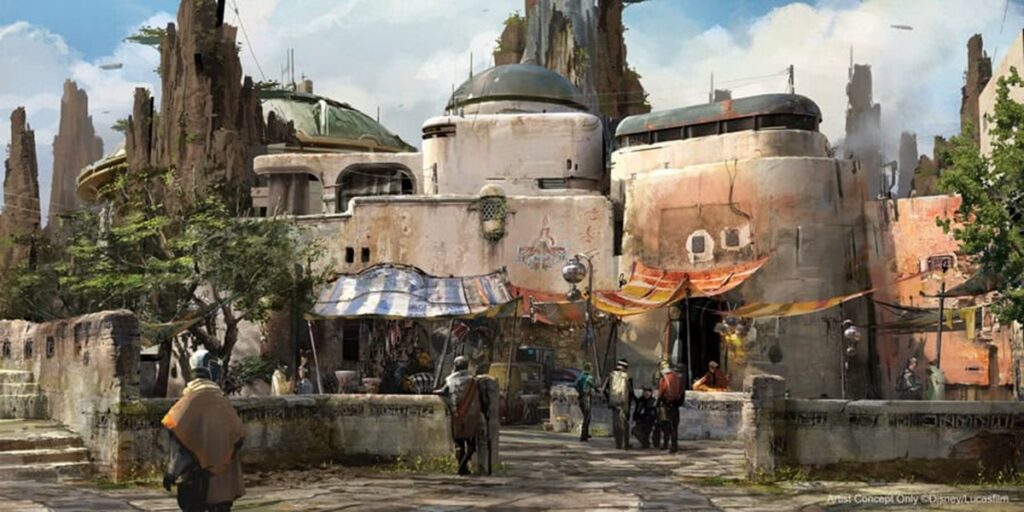
Savi’s Workshop – Handbuilt Lightsabers is one of the signature interactive experiences in Star Wars: Galaxy’s Edge at Disney’s Hollywood Studios, blending merchandise, live performance, environmental storytelling, and personalized role-playing into something far more elaborate than a conventional retail transaction. Opened on August 29, 2019, alongside the Florida debut of Galaxy’s Edge, Savi’s allows guests to construct a custom lightsaber inside a hidden workshop operated by a mysterious group known as the Gatherers.
The location is intentionally difficult to identify from the outside. Unlike a conventional Disney shop with a prominent sign and merchandise visible through large windows, Savi’s is disguised as a cluttered scrap-metal business in Black Spire Outpost. To an ordinary passerby—or, within the story, to the First Order—it appears to be little more than a salvage operation filled with discarded machinery, crates, and miscellaneous parts. The real purpose of the space is concealed behind that façade.
Within the fiction of Batuu, the Gatherers are dedicated to preserving knowledge of the Force and the Jedi during a period when such activity is dangerous. They travel the galaxy collecting fragments of old lightsabers, pieces of starships, materials from abandoned temples, unusual natural objects, kyber crystals, and other components that can be repurposed into new weapons. Savi, the figure behind the workshop, remains largely unseen, allowing the Gatherers themselves to serve as guides for visitors who have been entrusted with the secret.
That secrecy is essential to the experience. Galaxy’s Edge was designed around the idea that guests are not merely visiting a land based on Star Wars; they are temporarily inhabitants of the planet Batuu. At Savi’s, the guest becomes part of that fiction. Builders are not told they are purchasing a collectible replica. They are treated as individuals who have been quietly brought into a hidden workshop to undertake one of the most important traditions associated with the Jedi: constructing a lightsaber of their own.
The experience begins outside, where each builder selects one of four hilt design philosophies. These are not simply cosmetic categories; each has its own visual language and fictional history.
Peace and Justice draws inspiration from the Jedi of the Republic era, with components presented as salvaged remnants of fallen Jedi temples and crashed starships. The resulting sabers tend to have the clean metallic appearance most closely associated with traditional Jedi weapons.
Power and Control represents the dark side. Its pieces incorporate heavier, more aggressive forms, dark finishes, and design elements said to have originated with Sith warriors and abandoned temples.
Elemental Nature treats the lightsaber as an object connected directly with the living Force. Its components incorporate textures and forms inspired by materials such as Brylark wood, Cartusion whale bone, and other organic elements from across the galaxy.
Protection and Defense emphasizes ancient Force traditions rather than the familiar Jedi-versus-Sith visual vocabulary. Its components feature ornate patterns, inscriptions, and weathered metallic surfaces intended to suggest artifacts from much older civilizations.
Each builder receives a small cloisonné pin identifying the chosen theme. That pin serves both as a souvenir and as an operational signal allowing the Gatherers inside to provide the correct component set.
The transition into the inner workshop is deliberately theatrical. Once admitted, builders enter a circular, cave-like chamber whose stone walls conceal industrial machinery, salvaged containers, cables, and relics. Individual workstations surround the room, making the space feel part temple, part mechanic’s shop, and part secret gathering place.
A lead Gatherer begins the ceremony by explaining the history and significance of the lightsaber. The performance is solemn by Disney theme-park standards, avoiding the constant jokes and comedic interruptions found in many interactive attractions. The intent is to treat the object with the same mythic importance it receives in the films.
The first major decision inside is the selection of a kyber crystal, the fictional energy source at the heart of every lightsaber. Builders choose among four colors included in the standard experience: blue, green, violet, or red. Disney explicitly connects those colors with characters including Obi-Wan Kenobi, Luke Skywalker, Yoda, Mace Windu, Darth Vader, Darth Maul, and Asajj Ventress.
The crystal is not merely decorative. Each contains RFID technology that communicates with compatible lightsabers and other Galaxy’s Edge merchandise. Once installed in the finished hilt, the crystal determines the blade color and associated sound effects. Additional kyber crystals in other colors have traditionally been available separately from nearby Dok-Ondar’s Den of Antiquities, giving builders another level of customization after the experience.
The actual construction process follows. Each builder receives a tray of metal-feeling components corresponding to the chosen theme. Disney currently provides four sleeves, two emitters, two pommel caps, and two sets of activation plates and switches. The builder selects two sleeves and one piece from each of the other categories, assembling them around the central chassis containing the kyber crystal.
This modular approach allows many possible combinations within each design family. Two guests choosing Peace and Justice, for example, can leave with noticeably different hilts depending on their component selections.
The Gatherers circulate throughout the room to help when pieces refuse to align or when younger builders need assistance, but the physical assembly is intentionally left largely to the guest. That tactile element is critical. Rather than receiving a finished product after watching a demonstration, the builder actually handles the components and constructs the weapon.
Once the hilt is complete, the experience shifts from workshop activity into theatrical climax.
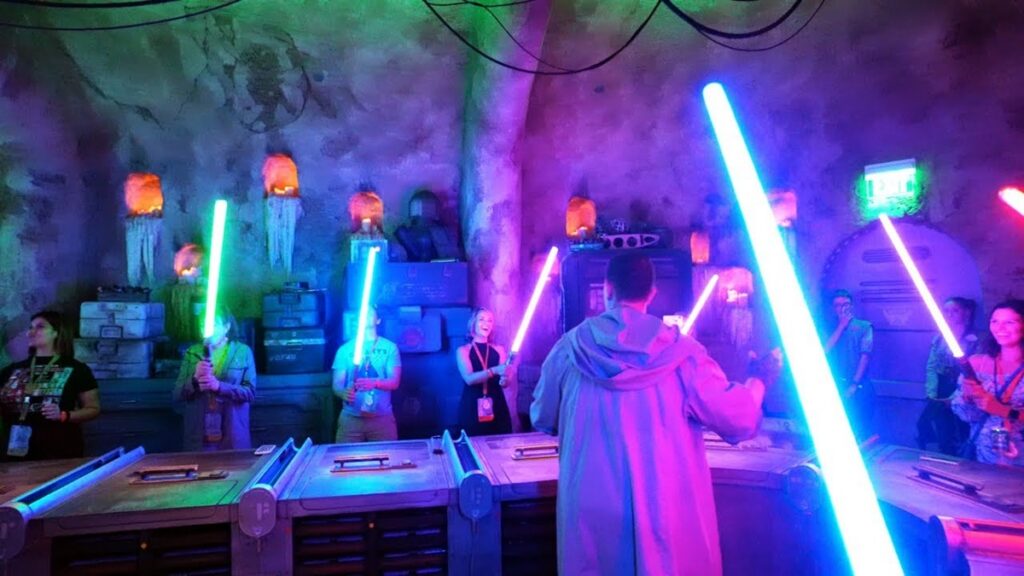
The unfinished hilts are placed into specialized activation stations, where Disney’s effects systems connect each one to a 31-inch lightsaber blade. The room darkens, music swells, and the ceremony incorporates the presence of Yoda, whose voice guides and encourages the new builders. One by one, the newly constructed weapons activate.
The culmination comes when everyone raises an illuminated lightsaber together.
This sequence is one of the reasons Savi’s has developed a reputation well beyond that of an expensive souvenir shop. Walt Disney Imagineering deliberately designed the final moments around the emotional language of Star Wars. Music associated with the Force, low theatrical lighting, the voice of a Jedi Master, and a room filled with glowing blades turn what could have been a straightforward product assembly into a ritual.
The music is particularly important. Imagineering’s sound team has discussed using musical material that recalls the moment in The Empire Strikes Back when Yoda raises Luke Skywalker’s X-wing from the swamp on Dagobah. The effect is intentionally designed to associate the builder’s first activation of the lightsaber with some of the franchise’s most emotionally resonant Force imagery.
Disney Imagineering Executive Creative Director Chris Beatty has described Savi’s as essentially part interactive experience, part show, and part retail, which is perhaps the most accurate way to categorize it. The lightsaber is the product being purchased, but the ceremony is a substantial part of what the guest is actually paying for.
That also distinguishes Savi’s from Dok-Ondar’s Den of Antiquities. Dok-Ondar’s sells Legacy Lightsabers modeled after established characters such as Luke Skywalker, Darth Maul, and Obi-Wan Kenobi. Savi’s instead allows guests to create a weapon without an existing owner. The premise is that this is your lightsaber, assembled from scavenged materials according to your own path through the Force.
The distinction matters within Galaxy’s Edge because merchandise was designed as part of the land’s storytelling from the beginning. Disney and Lucasfilm deliberately avoided treating every shop like a conventional franchise store. Toys look handmade at Toydarian Toymaker, creatures are sold from the Creature Stall, droids are assembled from parts at Droid Depot, and antiquities are traded through Dok-Ondar. At Savi’s, the purchase itself becomes a personal narrative.
The workshop also reflects the wider design philosophy behind Black Spire Outpost. Galaxy’s Edge takes place on Batuu, a remote planet created specifically for the Disney parks but incorporated into broader Star Wars storytelling. Instead of recreating Tatooine, Endor, or another famous movie location, Imagineering and Lucasfilm constructed a new setting where guests could plausibly have adventures that did not simply reproduce scenes already performed by film characters.
Savi’s fits this idea particularly well because lightsaber construction has always been a deeply personal event within Star Wars. Luke builds his own green-bladed weapon between The Empire Strikes Back and Return of the Jedi. Jedi traditionally construct their sabers as part of their training. By placing the guest in that same role rather than handing them a replica of Luke’s weapon, Disney makes the experience feel additive to the mythology rather than purely imitative.
The physical components have even escaped the theme parks and entered official Star Wars productions. Elements derived from Savi’s Workshop were used to construct Jedi Master Kelleran Beq’s lightsaber for Star Wars: Jedi Temple Challenge, while other Savi’s components appeared as set decoration. This is a particularly interesting reversal of the usual theme-park process: instead of the park reproducing props from the screen, physical objects created for Galaxy’s Edge became source material for later Star Wars productions.
Savi’s has also experienced operational changes since 2019. When Walt Disney World reopened in 2020 following the resort-wide pandemic closure, the normal building ceremony was temporarily suspended and the location was used for more limited retail activity. The full experience eventually returned, restoring the Gatherers, group-building format, and theatrical activation sequence.
The price has risen substantially since opening. As of October 2026, Walt Disney World lists the experience at $274.99 per lightsaber, plus tax. The price includes the completed custom hilt, kyber crystal, 31-inch blade, and carrying case. Each reservation allows one builder and one accompanying guest inside, with at least one person in the party required to be age 14 or older. Disney recommends the experience for guests age five and above.
Advance reservations are strongly recommended, and full payment is required when booking. Because space inside the workshop is limited, Savi’s operates more like a premium reserved experience than a traditional store. Same-day availability and walk-ins can occur, but they are not guaranteed.
That combination of scarcity, ceremony, and personalization has helped make Savi’s one of the most recognizable upcharge experiences at Walt Disney World. It is undeniably expensive, particularly compared with a mass-produced toy lightsaber, but the price reflects an experience deliberately designed to make the object meaningful before the guest ever carries it out of the building.
As a physical product, the finished lightsaber is substantial and customizable. As a theme-park experience, however, its real value lies in the process: entering a hidden room, selecting a connection to the Force, placing the kyber crystal into the chassis, assembling parts by hand, hearing the room come alive, and finally watching the blade ignite.
That is why Savi’s Workshop – Handbuilt Lightsabers occupies such an unusual position within Disney’s Hollywood Studios. Technically, Disney categorizes it as a shop. Operationally, it requires reservations and functions more like a boutique experience. Creatively, it is a small theatrical attraction. Within the story of Galaxy’s Edge, it is a clandestine gathering place where knowledge of the Jedi survives under the nose of the First Order.
The final product may be a lightsaber, but the real achievement of Savi’s is convincing the builder, for roughly the length of the ceremony, that they did not simply buy it—they earned the right to construct it.