
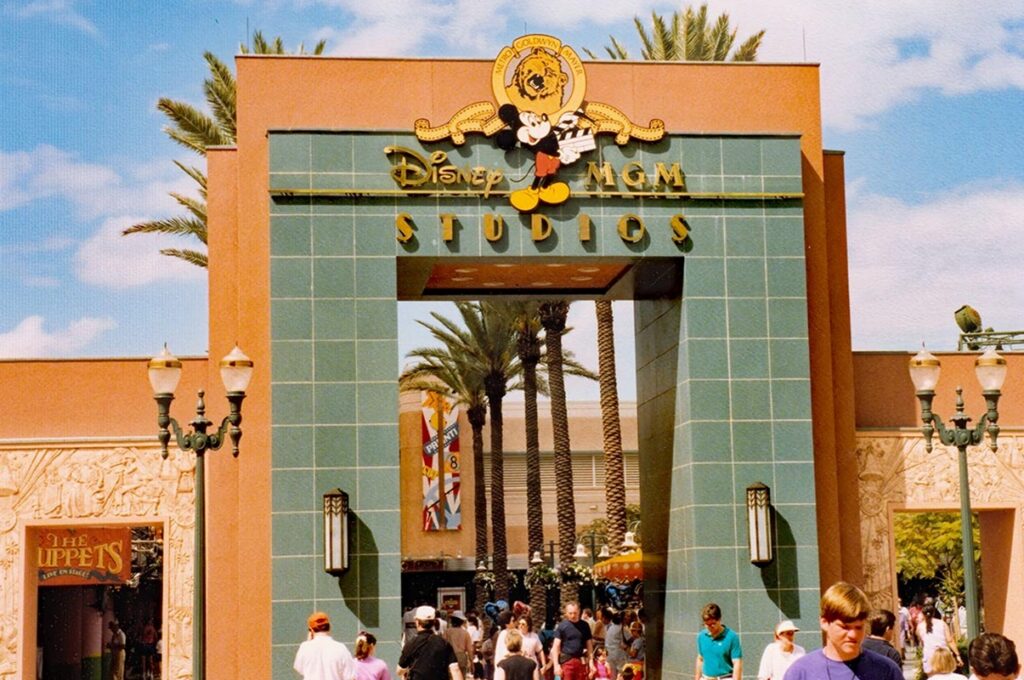
Cafeteria of the Stars was a name associated with Hollywood & Vine, one of the original restaurants at Disney-MGM Studios. Located in the park’s Echo Lake area, the restaurant opened on May 1, 1989, offering a cafeteria-style dining experience inspired by the inexpensive restaurants that once served actors, studio employees, and other entertainment industry workers in Hollywood. The restaurant underwent a significant transformation in 1998, reopening on November 22 as Hollywood & Vine Cafeteria of the Stars, a character dining buffet featuring Minnie Mouse and other Disney characters. Although the Cafeteria of the Stars name eventually disappeared, the restaurant itself survives as Hollywood & Vine at Disney’s Hollywood Studios.
The name requires some clarification because historical records use several variations. Disney’s official historical encyclopedia identifies Hollywood & Vine as an opening-day restaurant and acknowledges Cafeteria of the Stars as an alternate name. Contemporary material from April 1989 also used the Cafeteria of the Stars description when introducing the new park’s restaurants. However, the longer Hollywood & Vine Cafeteria of the Stars designation became particularly prominent with the restaurant’s 1998 refurbishment and introduction of character dining.
Consequently, Cafeteria of the Stars is best understood as part of the history of Hollywood & Vine rather than an entirely separate restaurant occupying the space before it.
Disney-MGM Studios opened on May 1, 1989, as Walt Disney World’s third theme park. Unlike Magic Kingdom, which recreated fantasy environments, or EPCOT Center, which emphasized technology and international culture, Disney-MGM Studios was designed around the history and production of motion pictures and television.
The original park combined Hollywood-inspired architecture with working film and television production facilities. Guests could explore the movie business through attractions such as The Great Movie Ride, the Backstage Studio Tour, and the Magic of Disney Animation.
The park’s restaurants were similarly integrated into the Hollywood theme. The Hollywood Brown Derby recreated the atmosphere of a famous Los Angeles restaurant, while the 50’s Prime Time Café presented a nostalgic midcentury family dining experience. The Soundstage Restaurant was designed to resemble a movie production environment.
Hollywood & Vine represented another aspect of the entertainment industry: the inexpensive cafeterias and casual restaurants where aspiring actors, studio employees, and established performers could find a meal.
The restaurant was located in the area now known as Echo Lake, originally associated with the park’s Hollywood-inspired streetscape and Lakeside Circle.
Echo Lake was modeled conceptually on the historic Echo Park area of Los Angeles. Its architecture and decorative details referenced the neighborhoods, apartment buildings, businesses, and entertainment establishments associated with Hollywood during the industry’s formative decades.
Hollywood & Vine occupied a prominent building near the intersection of Hollywood Boulevard and Echo Lake, immediately beside the 50’s Prime Time Café.
Its location placed it near several of the park’s original attractions and restaurants, including the Indiana Jones Epic Stunt Spectacular, Echo Lake itself, and the Hollywood Brown Derby farther along Hollywood Boulevard.
The restaurant’s name referenced Hollywood Boulevard and Vine Street, the famous Los Angeles intersection closely associated with the entertainment industry.
The building’s exterior was designed in an Art Deco style, with a turquoise-blue façade, streamlined architectural detailing, and decorative features inspired by the commercial buildings of early twentieth-century Los Angeles.
One particularly interesting element of its design is that the façade was not copied directly from a Hollywood restaurant.
Its architectural inspiration included a building at 200 Powell Street in San Francisco, near Union Square. That structure was originally constructed in 1913 and received a distinctive Art Deco remodeling in 1933.
Disney’s version adapted elements of that façade while incorporating them into the fictionalized Hollywood streetscape of Disney-MGM Studios.
The result was a building that felt appropriate to Hollywood’s Golden Age without necessarily replicating a single historic restaurant.
The restaurant’s cafeteria theme, however, did have a direct connection to real Hollywood dining history.
Its conceptual inspiration included the cafeterias that once operated along Vine Street, particularly a restaurant associated with the 1700 block of North Vine Street.
During the first half of the twentieth century, cafeterias were an important part of American urban dining.
Before the widespread development of modern fast-food chains, these restaurants provided relatively inexpensive meals with a wide selection of prepared dishes.
Guests could choose from meats, vegetables, salads, desserts, and other offerings without ordering from a conventional full-service menu.
Hollywood’s cafeteria culture was especially significant because it served people working in an industry characterized by irregular schedules and uncertain employment.
Actors, writers, technicians, musicians, and other entertainment professionals could purchase affordable meals while working or searching for opportunities.
Walt Disney and his brother Roy were familiar with this type of dining during their early years in Hollywood.
Historical accounts describe the brothers visiting cafeterias and purchasing different meals that they could share, allowing them to sample a broader selection of food while controlling expenses.
This connection gave Hollywood & Vine a historical foundation beyond its decorative theme.
The restaurant recreated the general atmosphere of the cafeterias that had once served Hollywood’s working entertainment community.
When Disney-MGM Studios opened in 1989, Hollywood & Vine operated as a cafeteria-style restaurant, sometimes described as a “buffeteria.”
This approach combined elements of cafeteria service with a broad selection of prepared foods.
Rather than presenting an elaborate table-service dining experience, the restaurant emphasized variety, convenience, and relatively affordable meals.
Its original menu included rotisserie chicken, smoked baby back ribs, seafood, and other American dishes.
The kitchen was arranged in a European-style display format that allowed guests to observe food preparation.
This was a distinctive feature for an opening-day Disney-MGM Studios restaurant.
By allowing guests to see cooks preparing meals, Hollywood & Vine incorporated an element of culinary theater into an otherwise straightforward dining operation.
The food itself was not especially exotic or specialized. Its appeal came from the ability to select familiar dishes in a setting that reflected the history of the surrounding movie industry.
The restaurant was associated with Disney-MGM Studios’ original culinary program under chef Reimund Pitz, who oversaw the park’s food-service operations during its opening period.
Pitz and his team helped establish dining locations intended to complement the new park’s historical and cinematic themes.
Hollywood & Vine offered a relatively informal alternative to the Hollywood Brown Derby, which emphasized classic restaurant dishes and a more refined atmosphere.
It also contrasted with the 50’s Prime Time Café, where servers interacted with guests in character and treated diners as members of a 1950s family.
At Hollywood & Vine, the primary theme came from the restaurant’s setting and historical inspiration rather than a scripted dining performance.
The interior contained another important decorative feature: a large mural celebrating Hollywood history.
Measuring approximately 42 feet long and eight feet high, the mural depicted notable locations and landmarks associated with the entertainment industry.
Among its subjects were the Disney Studios and the Carthay Circle Theatre, the famous Los Angeles movie palace where Snow White and the Seven Dwarfs premiered in 1937.
The mural helped establish the restaurant’s connection to Hollywood history while reinforcing the visual storytelling found throughout the original park.
Outside the building, Imagineers incorporated additional details inspired by the area’s fictional Golden Age setting.
The upper-story windows suggested apartments or offices above the ground-floor restaurant.
One window displayed a “No Actors” notice, referencing the reputation actors once had among landlords who considered entertainment professionals unreliable tenants.
Nearby, the Echo Lake Apartments featured a series of mailboxes containing names that paid tribute to Imagineers involved in the park’s development.
These details helped create the impression of a functioning Hollywood neighborhood rather than a collection of unrelated attractions and restaurants.
The restaurant remained part of Disney-MGM Studios’ original dining lineup throughout the early and middle 1990s.
Its cafeteria-style service was consistent with the park’s initial approach to dining, but Disney eventually began placing greater emphasis on character experiences and other entertainment-oriented restaurant concepts.
The major change arrived in 1998.
Hollywood & Vine underwent a refurbishment and reopened on November 22, 1998, as Hollywood & Vine Cafeteria of the Stars.
The new operation introduced character dining, with Minnie Mouse and other Disney characters appearing during meals.
The transformation represented a substantial change in the restaurant’s identity.
Instead of relying primarily on its historical cafeteria theme, the restaurant now offered families an opportunity to meet Disney characters while enjoying a buffet meal.
Character dining had already become an important part of Walt Disney World’s restaurant program, particularly at resorts and Magic Kingdom dining locations.
The introduction of character meals at Hollywood & Vine helped expand that experience within Disney-MGM Studios.
The restaurant’s relatively spacious interior and buffet format were well suited to the concept.
Guests could select their meals while characters circulated through the dining room, stopping for photographs and interactions.
The experience also made Hollywood & Vine particularly appealing to families traveling with younger children.
For visitors who wanted character interactions without waiting in traditional outdoor greeting lines, the restaurant offered another option.
The name Cafeteria of the Stars was especially appropriate to this version of Hollywood & Vine.
It combined the original concept of a Hollywood cafeteria with the presence of Disney’s own stars, turning a historical restaurant reference into a character dining experience.
The character buffet remained in operation through the early 2000s.
However, Disney made another significant change in March 2003.
The character dining program ended on March 23, 2003, and the restaurant returned to a more conventional buffet operation.
Breakfast service was also discontinued during this transition.
The decision marked the end of the particular character dining format associated with the 1998 Cafeteria of the Stars relaunch.
The restaurant itself did not close permanently, and the building continued serving guests under the Hollywood & Vine name.
The specific reasons for eliminating character dining have not been definitively established.
Contemporary commentary suggested that the restaurant faced competition from other Disney-MGM Studios dining establishments, but there is insufficient evidence to attribute the change exclusively to attendance, popularity, or financial performance.
What is clear is that the restaurant continued evolving rather than remaining tied to one dining concept.
By the middle of the 2000s, character dining had returned in some form.
A more substantial new identity emerged in 2006, when Hollywood & Vine introduced Playhouse Disney’s Play ‘n Dine.
The experience featured characters from Disney Channel’s Playhouse Disney programming, with meals accompanied by music and opportunities for children to interact with their favorite television personalities.
Characters associated with the experience included JoJo and Goliath from JoJo’s Circus and characters from Little Einsteins.
The new concept reflected the popularity of preschool-oriented Disney programming and complemented the nearby Playhouse Disney – Live on Stage! attraction.
This represented another important shift in Hollywood & Vine’s history.
The restaurant was no longer simply a buffet with familiar Disney characters. It had become a dining experience closely connected to a particular audience and entertainment brand.
The Playhouse Disney identity remained prominent for several years.
As Disney’s preschool television programming evolved, the restaurant’s character lineup changed as well.
The Playhouse Disney brand was eventually replaced by Disney Junior, and the restaurant adopted the Disney Junior Play ‘n Dine identity.
Characters appearing during this period included figures from popular Disney Junior programs, with the lineup changing as new series debuted and older programs left the network.
The restaurant continued to offer buffet dining, combining familiar American breakfast and lunch selections with character appearances and entertainment aimed at younger children.
In 2015, Disney introduced another dining concept that eventually became central to Hollywood & Vine’s identity: Minnie’s Seasonal Dining.
The experience brought Minnie Mouse and other familiar Disney characters to themed meals celebrating different seasons and holidays.
Rather than maintaining one character dining environment throughout the entire year, the restaurant introduced seasonal costumes, decorations, and menu variations.
Holiday Dine celebrated the Christmas season, while other experiences reflected Halloween, springtime, and Hollywood-inspired themes.
These events helped establish Hollywood & Vine as a flexible character dining location capable of changing its atmosphere throughout the year.
The concept also returned the restaurant to a broader audience.
While Disney Junior dining concentrated on younger children, Minnie’s Seasonal Dining appealed to families interested in meeting classic Disney characters regardless of age.
The restaurant subsequently developed a combination of preschool-oriented character meals and seasonal Minnie Mouse dining experiences, although the precise meal assignments and character lineups have changed over time.
The COVID-19 pandemic brought another major interruption.
Walt Disney World temporarily closed its theme parks in March 2020, and Hollywood & Vine suspended operations along with the resort’s other dining facilities.
When Disney’s Hollywood Studios reopened in July 2020, restaurants returned gradually under modified operating procedures.
Hollywood & Vine resumed service in September 2020 with a modified character dining experience.
Traditional buffet service was temporarily replaced by family-style dining, allowing meals to be served directly to tables.
Character interactions were also modified to accommodate physical distancing requirements.
Rather than approaching guests for conventional hugs and close-up photographs, characters appeared at a distance while continuing to entertain diners.
These changes were temporary, but they represented one of the most substantial operational adjustments in the restaurant’s history.
As Walt Disney World gradually restored its regular dining operations, Hollywood & Vine returned to buffet service and more conventional character interactions.
The restaurant continued operating as part of Disney’s Hollywood Studios’ Echo Lake dining lineup.
As of October 2026, Hollywood & Vine remains open in its original 1989 location.
Disney’s official restaurant listing identifies it as an American buffet and character dining establishment offering breakfast, lunch, and dinner.
Current offerings include Minnie’s Seasonal Dining, with characters wearing costumes appropriate to the time of year.
For the 2026 fall season, Halloween Dine operates from August 16 through November 3.
The restaurant transitions to Holiday Dine on November 4, 2026, with that experience scheduled to continue through January 6, 2027.
Silver Screen Dine is scheduled to follow beginning January 7, 2027.
The current breakfast buffet includes pastries, omelets, Mickey-shaped waffles, biscuits and gravy, eggs Benedict, French toast, and other American breakfast favorites.
Lunch and dinner offerings include salads, carved meats, roasted chicken, salmon, vegetables, pasta, and desserts.
The menu is considerably different from the original 1989 cafeteria offerings, although American comfort food remains an important part of the restaurant’s identity.
Hollywood & Vine also participates in Disney’s Fantasmic! Dining Package program.
Guests purchasing an eligible dining package receive a meal at the restaurant and a voucher for reserved seating at Fantasmic!, the park’s nighttime spectacular.
This arrangement connects the restaurant with another major Disney’s Hollywood Studios entertainment experience, although it is not part of the original Cafeteria of the Stars concept.
Disney’s published 2026 operating hours generally list breakfast from 8:30 a.m. until 10:30 a.m., lunch from 10:45 a.m. until 3:55 p.m., and dinner from 4 p.m. until 8 p.m.
Advance dining reservations are strongly recommended.
The original restaurant building remains in use, although its interior and dining operations have undergone numerous changes since 1989.
The exterior retains much of the Hollywood-inspired architectural character established when Disney-MGM Studios opened.
The restaurant’s position beside the 50’s Prime Time Café also remains recognizable, making it one of the relatively few original dining locations whose general physical setting has survived the park’s extensive redevelopment.
The historical succession is therefore somewhat different from that of an extinct restaurant demolished and replaced by an unrelated facility.
Hollywood & Vine opened on May 1, 1989, with a cafeteria-style concept already associated with the Cafeteria of the Stars description.
The restaurant underwent a major refurbishment and reopened as Hollywood & Vine Cafeteria of the Stars on November 22, 1998, introducing character dining.
The initial character dining program ended on March 23, 2003, while the restaurant continued operating.
Playhouse Disney’s Play ‘n Dine followed in 2006, with subsequent changes introducing Disney Junior dining and Minnie’s Seasonal Dining.
The restaurant continues operating as Hollywood & Vine in 2026.
For historical database purposes, it would be misleading to list Cafeteria of the Stars as an entirely independent restaurant that permanently closed and was replaced by Hollywood & Vine.
The names refer to successive identities and descriptions of the same restaurant, with the 1998 Cafeteria of the Stars branding representing a particularly important period in its history.
The building itself was constructed for Disney-MGM Studios’ original opening and did not replace a previous theme park dining location.
Its longevity makes it noteworthy among the park’s restaurants.
Disney’s Hollywood Studios has undergone enormous changes since 1989, with the removal of the Studio Backlot Tour, The Great Movie Ride, the original animation facilities, and numerous other attractions associated with its working-studio concept.
The park has increasingly emphasized immersive environments based on films and entertainment franchises, including Toy Story Land and Star Wars: Galaxy’s Edge.
Hollywood & Vine, by contrast, remains a connection to the park’s original Hollywood streetscape.
Although its food and entertainment have changed repeatedly, the restaurant still occupies the same general setting beside Echo Lake.
Its exterior architecture and historical details continue to evoke the Hollywood that Walt Disney and his contemporaries encountered during the early decades of the movie industry.
The Cafeteria of the Stars identity is particularly revealing because it bridges two different approaches to Disney theme park dining.
The original Hollywood & Vine was inspired by the real cafeterias of Los Angeles, connecting guests with Hollywood history through an accessible dining concept.
The 1998 transformation placed Disney characters at the center of that experience, reflecting the growing importance of character dining throughout Walt Disney World.
Later versions adapted the restaurant to the popularity of preschool television programming and seasonal entertainment.
That flexibility has helped Hollywood & Vine survive in a park where many original restaurants and attractions have disappeared.
Today, little remains of the original cafeteria operating model, but the building continues serving essentially the same broad purpose: providing guests with a convenient place to enjoy a substantial meal in a Hollywood-inspired environment.
Cafeteria of the Stars is therefore best remembered as an important chapter in the history of one of Disney-MGM Studios’ opening-day restaurants.
Its distinctive name, 1998 character dining relaunch, and connection to the cafeteria culture of old Hollywood make it a particularly interesting example of how Disney has adapted an original restaurant without abandoning its historic location.