
Hook’s Tavern was a small Peter Pan-themed snack stand in Fantasyland at Magic Kingdom that operated during the 1990s beside Peter Pan’s Flight. Opening on October 21, 1993, it replaced the long-running Troubadour Tavern and served a simple assortment of soft drinks, lemonade, chips, and other snacks from a walk-up counter.
Despite the name “Tavern,” Hook’s Tavern did not serve alcohol. Magic Kingdom remained essentially alcohol-free for ordinary park guests until Be Our Guest Restaurant began serving beer and wine in 2012.
The restaurant’s real distinction was its theming.
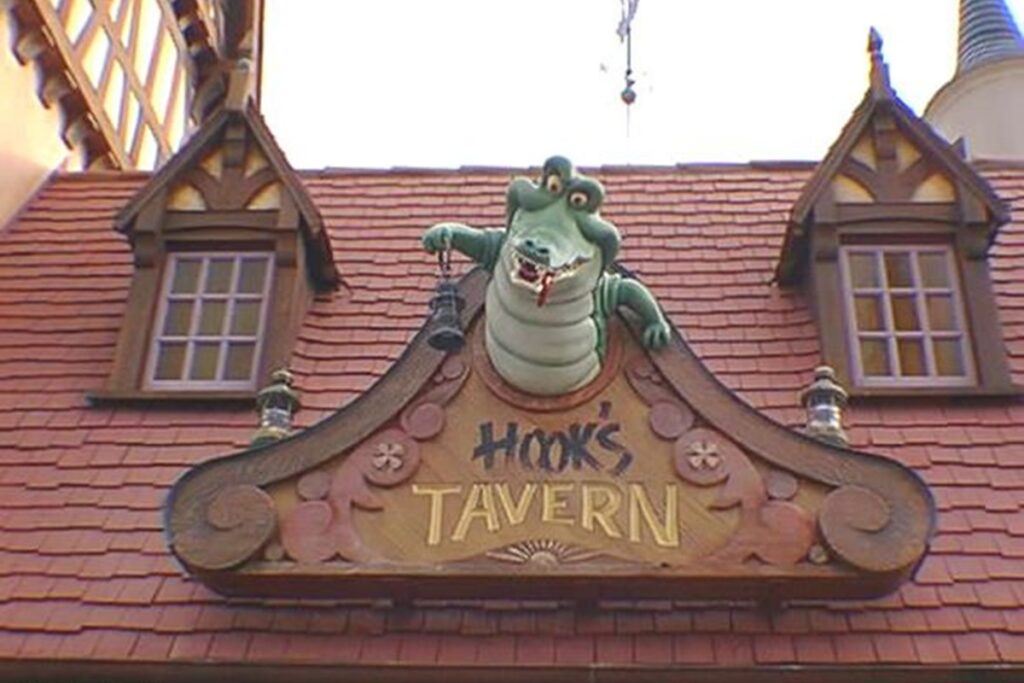
A whimsical sign above the building featured Tick-Tock the Crocodile, Captain Hook’s relentless nemesis from Disney’s 1953 animated film Peter Pan. The green crocodile leaned over the carved wooden Hook’s Tavern sign while holding a hanging lantern, immediately tying the otherwise modest food stand to the attraction next door.
That sign became far more memorable than the menu.
Hook’s Tavern occupied a location that had been serving Fantasyland guests since Magic Kingdom’s earliest days.
When Magic Kingdom opened in 1971, the building operated as Troubadour Tavern, a seasonal refreshment stand sponsored by Welch’s.
A 1972 Walt Disney World guide lists Troubadour Tavern among Fantasyland’s food locations and identifies its primary offerings as Welch’s grape juice and juice bars.
The concept fit the original Fantasyland aesthetic particularly well.
Magic Kingdom’s first version of Fantasyland was designed largely as a medieval tournament or European village fair, with striped tent façades, heraldic decoration, troubadours, knights, castles, and other broadly storybook elements.
A location named Troubadour Tavern therefore did not need to belong to a particular Disney movie.
Like Lancer’s Inn, The Round Table, and Tournament Tent, it fit the general fantasy-medieval vocabulary of the land.
Troubadour Tavern operated only seasonally for much of its life.
Over time, the Welch’s emphasis diminished, and historical records indicate that the stand eventually offered more conventional beverages, lemonade, and snacks.
By the early 1990s, Disney was steadily moving away from Fantasyland’s generic medieval naming toward stronger connections with recognizable animated films.
Gurgi’s Munchies & Crunchies became Lumiere’s Kitchen in 1993.
Mrs. Potts’ Cupboard followed in 1994.
The Little Big Top and other character-oriented identities appeared elsewhere around Fantasyland.
Renaming Troubadour Tavern after Captain Hook fit naturally into that broader transition.
The nearby Peter Pan’s Flight had already been one of Fantasyland’s signature attractions since 1971. Instead of requiring Disney to invent an entirely new restaurant concept, Hook’s Tavern gave the existing snack stand a direct relationship with one of the land’s most recognizable stories.
The transformation was relatively modest.
The basic building remained.
The walk-up service format remained.
The menu continued emphasizing refreshments rather than full meals.
What changed most noticeably was the identity.
The carved Hook’s Tavern sign and Tick-Tock figure gave the location an instantly understandable theme. Guests approaching Peter Pan’s Flight could see that this little tavern belonged to the same story world.
The restaurant was not designed as a full pirate dining environment.
There was no elaborate Captain Hook dining room, pirate ship interior, or character meal.
It was a snack counter with a strong visual joke.
That distinction is important because Hook’s Tavern is sometimes misremembered as a much larger restaurant.
Some longtime guests have confused it with nearby Columbia Harbour House, whose two-story dining rooms, nautical decorations, fishing equipment, and winding interior spaces can easily create memories that feel vaguely pirate-like.
Hook’s Tavern itself was considerably smaller.
It operated from a walk-up window and was associated primarily with drinks and packaged snacks.
Its compact size also helps explain why it disappeared so easily.
By the late 1990s, Disney was introducing FASTPASS throughout Walt Disney World.
Peter Pan’s Flight, with its consistently long waits and relatively low-capacity suspended ride vehicles, was a natural attraction for the new reservation system.
Around 1999, the former Hook’s Tavern location was converted into the FASTPASS distribution area for Peter Pan’s Flight.
The food operation disappeared.
The building, however, survived.
Disney even preserved the location’s most recognizable decorative element.
Tick-Tock the Crocodile was reused on the new Peter Pan FASTPASS signage, allowing the character that had advertised Hook’s Tavern to continue presiding over essentially the same spot.
Historical photographs show the transformation clearly.
The original Hook’s Tavern sign featured the crocodile above the restaurant name against a brown-toned roof.
After the conversion, Disney modified the signage for Peter Pan’s FASTPASS operation, repainted portions of the structure, and retained Tick-Tock as a visual connection to the attraction.
That reuse gave Hook’s Tavern an unusually visible afterlife.
Many extinct Walt Disney World restaurants disappear so completely that guests can stand on their former sites without seeing anything recognizable.
Hook’s Tavern left behind its mascot.
For years, guests picking up paper FASTPASS tickets for Peter Pan’s Flight walked directly beneath a decorative element that had once advertised a snack stand.
The Peter Pan FASTPASS operation itself eventually became obsolete.
Disney replaced the old paper FASTPASS system with FastPass+ in the 2010s, eliminating the need for the familiar attraction-specific ticket machines. The former Hook’s Tavern structure consequently stopped serving the operational role that had replaced the restaurant.
Its Peter Pan connection remained appropriate, however, because the location sits beside an attraction whose story includes both Captain Hook and the crocodile.
Hook’s Tavern is also a useful example of the way Magic Kingdom’s Fantasyland changed during the 1990s.
The land had originally been conceived more as a general medieval fair containing Disney attractions.
By the end of the century, Disney increasingly wanted every shop, snack stand, and piece of signage to belong to a specific story.
Troubadour Tavern could have existed in almost any imaginary European village.
Hook’s Tavern could exist only near Peter Pan.
That stronger storytelling connection has become standard practice in modern Fantasyland design.
The restaurant’s menu may have been forgettable, but its naming and visual identity anticipated that shift.
There is another amusing historical detail in the word “Tavern.”
During Hook’s entire existence, Magic Kingdom did not offer alcoholic beverages to ordinary guests.
When Be Our Guest Restaurant opened in 2012, beer and wine became publicly available inside the park for the first time.
Hook’s Tavern had already been gone for more than a decade.
So despite its pirate captain, lantern-bearing crocodile, and tavern name, guests stopping there in the 1990s were more likely to leave with lemonade and chips than anything Captain Hook might have ordered aboard the Jolly Roger.
Its operating life was relatively short compared with the location it replaced.
Troubadour Tavern lasted more than two decades.
Hook’s Tavern lasted only part of the 1990s before FASTPASS took over the space.
Yet Hook’s has arguably remained more memorable because of its distinctive sign and direct connection to Peter Pan’s Flight.
For many guests who visited Magic Kingdom during that era, the image of Tick-Tock leaning over the little tavern is enough to bring the entire corner of old Fantasyland back into focus.
Peter Pan’s Flight nearby.
The old tournament-style façades.
The Fantasyland Theater across the way.
And a tiny snack stand named after a pirate captain who probably would not have appreciated having his restaurant guarded by the crocodile trying to eat him.