The Studio Pizzeria was a short-lived Italian restaurant at Disney-MGM Studios, now Disney’s Hollywood Studios. It opened on June 15, 1991, and operated for just over three months before becoming Mama Melrose’s Ristorante Italiano on September 26, 1991. Although its existence was brief, Studio Pizzeria occupies an interesting place in the park’s history because the restaurant emerged from Disney’s abandoned plans for an elaborate Muppets-themed dining experience. Its successor went on to operate for nearly 34 years, until the surrounding area closed for redevelopment in May 2025.
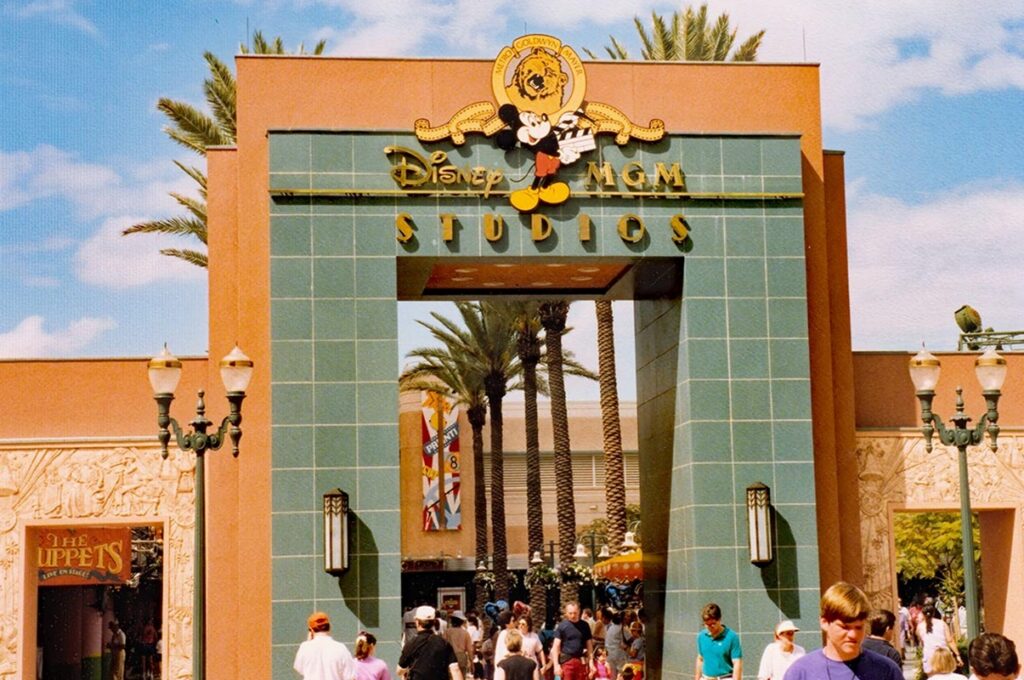
The restaurant was located in the Backlot section of Disney-MGM Studios, near the newly constructed Muppet*Vision 3D attraction. The building stood along a narrow pedestrian passage behind the Muppet theater, in an industrial-looking section of the park designed to resemble the service streets and production facilities of a Hollywood movie studio.
The same structure later housed Mama Melrose’s Ristorante Italiano, making the location easy to identify in historical photographs and maps. In the park’s final configuration before the 2025 closures, it was situated near PizzeRizzo and Muppet*Vision 3D, within the area known as Grand Avenue.
Studio Pizzeria was not an opening-day restaurant. Disney-MGM Studios opened on May 1, 1989, with an assortment of dining locations designed around the park’s working-movie-studio identity.
During the following two years, Disney expanded its attractions and restaurants as the park developed beyond its original layout. One of the most ambitious planned additions was an entire section devoted to Jim Henson’s Muppets.
In August 1989, Disney and Jim Henson announced an agreement that was intended to bring Henson’s characters and creative organization into the Disney family. The proposed relationship included far more than the rights to show Muppet films and television programs.
Disney envisioned a substantial Muppets presence at Disney-MGM Studios, complete with attractions, shops, restaurants, and entertainment.
The centerpiece would be Muppet*Vision 3D, a technologically sophisticated theater presentation combining film, Audio-Animatronics, live effects, and the Muppets’ distinctive brand of humor.
Additional concepts included The Great Muppet Movie Ride, a parody of the park’s Great Movie Ride in which Muppet characters would recreate famous scenes from cinema history.
The planned development was intended to give the Muppets their own interpretation of a working Hollywood studio.
The restaurant concept was equally ambitious.
Rather than opening a conventional Italian restaurant, Disney and Henson explored plans for The Great Gonzo’s Pizza Pandemonium Parlor.
The proposed restaurant would have been operated by Gonzo and Rizzo the Rat, two characters whose unpredictable behavior was ideally suited to an elaborate comedic dining experience.
The establishment was envisioned as a parody of the celebrity-themed restaurants popular during the period, with an atmosphere that mixed Hollywood memorabilia, unusual decorations, and Muppet humor.
Guests would have encountered various mechanical effects and comic mishaps throughout the restaurant.
The concept reportedly included an elaborate system in which animatronic rats would deliver pizzas and other food items around the dining room using overhead tracks.
The restaurant’s equipment and scenery would have created the impression that Gonzo and Rizzo were operating a chaotic business where nearly everything that could go wrong eventually did.
This approach would have distinguished the proposed restaurant from Disney-MGM Studios’ conventional table-service locations.
Instead of depending exclusively on decorative theming, the dining room itself would have become a continuously operating Muppet performance.
However, those plans were overtaken by events.
Jim Henson died unexpectedly on May 16, 1990, at the age of 53.
His death occurred while negotiations over Disney’s acquisition of Henson’s company were still underway.
The proposed acquisition subsequently fell apart, leaving Disney unable to proceed with the full Muppets-themed development as originally envisioned.
Muppet*Vision 3D ultimately opened under a separate agreement that allowed the completed attraction to move forward.
The surrounding attractions and restaurant concepts were substantially revised.
The Great Gonzo’s Pizza Pandemonium Parlor was never completed as planned.
Instead, Disney retained the idea of opening an Italian restaurant in the new Backlot area, but without the extensive Muppets theming and mechanical comedy effects.
The resulting establishment was The Studio Pizzeria.
The restaurant officially opened on June 15, 1991, less than a month after the May 1991 debut of Muppet*Vision 3D.
Its name was straightforward, referring to the restaurant’s location within the fictional working studio environment and its Italian specialty.
The brief operating period has made Studio Pizzeria a relatively obscure part of Walt Disney World dining history.
Unlike restaurants that operated for decades, it had little opportunity to develop a distinct reputation, recognizable merchandise, or a substantial collection of surviving promotional materials.
Nevertheless, its existence is documented in Disney’s official historical encyclopedia.
The Studio Pizzeria’s original menu is not extensively preserved in the available historical records.
Pizza was central to its identity, and the restaurant is generally described as an Italian dining location.
Some retrospective accounts describe it as a quick-service establishment before its transformation into Mama Melrose’s, but a complete contemporary menu establishing its original service format, entrées, and prices has not been independently verified.
Consequently, specific pizza varieties, portion sizes, recipes, and prices should not be attributed to Studio Pizzeria without supporting contemporary documentation.
The same caution applies to its interior appearance.
Although the building subsequently became familiar for Mama Melrose’s eclectic decorations, those later details should not automatically be assigned to the original Studio Pizzeria.
The surviving evidence does not establish which furnishings, murals, lighting fixtures, or architectural decorations were present during the restaurant’s brief summer 1991 operation.
What is clear is that the location was part of the newly developed area surrounding Muppet*Vision 3D.
Its industrial-style exterior suited the Backlot environment, where restaurants and other businesses were designed to resemble facilities associated with a working movie studio.
The building appeared to occupy a converted warehouse or production structure rather than a traditional freestanding restaurant.
That concept would become an important part of its successor’s identity.
On September 26, 1991, The Studio Pizzeria was replaced by Mama Melrose’s Ristorante Italiano.
The change occurred just 103 days after the original restaurant opened.
Disney’s official historical records identify September 26 as the opening date for Mama Melrose’s and explicitly list The Studio Pizzeria as its predecessor.
The precise reason for the rapid name change has not been definitively documented.
One reasonable interpretation is that Studio Pizzeria functioned as an interim concept while Disney finalized the restaurant’s new identity following the collapse of the larger Muppets development.
However, that explanation remains an interpretation rather than a confirmed statement of Disney’s original intentions.
The available historical record establishes the sequence of events but does not provide a conclusive internal explanation for the restaurant’s unusually short life.
The replacement restaurant introduced a more elaborate fictional backstory.
According to Disney’s story, Mama Melrose was a young woman from Sicily who traveled to Hollywood hoping to become a movie star.
Although she initially pursued an acting career, she discovered that her culinary talents were more appreciated than her performances.
While working as an extra on movie sets, she began preparing Italian meals for fellow actors and production workers.
Her cooking attracted a growing following, eventually inspiring her to open a restaurant in a vacant warehouse on the studio backlot.
Hollywood insiders nicknamed her Mama Melrose after Melrose Avenue, one of Los Angeles’ best-known thoroughfares.
The restaurant’s identity combined Italian-American cooking with references to Hollywood’s entertainment industry.
Its slogan described the experience as the place where Italy meets California in the heart of the Backlot.
This fictional history gave the business a stronger thematic identity than the generic Studio Pizzeria name.
The restaurant’s decorations supported the concept.
The interior featured strings of colored lights, hanging grapes, wine bottles, celebrity photographs, record albums, and an assortment of Italian-American memorabilia.
Tables and booths were arranged beneath exposed structural elements, reinforcing the impression that Mama had transformed an existing production warehouse into a neighborhood restaurant.
The environment was intentionally eclectic.
Rather than presenting the elegance of a formal Italian dining room, Mama Melrose’s resembled a lively family-owned establishment filled with souvenirs and decorations collected over the years.
That character helped the restaurant establish a recognizable identity within Disney-MGM Studios.
The menu also evolved into a broad selection of Italian-American dishes, including pizzas, pasta, chicken, seafood, and other entrées.
Unlike the original Studio Pizzeria, Mama Melrose’s became a full table-service restaurant associated with reservations and a more extensive dining experience.
The transition proved remarkably successful in terms of longevity.
Although The Studio Pizzeria survived for only three months, Mama Melrose’s continued serving guests through multiple phases of the park’s development.
During the 1990s, the restaurant remained part of the Backlot environment near Muppet*Vision 3D.
In the following decades, the surrounding area underwent numerous changes.
The former New York Street and Streets of America environments evolved, movie-production attractions disappeared, and Disney-MGM Studios was renamed Disney’s Hollywood Studios in January 2008.
The restaurant continued operating through those transformations.
In 2016, the nearby Toy Story Pizza Planet restaurant was converted into PizzeRizzo, introducing a Muppets-themed pizza restaurant operated by the fictional Rizzo the Rat.
The arrival of PizzeRizzo created an interesting historical connection to the original plans for Gonzo’s Pizza Pandemonium Parlor.
Although PizzeRizzo was a substantially simpler counter-service restaurant, it finally brought the idea of a Muppet character operating a pizza establishment to this section of the park.
However, PizzeRizzo occupied a different building from the original Studio Pizzeria.
The two should not be confused or treated as successive names for the same restaurant.
The original Studio Pizzeria building remained occupied by Mama Melrose’s throughout this period.
The surrounding neighborhood was later incorporated into Grand Avenue, a redesigned Los Angeles-inspired environment connecting the former Muppets area with Star Wars: Galaxy’s Edge.
While other nearby facilities were removed or extensively modified, Mama Melrose’s continued operating in its established location.
Its survival made the restaurant one of the longest-lasting remnants of the park’s early 1990s Backlot expansion.
That continuity finally ended in 2025.
At the D23 event in August 2024, Disney announced plans for a new Monsters, Inc.-themed land at Disney’s Hollywood Studios.
The proposed development would introduce a suspended roller coaster inspired by the door-vault sequence from the 2001 Pixar film.
Disney subsequently confirmed that the new land would replace the existing Muppets Courtyard and portions of Grand Avenue.
The redevelopment affected Muppet*Vision 3D, PizzeRizzo, Stage 1 Company Store, and Mama Melrose’s Ristorante Italiano.
In January 2025, Disney announced that Mama Melrose’s would serve its final guests on May 10, 2025.
Muppet*Vision 3D and PizzeRizzo would remain open slightly longer, with their final operating day scheduled for June 7.
Mama Melrose’s closed permanently at the end of May 10, 2025.
The closure brought the dining history of the original Studio Pizzeria location full circle.
The restaurant space had been developed during Disney’s ambitious Muppets expansion plans in the early 1990s.
The collapse of those plans resulted in the short-lived Studio Pizzeria and its rapid replacement by Mama Melrose’s.
Nearly 34 years later, the same area was once again selected for a substantial redevelopment based on a different entertainment franchise.
Disney’s concept artwork for the Monsters, Inc. expansion depicts a restaurant inspired by Harryhausen’s, the upscale sushi restaurant featured in the original film.
In Monsters, Inc., Harryhausen’s is where Mike Wazowski takes Celia Mae for a birthday dinner before an unfortunate series of events involving Boo and the Child Detection Agency.
The concept artwork places the fictional restaurant in approximately the area previously occupied by Mama Melrose’s.
However, concept artwork alone does not establish the exact construction method, final restaurant layout, or whether the entire original building will be retained.
As of October 2026, The Studio Pizzeria remains an extinct restaurant, and its former successor, Mama Melrose’s Ristorante Italiano, is also permanently closed.
The surrounding Grand Avenue area is undergoing redevelopment for the Monsters, Inc.-themed expansion.
The final identity and configuration of any restaurant occupying the former Studio Pizzeria site should be distinguished from the concepts depicted in preliminary artwork until Disney confirms the completed plans.
Studio Pizzeria’s significance lies primarily in its relationship to a much larger period of change at Disney-MGM Studios.
The restaurant was not especially famous, and its limited operating history left comparatively few surviving records.
Nevertheless, its brief existence reveals how dramatically Disney’s plans for the Muppets area changed following Jim Henson’s death.
The proposed Gonzo restaurant would have been an elaborate theatrical dining experience filled with mechanical effects and Muppet comedy.
Instead, guests received a conventional Italian restaurant that operated under the Studio Pizzeria name for just over three months.
That restaurant was subsequently transformed into Mama Melrose’s, which established its own identity and became a fixture of the park for more than three decades.
The sequence illustrates how a themed entertainment project can evolve when licensing arrangements, creative partnerships, and business circumstances change.
It also demonstrates the importance of distinguishing between restaurants that shared a physical location but operated under different names and concepts.
The Studio Pizzeria was not a former name for Toy Story Pizza Planet, nor was it an early version of PizzeRizzo.
It was the immediate predecessor of Mama Melrose’s Ristorante Italiano, occupying the same restaurant space near Muppet*Vision 3D.
For historical purposes, its verified operating dates are June 15 through September 1991, with Mama Melrose’s officially opening on September 26.
Although The Studio Pizzeria existed for only a small fraction of Disney-MGM Studios’ history, it remains a noteworthy example of an early restaurant concept created during the park’s rapid expansion.
Its connection to the unrealized Great Gonzo’s Pizza Pandemonium Parlor, the development of the Muppets area, and the long-running Mama Melrose’s restaurant makes it an important piece of the park’s dining history.