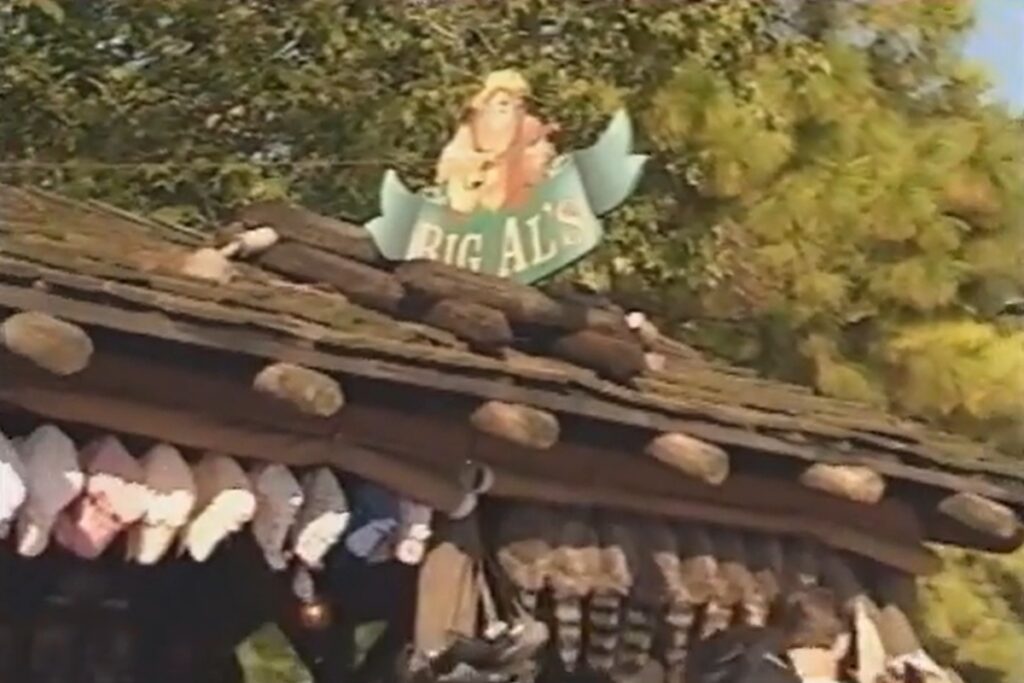
Big Al’s brought a little Country Bear humor to shopping in Frontierland. Situated across from the Country Bear Jamboree, beside the former Rivers of America waterfront, this compact merchandise stand sold western-style souvenirs from a rustic cabin setting. A depiction of Big Al playing his guitar above the shop made its connection to the nearby theater unmistakable. It was a small business with a particularly fitting namesake: one of Frontierland’s most recognizable performers.
The cabin appearance helped Big Al’s belong to its surroundings. Its modest scale, wooden construction, and chimney suggested a frontier dwelling adapted for trade. Merchandise was displayed around an open-air sales area, allowing visitors to browse as they passed through the land. The building supplied enough personality to be recognizable without requiring a large storefront or elaborate interior.
Its fictional premise extended the Country Bears’ world beyond the stage. Big Al’s cabin had become a shop where the bear could benefit from the performers’ popularity. That idea gave an ordinary retail stop a playful explanation. Guests leaving the theater could encounter the suggestion that one of its stars maintained a home—and a sideline business—just across the way.
Big Al was especially well suited to the joke. In the original Country Bear Jamboree, his mournful rendition of “Blood on the Saddle” made him a memorable part of the ensemble. Giving him a souvenir stand allowed that personality to contribute to Frontierland’s street scene. The character reference remained understandable even for visitors who recognized his appearance more readily than his name.
The merchandise emphasized the land’s western setting. Cowboy hats, coonskin caps, and sheriff’s badges offered familiar accessories for a little frontier make-believe. Toys and other small souvenirs rounded out the assortment. A 1996 Magic Kingdom guide also listed suntan lotion, illustrating how the stand combined themed purchases with practical items guests might need during a Florida park day.
These were generally purchases that could become part of the visit immediately. A child could put on a cowboy hat or badge and continue through Frontierland with a new role to play. The stand’s accessibility suited that kind of spontaneous stop: something caught the eye, a family paused to investigate, and the souvenir joined the day’s activities.
The structure had a history extending well before its Big Al identity. It began as a ride-ticket booth when Magic Kingdom opened in 1971, during the period when individual attractions required ticket coupons. After that original function ended, the building served as a carving location before becoming a merchandise shop in 1989. Its evolution reflected the reuse of small park structures as guest needs and operating practices changed.
That background distinguished Big Al’s from a newly built souvenir cart. Beneath its character branding was a piece of early Magic Kingdom infrastructure that had found another purpose. The cabin setting connected it visually to Frontierland, while its successive uses connected it to several decades of park operations.
Big Al’s closed in May 2026 amid construction activity associated with the Piston Peak development. Construction walls subsequently surrounded the stand, ending its long run as an accessible shopping stop across from the Country Bears.
Its appeal rested in the relationship between character, building, and merchandise. A rustic cabin belonged in Frontierland; western accessories suited the cabin; and Big Al gave the whole arrangement a sense of humor. For guests who paused there, the result was a souvenir shop that felt like a small extension of the entertainment nearby, with a history considerably longer than its size suggested.