
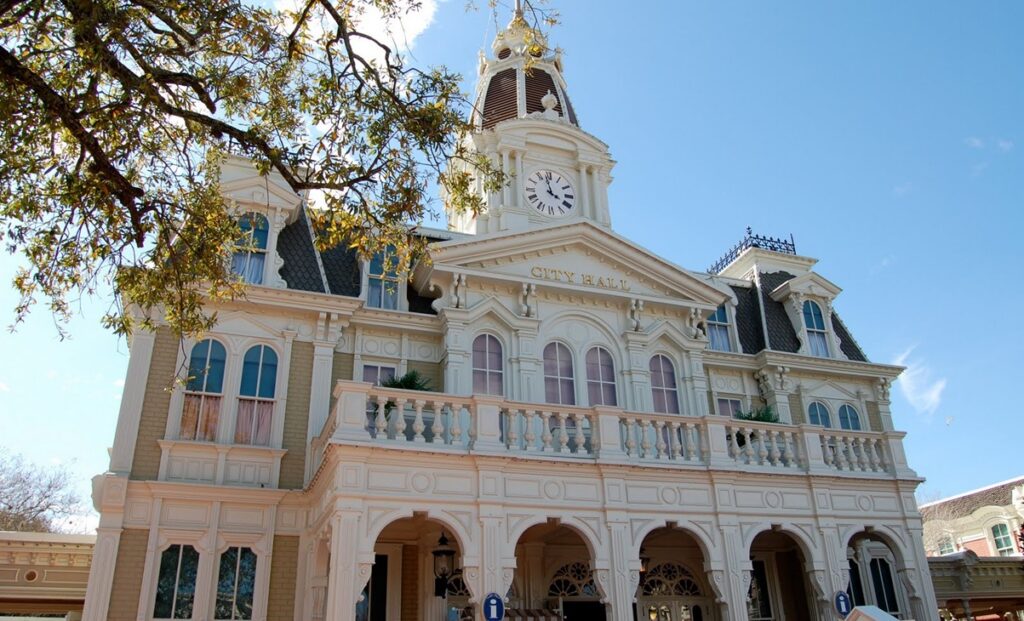
City Hall is one of the original landmarks of Main Street, U.S.A. at Magic Kingdom, standing prominently on the west side of Town Square immediately after guests pass beneath the Walt Disney World Railroad station and enter the park. Open since October 1, 1971, the stately turn-of-the-20th-century municipal building is both an important piece of Main Street’s architectural storytelling and one of the most functional spaces in Magic Kingdom. It is home to the park’s Guest Relations operation, making it the place generations of visitors have visited for information, assistance, ticket questions, accessibility services, lost-and-found help, and solutions to the inevitable complications that can arise during a day at Walt Disney World.
From a storytelling perspective, City Hall helps establish Main Street, U.S.A. as an actual town rather than simply an avenue lined with shops. The first area guests encounter after entering beneath the railroad tracks is Town Square, effectively the community’s civic center. City Hall occupies one side of that square, while the large building now known as Town Square Theater anchors the opposite side. Nearby are the fire station, Harmony Barber Shop, shops, restaurants, and the flagpole. Together, these elements create the illusion of arriving in a prosperous American town around the beginning of the 20th century.
City Hall’s prominent position is deliberate. In a real American town of the period, the municipal building would often have been one of the community’s most important structures, and Magic Kingdom’s version communicates that importance through its size, symmetrical façade, elaborate ornamentation, and central clock tower.
The building combines the decorative vocabulary associated with late Victorian civic architecture with the idealized visual language of Disney’s Main Street. Its pale exterior features arched openings at street level, ornamental columns, detailed moldings, a balustraded second-story terrace, tall windows, dormers, and an ornate tower rising above the roofline. A large clock faces Town Square, helping City Hall read immediately as an important public building even to guests who never enter it.
The basic architectural DNA of Disney’s City Hall stretches back to the development of the original Disneyland. Imagineer Harper Goff, one of the key designers of Main Street, U.S.A., drew heavily from the architecture of his hometown of Fort Collins, Colorado. Goff had photographs taken of Fort Collins buildings-including its city hall and bank-and used them as references while working with Walt Disney on Disneyland’s Main Street. Marceline, Missouri, where Walt spent formative childhood years, also influenced the emotional character of Main Street, but the architecture was never intended to be a literal recreation of Marceline.
Magic Kingdom subsequently expanded the Main Street concept for Florida. Whereas Disneyland’s version was designed with a more intimate scale, Walt Disney World’s Main Street represents a somewhat larger and more prosperous American community. City Hall therefore feels suitably imposing without becoming so grand that it overwhelms Town Square.
Like much of Main Street, the building also uses Disney’s carefully controlled sense of scale. The architecture feels substantial enough to establish a convincing civic environment while remaining theatrical. Decorative details, rooflines, windows, and upper stories are arranged to create an idealized streetscape rather than a perfectly literal municipal building.
Inside, the setting shifts from outdoor civic architecture to an appropriately formal municipal interior. Woodwork, decorative moldings, period-inspired furnishings, historic-looking artwork, and subdued colors maintain the turn-of-the-century theme even though the services being provided are entirely modern.
Among the more interesting decorative elements traditionally found inside are images of Walt and Roy O. Disney, effectively serving as the “founding fathers” of Walt Disney World. Artwork has also included historical American scenes and portraits associated with figures such as George Washington and Abraham Lincoln. Some pieces have connections to artwork created for the original version of The Hall of Presidents, creating a subtle thematic bridge between Main Street’s civic center and Liberty Square’s presidential attraction.
The real purpose of the building, however, is Guest Relations.
City Hall remains one of the most important problem-solving locations in Magic Kingdom. Disney currently identifies its Guest Relations services as including park information, accessibility assistance, help for international guests, dining assistance, separated-party assistance, ticket information and upgrades, and other general guest support. Guide maps and accessibility information are also available.
Lost and Found has historically been closely associated with City Hall, and Disney continues to identify City Hall as Magic Kingdom’s Lost and Found location. Guests who discover shortly after losing something that an item has been turned in may therefore find themselves returning to the same building that greeted them near the beginning of their day.
The nature of Guest Relations has changed significantly as Walt Disney World itself has become more technologically complex. In the 1970s and 1980s, the types of questions guests brought to a service counter centered heavily on maps, attraction information, reservations, transportation, tickets, and physical paperwork. Modern Cast Members may also help guests navigate digital ticketing, My Disney Experience issues, accessibility procedures, dining systems, and the increasingly interconnected technology surrounding a Walt Disney World vacation.
Some services have moved partially or completely online. For example, current Disability Access Service registration is handled through live video chat rather than in person at City Hall, although Guest Relations and Guest Experience Team locations can still assist eligible registered guests with certain day-of-visit needs such as obtaining return times when necessary. That evolution illustrates an important point about City Hall: its purpose has remained remarkably consistent even as the problems it solves have changed.
The location of Guest Relations is itself an example of thoughtful park design.
Guests needing help when they first arrive do not have to travel deep into Magic Kingdom. City Hall is only moments beyond the entrance. Likewise, visitors who encounter an unresolved issue during the day can stop there on their way out. The building’s obvious civic appearance also makes its function intuitive. In the fictional town, guests go to City Hall for assistance; in the real theme park, they do essentially the same thing.
City Hall also forms an important visual component of Town Square, one of the most carefully staged transitions in Magic Kingdom.
Guests do not walk directly from the entrance gates into a view of Cinderella Castle. Instead, they first approach the Walt Disney World Railroad station, which largely blocks the park beyond it. Passing through the tunnels beneath the tracks functions almost like passing through a theater curtain. Attraction posters line the entrance tunnels like advertisements for the performances awaiting inside.
Only after emerging on the other side does Town Square appear.
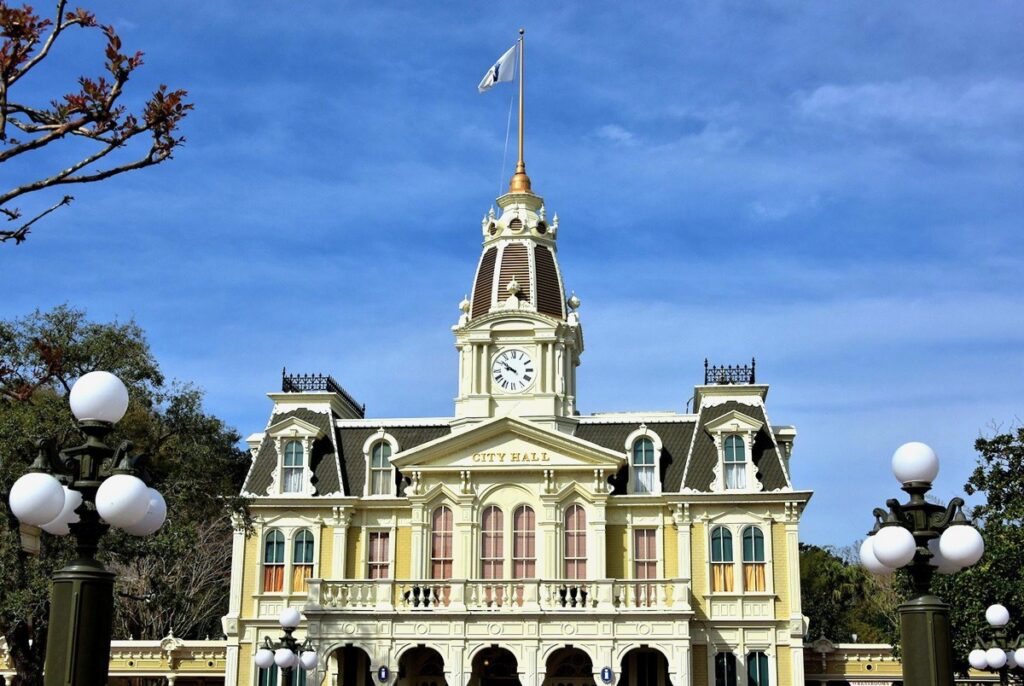
City Hall helps make that first reveal believable. The park does not immediately announce itself as a fantasy kingdom. Guests initially find themselves in a familiar American community, with a train station behind them, a flagpole in the center, and civic and commercial buildings surrounding the square. Cinderella Castle is visible only after attention is drawn farther down Main Street.
That theatrical progression is central to the design of Magic Kingdom.
City Hall has also been a surprisingly useful backdrop for the ceremonial side of Disney history. Town Square has hosted countless patriotic presentations, entertainment performances, holiday decorations, and anniversary events. Most significantly, Walt Disney World’s formal dedication ceremony took place in Town Square on October 25, 1971, several weeks after the resort began regular operation. Roy O. Disney dedicated Walt Disney World in honor of his brother, with Mickey Mouse standing beside him.
The American flag associated with those opening ceremonies has an extraordinary history of its own. The flag had flown over the White House on October 1, 1971, the day Walt Disney World officially opened, before becoming part of the resort’s dedication observances. Decades later, the Walt Disney Archives returned it to Florida for Walt Disney World’s 50th anniversary, when it was displayed at The Hall of Presidents.
Although City Hall was not itself the subject of the dedication, its position overlooking Town Square places the building within one of the most historically significant physical spaces at Walt Disney World.
The exterior has naturally required extensive upkeep during more than five decades of Florida heat, rain, humidity, and intense sunlight. One of its more visible recent refurbishments began in January 2020, when scaffolding and scrims gradually covered much of the building. City Hall remained operational while the exterior work proceeded. The refurbishment was interrupted by Walt Disney World’s pandemic closure but eventually resumed, and by September 2020 the scrims had been removed to reveal a freshly painted and cosmetically restored façade.
Such maintenance is particularly important on Main Street because the buildings are supposed to appear old without actually looking neglected. Paint, trim, railings, clocks, signs, roofs, and ornamental details require constant preservation so that the idealized turn-of-the-century town appears timeless rather than weather-beaten.
City Hall also demonstrates an important difference between Main Street, U.S.A. and many other themed lands. Not every space exists primarily to entertain. Some buildings conceal merchandise operations, restaurants, administrative offices, or essential guest services, yet Imagineering presents them as logical components of the fictional town.
Guest Relations could theoretically operate from a modern service center marked with large informational signs. Instead, it occupies the municipal building.
That choice helps transform infrastructure into storytelling.
A guest visiting because a ticket will not work, a dining reservation has disappeared, a family member has become separated from the group, or a personal item has gone missing is still interacting with Main Street’s fictional community. City Hall performs a genuine operational function while simultaneously making Town Square feel complete.
It is also one of the relatively few Magic Kingdom locations whose essential identity has remained nearly untouched throughout the park’s entire existence. Main Street has lost specialty shops, absorbed neighboring storefronts, changed sponsors, altered restaurants, and modernized its merchandise offerings. Ticketing and vacation-planning systems have undergone repeated revolutions. Yet the large civic building beside Town Square remains City Hall, and guests still go there when they need assistance.
That continuity gives the building unusual significance.
For many people, City Hall is associated not with an attraction or merchandise purchase but with a very specific moment when a Cast Member helped rescue part of a vacation. Guest Relations Cast Members routinely deal with the difficult side of operating the world’s most visited theme parks: confusion, lost belongings, accessibility needs, ticket complications, disappointed guests, separated families, and plans that have gone wrong. As a result, the building often represents Disney service in its most practical form.
At the same time, guests can walk past City Hall dozens of times without ever needing to enter it and still benefit from its presence. Its clock tower, Victorian façade, balcony, nighttime illumination, and prominent position give Town Square visual weight. Together with the railroad station, firehouse, flagpole, and surrounding storefronts, it tells arriving visitors that Main Street is a community with institutions and history rather than simply a themed corridor leading toward rides.
More than 55 years after Magic Kingdom opened, City Hall remains one of Main Street, U.S.A.’s most successful combinations of form and function. It is an opening-day piece of Magic Kingdom architecture, the civic anchor of Town Square, a direct descendant of the Main Street concepts developed by Walt Disney and Harper Goff, and the operational home of Guest Relations.
For most visitors, Cinderella Castle will always dominate the first view down Main Street. But City Hall performs a quieter job just inside the gates: it helps convince guests that before they reach the worlds of pirates, presidents, ghosts, princesses, and tomorrow, they have first arrived in a real American town-and if they need help while they are there, the town hall is exactly where it should be.