
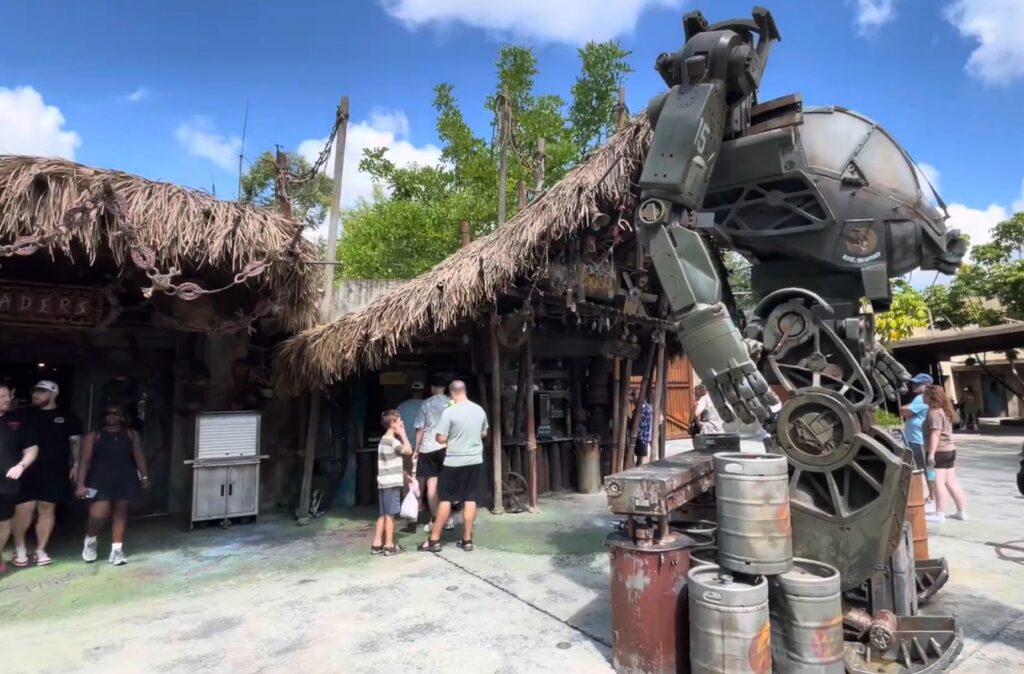
Windtraders is the primary merchandise shop in Pandora – The World of Avatar at Disney’s Animal Kingdom, combining a traditional attraction gift shop with some of the most elaborate retail storytelling at Walt Disney World. Opening with Pandora on May 27, 2017, Windtraders occupies a repurposed Resources Development Administration facility near Avatar Flight of Passage, and its design deliberately illustrates one of the central ideas behind the land: a former industrial installation has been reclaimed by nature and adapted for a new generation of human visitors who approach Pandora with greater respect for its environment and Na’vi culture.
Windtraders is positioned near the end of the exit route from Avatar Flight of Passage, making it a natural stopping point after guests have experienced the sensation of bonding with and flying on a mountain banshee. Unlike older Disney attraction gift shops that often look like conventional retail spaces decorated around a ride, however, Windtraders was designed to remain completely inside Pandora’s fictional world. Its shelves, merchandise fixtures, signage, props, and Cast Member roles all support the premise that guests are eco-tourists visiting the Valley of Mo’ara through Alpha Centauri Expeditions, or ACE.
That story is particularly important to understanding the building itself.
Pandora – The World of Avatar is set long after the destructive activities associated with the Resources Development Administration seen in James Cameron’s original Avatar. Human visitors have returned under very different circumstances, with ACE organizing environmentally responsible expeditions into the Valley of Mo’ara. Windtraders occupies what Disney explicitly describes as a transformed RDA structure.
The old industrial building has not been restored to a pristine human facility. Instead, Pandora appears to be slowly consuming it.
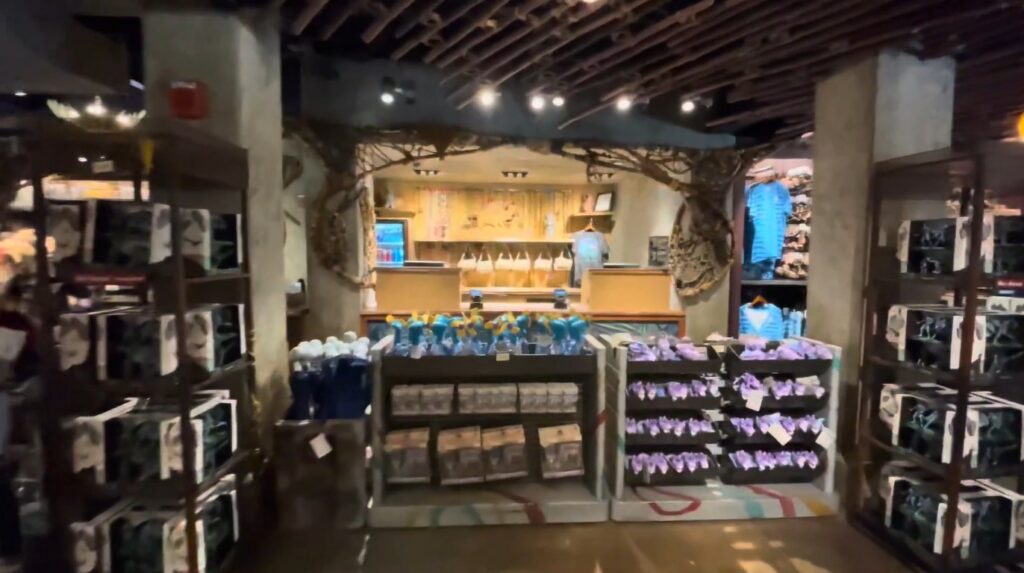
Enormous root systems twist across walls and merchandise displays. Natural-looking branches become shelving. Organic forms grow through and around the remnants of human construction. Industrial surfaces coexist with Na’vi-inspired decoration, animal imagery, woven materials, natural textures, and colorful artwork. The visual message is consistent with Pandora itself: human technology may temporarily impose itself on the landscape, but nature ultimately remains the more powerful force.
That environmental storytelling makes Windtraders particularly effective as part of Disney’s Animal Kingdom. A conventional Avatar store filled with movie logos would have worked commercially, but it would have undercut a land built around ecology, cultural exchange, and the relationship between people and the natural world. Instead, the merchandise is presented as though it has been gathered, created, studied, or traded within Pandora itself.
Disney divides much of the shop’s inventory conceptually between Na’vi cultural items, Pandoran wildlife, scientific and exploratory merchandise, and Alpha Centauri Expeditions equipment. Apparel, accessories, toys, plush, pins, artwork, collectibles, science kits, and other souvenirs rotate regularly, but the strongest merchandise tends to be material that feels specifically connected with Pandora rather than Walt Disney World in general.
This was a deliberate strategy from the land’s opening. Windtraders was intended to sell products that extended experiences guests had just encountered outside. Someone who had walked beneath the floating mountains might purchase a bioluminescent-looking piece of décor. A child fascinated by Pandoran wildlife could bring home a creature toy. Guests who had just flown on a banshee could participate in an even more elaborate retail experience built around that animal.
The most famous example is the Banshee Rookery.
Mountain banshees, or ikran, occupy a central place in Na’vi culture and in Avatar Flight of Passage. Bonding with one represents an important rite of passage, so Disney turned the purchase of a banshee toy into a small ceremony rather than simply placing boxes on a shelf.
At the Rookery, colorful banshees perch among a sculpted mass of branches and roots. An ACE Naturalist helps guests select-or, within the story, connect with-a particular creature. Earlier versions of the experience included a Banshee Pledge emphasizing responsibility toward the creature and Pandora’s environment, strengthening the idea that the guest was adopting a living companion rather than purchasing a toy.
The interactive banshee became one of Pandora’s defining souvenirs almost immediately. Demand was so high during the land’s opening weeks that the Rookery temporarily sold out.
Disney has repeatedly updated the concept rather than allowing it to become a static 2017 souvenir. The latest generation of interactive shoulder banshees debuted in late 2024 and remained available at Windtraders in 2026. These redesigned creatures feature glow-in-the-dark bioluminescent details, wireless remote control, head, mouth and wing movement, authentic creature sounds supplied with involvement from Lightstorm Entertainment, and the ability to interact with other compatible banshees.
As of summer 2026, Windtraders continued stocking several different color variations through the Banshee Rookery, demonstrating how enduring the experience has been nearly a decade after Pandora opened.
The Rookery is important because it demonstrates one of the most successful principles behind Pandora merchandise: the product continues the attraction rather than merely commemorating it.
A guest rides Flight of Passage and experiences the fictional process of linking with an avatar and bonding with a banshee. Minutes later, that guest can enter Windtraders and participate in another version of the bonding ritual. Merchandise becomes the final scene of the story.
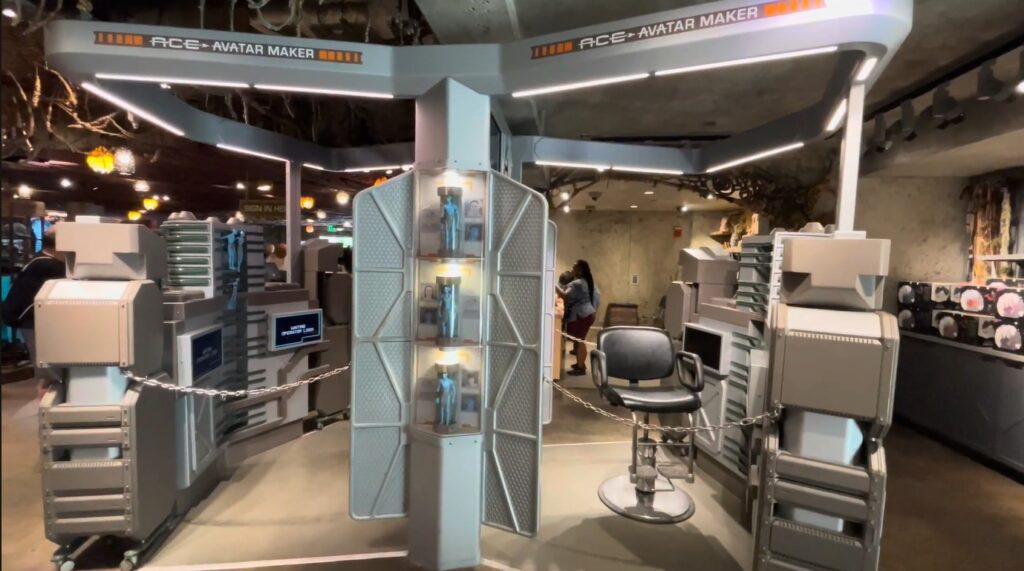
Windtraders originally took this idea even further with the ACE Avatar Maker.
Introduced just after Pandora opened in 2017, Avatar Maker allowed guests to transform themselves into personalized Na’vi-style action figures. A specialized booth digitally scanned the guest’s face, after which facial characteristics and other details could be incorporated into a customized figure approximately ten inches tall. Guests could select body and styling options before receiving their personalized avatar.
The premise was directly connected with Avatar Flight of Passage. That attraction’s fictional scientific narrative involves matching human visitors with avatar bodies capable of experiencing Pandora from a Na’vi perspective. ACE Avatar Maker turned the same basic concept into physical merchandise: instead of merely imagining what their avatar might look like, guests could take one home.
The experience had an uneven operational history after 2020, experiencing extended periods of closure before eventually returning. It ultimately closed permanently in 2025, and by December of that year the specialized Avatar Maker equipment had been completely removed from Windtraders.
Its disappearance ended one of the shop’s most unusual original experiences, but it remains an important part of Windtraders’ history because it illustrates how ambitious Disney’s merchandise program for Pandora was at opening. The goal was not simply to create unusually themed products; Disney wanted the process of obtaining those products to become entertainment.
Another personalization concept involved Na’vi-inspired jewelry. At various points, guests could assemble bracelets and necklaces using beads, feathers, decorative connectors, and other elements at an organic-looking workstation resembling a living tree. Again, the physical presentation was as important as the product itself. The station looked like something that had grown naturally within the surrounding environment instead of a standard jewelry counter.
Traditional merchandise has always occupied much of Windtraders as well.
Na’vi ears, tails, apparel, necklaces, toys, creature figures, Pandora-branded clothing, ACE expedition gear, mugs, pins, artwork, and home décor have appeared throughout the shop’s history. Pandoran animals represented in merchandise have included banshees, direhorses, prolemuris, and thanators, while some early collectibles pushed surprisingly far into the fictional science of the land.
Windtraders has periodically sold items inspired by Pandora’s bioluminescent plant life, educational science kits, and objects designed to look like specimens or discoveries rather than conventional theme-park souvenirs. This reinforces the idea that ACE visitors are participating in an expedition and may want to bring back something related to what they have encountered.
The store’s product selection has also evolved alongside the broader Avatar franchise.
Following the theatrical expansion of James Cameron’s series, Disney has introduced new collections inspired by later films rather than limiting Windtraders to imagery from the 2009 original. In 2026, merchandise inspired by Avatar: Fire and Ash continued that evolution, bringing newer characters, creatures, colors, and visual motifs into a shop originally built around the first film and the Valley of Mo’ara.
That adaptability is valuable because Pandora – The World of Avatar was deliberately created as more than a recreation of a single movie set. Disney and Lightstorm developed the Valley of Mo’ara as a new location within Pandora, giving Imagineers room to expand the setting rather than forcing the land to reproduce scenes guests already knew from the films.
Windtraders follows the same philosophy. It does not feel like a museum store attached to a 2009 movie. It behaves like an active trading and expedition supply location capable of incorporating new discoveries from an expanding fictional world.
The shop is also historically significant within Disney’s Animal Kingdom because Pandora itself replaced Camp Minnie-Mickey, one of the park’s original lands. Camp Minnie-Mickey closed in 2014, and the enormous redevelopment that followed introduced Pandora’s floating mountains, Na’vi River Journey, Avatar Flight of Passage, Satu’li Canteen, Pongu Pongu, and Windtraders in 2017.
The change represented one of the most ambitious transformations in Animal Kingdom history. Camp Minnie-Mickey had largely consisted of character encounters and entertainment built within a rustic woodland environment. Pandora introduced an entirely fabricated extraterrestrial ecosystem filled with complex rockwork, landscaping, engineered plant life, bioluminescent effects, sound design, and fictional anthropology.
Windtraders became the commercial component of that ecosystem, but Imagineering carefully avoided allowing it to feel commercially detached from the land.
That can be seen in small details throughout the building. Merchandise is often displayed among roots and organic formations rather than conventional shelving. Lighting fixtures combine human industrial technology with materials suggesting Na’vi influence. Colors and patterns echo elements seen around the Valley of Mo’ara. Even the distinction between decoration and merchandise can occasionally become difficult to identify.
This is one reason the shop is worth exploring even for guests who do not intend to buy anything.
Like Dok-Ondar’s Den of Antiquities in Galaxy’s Edge, Windtraders demonstrates that a Disney retail space can function as environmental storytelling. The building communicates what happened in Pandora after the RDA era, how human infrastructure has been reused, how nature has reclaimed portions of the facility, and how human visitors now interact with Na’vi culture.
There is also a meaningful difference between Windtraders and a store such as Island Mercantile elsewhere in Animal Kingdom.
Island Mercantile is a broad park merchandise destination capable of absorbing changing Disney collections. Windtraders is deliberately specific. Its success depends on merchandise that could plausibly belong to Pandora, ACE, the Na’vi, or the Avatar universe. That specialization preserves the integrity of the land and makes the store itself feel like another destination rather than simply somewhere to find products available elsewhere.
More than nine years after opening, Windtraders remains Pandora’s primary merchandise location and one of Disney’s Animal Kingdom’s most immersive shops. The ACE Avatar Maker may have disappeared, product lines have changed, and newer generations of banshees have replaced their predecessors, but the central idea has remained remarkably consistent.
Guests leave Avatar Flight of Passage having temporarily experienced Pandora through another body and flown with one of its most extraordinary creatures. Windtraders then gives them a way to continue that experience physically-whether through a banshee perched on their shoulder, an ACE expedition shirt, Na’vi-inspired jewelry, artwork, a creature figure, or some other artifact of their imaginary journey.
For a location whose practical purpose is selling souvenirs, Windtraders is unusually successful at disguising the transaction inside the story. It does not simply ask visitors what they would like to buy from Pandora.
It asks what they would like to bring back from their expedition.