
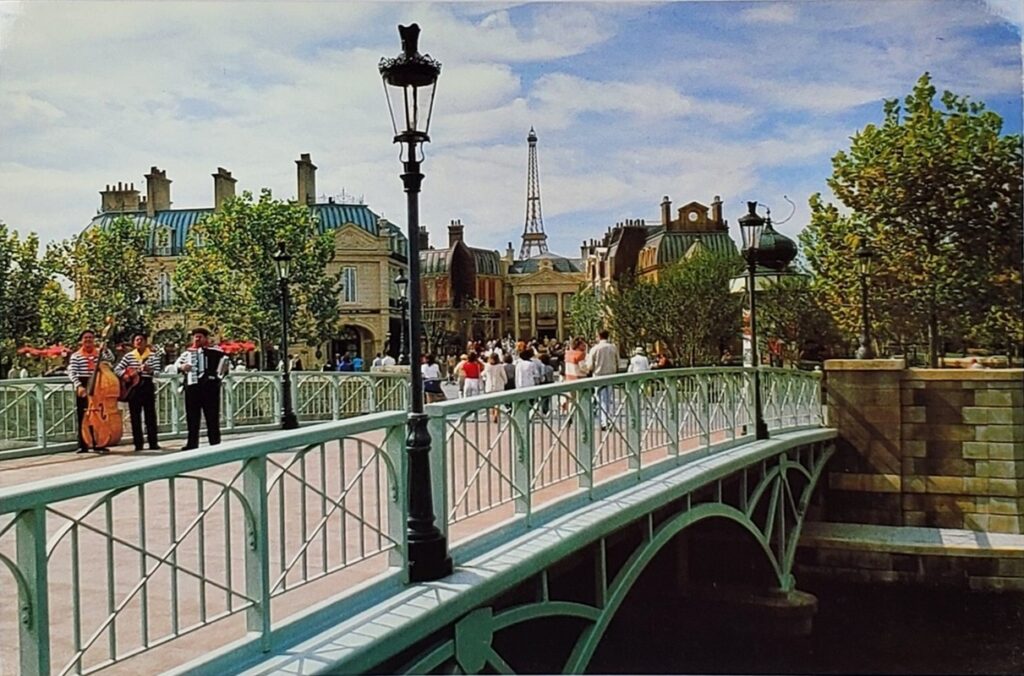
Au Petit Café was an opening-day table-service restaurant in EPCOT Center’s France pavilion that operated from October 1, 1982 until June 9, 1997. Designed as a traditional French sidewalk café, the restaurant occupied an outdoor, canopy-covered terrace immediately beside Les Chefs de France, where guests could sit at small café tables overlooking the World Showcase promenade.
Compared with its neighboring French restaurants, Au Petit Café was deliberately casual.
It served lighter French cuisine—particularly soups, salads, baguette sandwiches, and smaller entrées—while providing one of the best people-watching locations in early World Showcase.
The restaurant ultimately disappeared not because the location failed, but because Disney needed more indoor capacity at the extremely popular Les Chefs de France. Au Petit Café was enclosed and incorporated into an expanded Chefs de France during a major 1997 renovation.
Its former footprint remains recognizable today as part of the bright, window-lined dining area at the front of the current restaurant.
Au Petit Café debuted alongside EPCOT Center itself.
When the park opened on October 1, 1982, World Showcase was intended to present individual countries through architecture, entertainment, films, merchandise, Cast Members, and—perhaps most importantly—food.
France was particularly ambitious in that regard.
The pavilion opened with Les Chefs de France as its principal table-service restaurant, Boulangerie Pâtisserie for pastries and lighter counter-service items, and Au Petit Café as the outdoor alternative.
The pavilion also contained shops devoted to French wine, perfume, cookware, flowers, artwork, and other imported merchandise.
Together, these businesses were intended to make the pavilion feel less like a theme-park recreation and more like a small piece of France transported to Florida.
Au Petit Café was particularly effective because it relied on an experience that was instantly recognizable as French.
Outdoor café culture.
The restaurant was situated against the pale Parisian-style façade housing Les Chefs de France. Small round tables and chairs filled the terrace while decorative lamps, wrought-iron architectural details, awnings, umbrellas, and the surrounding pavilion scenery created the impression of a café along a French boulevard.
Unlike many restaurants that separate diners from the park around them, Au Petit Café made World Showcase part of the meal.
Guests could watch Friendship Boats cross the lagoon.
They could see visitors moving between France and the United Kingdom.
Street performers and pavilion entertainment might pass nearby.
At night, the promenade and surrounding architecture became part of the atmosphere as World Showcase lighting came on around the lagoon.
The outdoor setting also made the restaurant unmistakably different from Les Chefs de France despite their physical proximity.
Les Chefs offered an enclosed brasserie-style dining room.
Au Petit Café was the sidewalk café.
That distinction became even stronger in 1984 when Disney added Bistro de Paris upstairs.
The France pavilion could then offer three distinctly different levels of table-service dining within essentially the same restaurant complex.
Au Petit Café was the most casual.
Les Chefs de France occupied the middle ground as a French brasserie.
Bistro de Paris offered the most formal experience upstairs.
That was an unusually sophisticated dining arrangement for a theme park in the 1980s.
All three restaurants were connected with an extraordinary collection of French culinary talent.
The France pavilion’s dining operation was established with celebrated chefs Paul Bocuse, Roger Vergé, and Gaston Lenôtre.
Bocuse became one of the defining figures of nouvelle cuisine and one of the most internationally recognized French chefs of the 20th century.
Vergé was celebrated particularly for his Cuisine du Soleil approach in southern France.
Lenôtre was one of France’s great pastry chefs and built an international culinary empire around pastries, chocolates, catering, and professional culinary education.
Their involvement gave EPCOT’s France pavilion considerable culinary credibility at a time when theme-park food was still commonly associated with hamburgers, fried foods, and quick-service meals.
Au Petit Café benefited from that same operation while offering a more accessible format.
Disney’s own historical description characterizes it as providing lighter fare than Les Chefs de France or Bistro de Paris while retaining genuine French cuisine.
By the restaurant’s final years, official EPCOT guide maps described the menu very clearly:
Soups.
Salads.
Baguette sandwiches.
Lunch and dinner were served with table service.
Unlike Les Chefs de France and Bistro de Paris, however, Au Petit Café generally did not require or accept advance reservations or Priority Seating.
Guests could approach the café and, when space was available, sit down for a comparatively spontaneous French meal.
That flexibility made it particularly valuable in World Showcase.
Dining at EPCOT could be extremely competitive even during the park’s early decades. Before online reservations and smartphone apps, guests could make same-day dining arrangements through WorldKey information terminals and other in-park systems.
The major France restaurants were highly popular.
Au Petit Café offered another possibility for guests who wanted French food without securing a formal reservation.
The menu could still be more substantial than the word “café” might suggest.
A surviving 1994 Walt Disney World dining promotion grouped Au Petit Café with Les Chefs de France for an early-evening special.
Entrée choices included filet of orange roughy, chicken breast baked in puff pastry, and beef braised in red Burgundy wine, followed by French pastry selections.
That menu illustrates an important point about the restaurant.
Au Petit Café was casual in atmosphere, not necessarily simplistic in cuisine.
Guests could eat a baguette sandwich or salad, but the kitchen could also serve recognizable French-influenced entrées.
Children were accommodated as well.
A surviving EPCOT Center children’s menu used jointly by Chefs de France, Au Petit Café, and Bistro de Paris included chicken with pasta, a ground-beef croquette served in brioche with French fries, and fried orange roughy with fries.
Even the children’s selections reflected an effort to maintain some connection to the pavilion’s French culinary identity while still providing familiar choices.
The restaurant’s outdoor setting was both its greatest strength and its eventual weakness.
Sitting outside at a Parisian-style café was atmospheric during pleasant Florida weather.
During the summer, however, temperatures and humidity could be intense.
Afternoon thunderstorms were another constant concern.
Even with awnings and umbrellas, an open-air table could not offer the dependable comfort of an air-conditioned dining room.
Meanwhile, Les Chefs de France remained extremely popular and needed additional capacity.
By the mid-1990s, expanding the adjoining restaurant made considerable operational sense.
Au Petit Café served its final guests on June 9, 1997.
Les Chefs de France also temporarily closed as Disney began a substantial remodeling of the restaurant complex.
Bistro de Paris upstairs remained available during much of the construction period, at one point temporarily carrying the Les Chefs de France name while the downstairs restaurant was unavailable.
When the project was completed later that year, Au Petit Café no longer existed as an independent restaurant.
Its former outdoor dining area had been enclosed and incorporated into Les Chefs de France.
The expanded restaurant reopened in November 1997.
The change solved several problems at once.
Chefs de France gained more seats.
The former café space became air-conditioned.
Guests retained the attractive views of the World Showcase promenade through large windows.
And Disney no longer had to operate two closely connected downstairs table-service restaurants with overlapping kitchens and menus.
The modern result still provides a visible connection to Au Petit Café.
Chefs de France today has a bright front dining section lined with large windows facing the promenade. The area functions almost like an enclosed sunroom.
That portion of the restaurant occupies the space once used by the outdoor sidewalk café.
Guests eating there are therefore sitting in essentially the same location where Au Petit Café tables stood during the 1980s and 1990s.
The atmosphere has changed considerably.
There are walls and air conditioning now.
The café umbrellas are gone.
The restaurant has a unified Chefs de France identity.
But the view remains one of its greatest features.
Disney’s current description of Chefs de France specifically highlights its expansive windows overlooking World Showcase promenade, an experience that carries forward one of Au Petit Café’s defining characteristics.
Au Petit Café is easy to overlook in EPCOT history because it was never replaced by an entirely different attraction or restaurant.
Its space simply disappeared inside something larger.
There is no vacant building to photograph.
There is no old sign hidden in a backstage area.
A portion of Chefs de France effectively swallowed it.
That makes Au Petit Café an especially interesting example of how EPCOT has evolved without necessarily erasing its physical history.
From 1982 through 1997, visitors could sit outside in the France pavilion, order a French lunch or dinner, and watch World Showcase move past their table.
There were no Disney characters involved.
There was no elaborate intellectual-property storyline.
The attraction was the setting itself.
For fifteen years, Au Petit Café offered something that fit EPCOT Center’s original World Showcase philosophy almost perfectly:
a small taste of everyday France, served outdoors beside a busy pedestrian street.