
King Stefan’s Banquet Hall was the original table-service restaurant inside Cinderella Castle at Magic Kingdom, opening with the park on October 1, 1971. For more than 25 years, guests climbed into the upper portion of Walt Disney World’s most recognizable landmark to dine beneath vaulted ceilings, heraldic banners, stone arches, and stained-glass windows overlooking Fantasyland.
The restaurant was renamed Cinderella’s Royal Table on April 28, 1997, but the dining room itself survives and remains one of Magic Kingdom’s most distinctive restaurant spaces.
King Stefan’s Banquet Hall is also responsible for one of the strangest naming decisions in Walt Disney World history.
King Stefan is not Cinderella’s father.
He is the father of Princess Aurora in Disney’s 1959 animated film Sleeping Beauty.
When Imagineers were developing the restaurant, they wanted a regal name appropriate for a medieval banquet hall. Cinderella’s father was unnamed in the 1950 film and did not provide the obvious royal identity the designers wanted. According to Disney’s own historical account, Imagineers therefore borrowed King Stefan from Sleeping Beauty.
For decades, guests consequently entered Cinderella Castle to eat at a restaurant named for the father of an entirely different Disney princess.
Disney itself has acknowledged the oddity. D23 notes that the name generated years of questions from both visitors and Cast Members, including the obvious: “Who’s King Stefan?”
The unusual name aside, the restaurant was designed to feel appropriately royal.
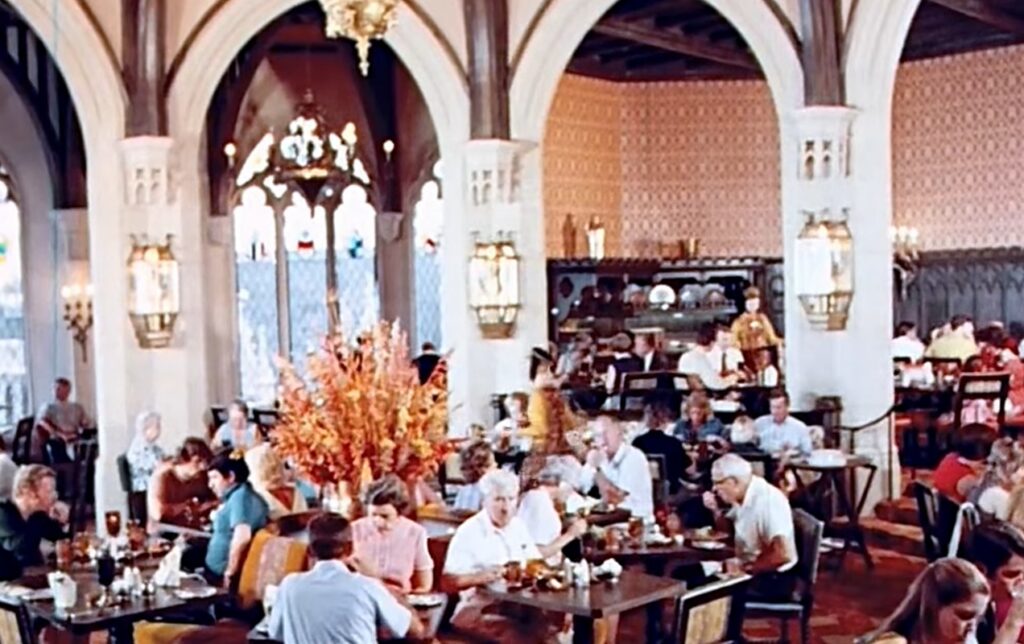
Guests entered Cinderella Castle from the Fantasyland side and made their way upstairs to a comparatively intimate circular dining room. High vaulted ceilings, massive stone-style columns, dark wooden beams, wrought-iron chandeliers, medieval banners, heraldic shields, and tall leaded-glass windows created the atmosphere of a European castle banquet hall.
Those windows remain one of the space’s defining features.
Unlike a completely enclosed themed restaurant, King Stefan’s Banquet Hall allowed diners to look outward from Cinderella Castle toward Fantasyland. The views reinforced the unusual reality that guests were not eating beside the castle or in a building decorated to resemble one.
They were actually dining inside it.
The room’s relatively small size also gave the restaurant a completely different character from Magic Kingdom’s larger dining halls. It was never capable of serving enormous numbers of guests, which helped make eating there feel like a special event even before princess character dining became its defining attraction.
During its early years, the experience leaned more heavily into the idea of a medieval banquet.
Servers wore period-inspired costumes, and historical accounts describe madrigal-style singers occasionally providing entertainment during meals. Guests were addressed with appropriately courtly language, helping the restaurant feel less like a conventional theme-park dining room.
The menu was considerably more ambitious than the typical hamburgers, hot dogs, and fried foods found elsewhere in the young Magic Kingdom.
Over the years, King Stefan’s served dishes such as Beef and Barley Soup, Fried Brie Cheese, Duchess Quiche, Chicken Divan, seafood dishes, grilled fish, roast beef sandwiches, prime rib, salads, stews, and crepes.
Disney’s own archives have preserved recipes for two particularly well-remembered dishes: Beef and Barley Soup and Fried Brie Cheese.
The food evolved considerably during the restaurant’s 25-year run, but King Stefan’s generally occupied a more upscale position within Magic Kingdom dining. Lunch and dinner could feel like a genuine sit-down meal rather than simply a break between attractions.
That distinction was especially pronounced during Walt Disney World’s earliest decades, when dining inside Cinderella Castle was itself still something of a novelty.
The restaurant also developed its own fictional history.
Vintage menus described King Stefan’s Banquet Hall as if it were a genuine royal establishment rather than simply a restaurant housed inside a theme-park icon. Medieval imagery, royal language, and decorative storytelling extended the experience onto menus and children’s materials.
Children’s menus from the 1980s included castle imagery, knights, mazes, and other medieval activities that reinforced the atmosphere while families waited for their meals.
For much of its existence, however, King Stefan’s Banquet Hall was not primarily a princess character restaurant.
That is an important distinction from Cinderella’s Royal Table as guests know it today.
Disney characters did appear in and around the restaurant at various points, and the castle naturally attracted guests hoping to see Cinderella. But the establishment’s core identity was initially the experience of eating in a medieval banquet hall inside Cinderella Castle.
That began changing significantly during the 1990s.
By the middle of the decade, Disney was offering the popular “Once Upon a Time” character breakfast at King Stefan’s Banquet Hall. Cinderella appeared with other members of Disney’s royal character lineup, turning breakfast inside the castle into one of Walt Disney World’s most difficult reservations to obtain.
The concept proved exceptionally successful.
The castle was an almost ideal setting for princess dining, and the character breakfast gave Disney an opportunity to turn what had always been an atmospheric restaurant into an experience centered more directly on Cinderella.
That shift also made the King Stefan name increasingly awkward.
Guests were now attending a Cinderella character meal inside Cinderella Castle at a restaurant named after Aurora’s father.
Disney finally corrected the mismatch in 1997.
On April 28, King Stefan’s Banquet Hall became Cinderella’s Royal Table.
The change was more than cosmetic, but it did not erase the restaurant’s original character.
The same soaring Gothic-style room remained.
The stained-glass windows remained.
The medieval flags and heraldic shields remained.
Guests continued climbing into the castle to dine in the same remarkable physical space.
What changed was the restaurant’s identity.
Instead of asking diners to accept the unexplained presence of Sleeping Beauty’s father inside Cinderella Castle, Disney finally made the restaurant belong explicitly to the princess whose name was already on the building.
Character dining gradually expanded beyond breakfast.
Cinderella’s Royal Table eventually added princess appearances during lunch and dinner, developing into the full fairytale dining experience operating today.
As of 2026, guests first meet Cinderella in the castle’s Grand Hall before proceeding upstairs by staircase or elevator. Once inside the banquet room, additional Disney Princesses circulate among the tables for photographs and autographs.
The modern restaurant therefore feels substantially different operationally from King Stefan’s Banquet Hall even though the architectural environment is largely the same.
Today, the princesses are the primary attraction.
During much of the King Stefan era, the castle itself was.
That earlier experience is one reason the restaurant remains particularly nostalgic for longtime Walt Disney World visitors. Before character dining became the dominant concept, guests could simply have lunch or dinner in Cinderella Castle and enjoy the unusual setting.
A prime rib dinner beside a stained-glass window overlooking Fantasyland could be the entire experience.
There was no need for every table to become part of a structured princess encounter.
King Stefan’s Banquet Hall also represents an interesting example of early Walt Disney World theming.
Modern Disney design tends to be extremely careful about intellectual-property consistency. A restaurant inside Cinderella Castle would almost certainly never be named after Aurora’s father today.
In 1971, Imagineers were sometimes willing to prioritize atmosphere over strict character continuity.
They needed a regal-sounding king.
King Stefan was a regal-sounding king.
For more than a quarter century, that was apparently enough.
The name eventually became too conspicuous to ignore, but the restaurant it represented proved remarkably durable.
More than 50 years after King Stefan’s Banquet Hall served its first guests, visitors are still eating in essentially the same magnificent room.
The menu has changed.
The characters have changed.
The reservation process has changed dramatically.
The name above the door changed in 1997.
But the central appeal remains exactly what it was on October 1, 1971.
Guests can walk into Cinderella Castle, climb above Fantasyland, and eat a meal inside the most famous building at Walt Disney World.
King Stefan may never have belonged there.
The banquet hall certainly did.