
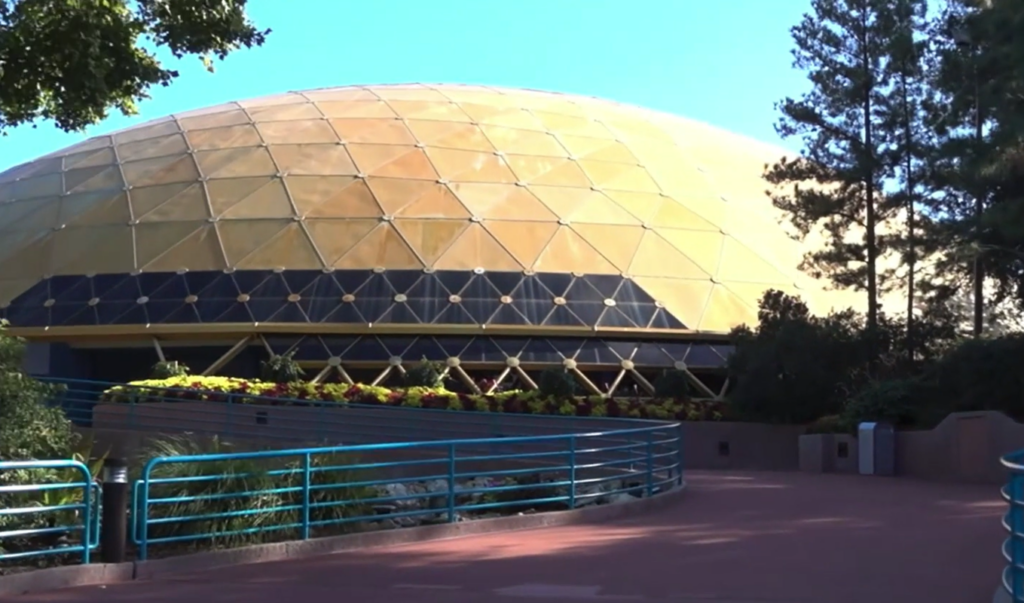
Pure & Simple was a counter-service restaurant located inside the former Wonders of Life pavilion at EPCOT Center. Opened with the pavilion on October 19, 1989, the restaurant specialized in healthier alternatives to traditional theme park food, including salads, sandwiches, fruit, yogurt, smoothies, and its signature Wonder Waffle. With its emphasis on nutrition and balanced eating, Pure & Simple was closely integrated into the pavilion’s educational mission, making it one of the more distinctive dining locations in EPCOT’s original Future World.
Unlike many Walt Disney World restaurants that adopted elaborate fictional settings or themes inspired by animated films, Pure & Simple developed its identity around a relatively straightforward concept: demonstrating that nutritious food could also be appealing, convenient, and enjoyable.
The restaurant’s original slogan, “Guilt-Free Goodies,” appeared prominently on its signage and communicated its approach to dining. At a time when hamburgers, fried chicken, pizza, and other familiar fast-food items dominated many theme park menus, Pure & Simple offered guests an alternative that reflected growing public interest in nutrition, exercise, and healthier lifestyles.
Its location within Wonders of Life was particularly appropriate.
The pavilion opened on October 19, 1989, in Future World East, between the Universe of Energy and Horizons pavilions. Housed beneath a large gold-colored dome, Wonders of Life explored the human body, medicine, physical fitness, nutrition, and the relationship between everyday choices and personal health.
The pavilion was sponsored by Metropolitan Life Insurance Company, commonly known as MetLife, which provided financial support for the development of the attraction complex.
Wonders of Life was one of EPCOT Center’s last major additions to the original Future World lineup and introduced a different approach to the park’s educational philosophy.
Rather than concentrating on a single technology or industrial subject, the pavilion examined human health through a combination of elaborate attractions, interactive exhibits, physical activities, films, and live entertainment.
Its two largest attractions were Body Wars and Cranium Command.
Body Wars was a motion-simulator adventure that placed guests aboard a miniature research vehicle traveling through the human body. The attraction combined a science-fiction premise with information about anatomy and medical science.
Cranium Command used Audio-Animatronics, film sequences, and comedy to explain how the brain coordinates the body’s functions. Guests watched as Buzzy, a rookie brain pilot, attempted to guide a twelve-year-old boy through the challenges of an ordinary day.
Other experiences included The Making of Me, a film about human reproduction; Goofy About Health, which used classic Goofy animation to explore health and fitness; and interactive exhibits such as Sensory Funhouse, Wonder Cycles, Coach’s Corner, and Frontiers of Medicine.
Pure & Simple was located within the pavilion’s central Fitness Fairgrounds area, near the AnaComical Players theater.
The Fitness Fairgrounds served as the pavilion’s principal gathering space, connecting the various exhibits, theater attractions, and guest facilities. Its brightly colored interior featured playful architecture and an environment intended to suggest an energetic health-and-fitness fair.
The restaurant was positioned along the edge of this central space, with its dining area elevated slightly above the surrounding pavilion floor.
This raised seating arrangement helped distinguish Pure & Simple from the nearby exhibits without isolating it behind the walls of a conventional restaurant. Guests could sit and eat while remaining visually connected to the larger Wonders of Life environment.
Historical photographs show an open dining arrangement with tables overlooking the activity within the pavilion. The layout created a comparatively informal atmosphere, allowing families to take a break from the attractions without leaving the building.
This was particularly useful because Wonders of Life was designed as a self-contained experience. Guests could spend considerable time exploring its attractions, demonstrations, and exhibits without returning to the main pathways of Future World.
Pure & Simple provided the pavilion with its own dining facility, allowing visitors to purchase breakfast, lunch, or snacks while remaining inside the health-themed environment.
The restaurant’s menu was central to its identity.
Among its early offerings were oat-bran waffles with fruit toppings, frozen yogurt, fruit smoothies, muffins, fresh fruit juices, salads, and sandwiches.
Lunch selections included vegetable pizza, soup, Caesar salad, and chicken wraps.
These items were intended to provide alternatives to heavier theme park meals while still accommodating the expectations of guests looking for familiar and satisfying food.
One of the restaurant’s most distinctive offerings was the Wonder Waffle.
The Wonder Waffle was shaped like a pentagon composed of five heart-shaped sections, giving it an appearance unlike the traditional round or square waffles served at most restaurants.
The design fit the playful educational atmosphere of Wonders of Life while offering a breakfast item that guests could customize.
Originally, the Wonder Waffle was served with access to a hot toppings bar.
Guests could add warm fruit toppings, including strawberry and blueberry preparations, along with other available accompaniments.
This self-service feature became one of the restaurant’s most memorable elements, particularly for visitors who enjoyed experimenting with different combinations.
The hot toppings bar was eventually replaced by a cold toppings bar.
Later, Disney eliminated the self-service toppings area entirely and instead provided individual cups of toppings with the waffles.
The changes illustrate how Pure & Simple’s operations evolved over time, even while the Wonder Waffle remained closely associated with the restaurant.
The transition away from the toppings bar may have simplified service and food handling, but the specific operational reasons have not been firmly documented.
Breakfast was an important component of Pure & Simple’s original menu.
In addition to the Wonder Waffle, the restaurant offered breakfast pizza, breakfast wraps, bagel sandwiches, low-fat muffins, bagels, and cereal served with milk.
Some breakfast-style items were available throughout the day, allowing guests to purchase lighter meals or snacks outside conventional breakfast hours.
This flexibility was unusual enough to distinguish Pure & Simple from many other counter-service locations.
The restaurant also offered fresh fruit cups, sometimes accompanied by yogurt toppings, and various lower-fat options intended to complement the pavilion’s educational focus.
Historical menu photographs show that healthier selections were identified with a red apple symbol, reinforcing the restaurant’s nutritional emphasis.
Even the food-service accessories reflected the pavilion’s identity.
Surviving photographs show a Pure & Simple serving tray decorated with a colorful illustrated map of Wonders of Life. The design included recognizable pavilion features and details such as the Snoopy blimp that flew inside the dome.
These customized accessories are a useful reminder of how thoroughly the original EPCOT Center integrated its restaurants into their surrounding pavilions.
Rather than treating dining facilities as unrelated commercial operations, Disney frequently incorporated pavilion-specific graphics, terminology, and visual references into menus, trays, signage, and other everyday objects.
Pure & Simple followed that approach particularly closely.
The restaurant’s emphasis on healthy eating was also a natural extension of the pavilion’s sponsorship.
MetLife’s involvement gave Wonders of Life a corporate connection to subjects such as wellness, longevity, medical care, and personal responsibility for health.
However, MetLife’s sponsorship applied to the pavilion as a whole. Surviving evidence does not establish a separate restaurant-specific sponsorship agreement for Pure & Simple.
The distinction is important because the restaurant’s nutritional identity was clearly related to the pavilion’s educational mission, but that relationship does not necessarily mean that MetLife independently operated or sponsored the food-service location.
Over time, the restaurant’s menu became less exclusively focused on healthier alternatives.
Although items such as waffles, salads, yogurt, and sandwiches remained associated with Pure & Simple, later menus included more conventional theme park offerings.
Historical photographs document hot dogs and potato chips among its later selections.
This shift was particularly noticeable when compared with the restaurant’s original “Guilt-Free Goodies” positioning.
While the reasons behind individual menu changes have not been documented, the evolution suggests that the restaurant gradually moved toward food choices with broader appeal.
The change also reflected a practical challenge faced by theme park dining facilities: balancing a specialized culinary concept with the preferences of a diverse audience.
Guests visiting Wonders of Life were not necessarily interested in eating a particularly healthy meal, even if they enjoyed the pavilion’s attractions.
Families looking for quick, familiar food could be more interested in a hot dog or sandwich than in a low-fat breakfast or vegetable pizza.
Pure & Simple’s changing menu therefore provides an interesting example of the tension between EPCOT’s original educational objectives and the practical realities of operating a major tourist destination.
The restaurant remained a recognizable part of Wonders of Life throughout the 1990s.
Its convenient location, air-conditioned seating, and distinctive breakfast offerings made it particularly appealing to guests spending time in Future World East.
The Wonders of Life pavilion itself, however, gradually faced operational difficulties.
Although it had opened as one of EPCOT Center’s major new attractions in 1989, the pavilion became less prominent as the park’s entertainment priorities shifted.
Several of its exhibits required updating, and the broader Future World area underwent substantial changes during the 1990s.
Horizons, located nearby, closed permanently in January 1999. The Universe of Energy had undergone a major transformation in 1996, becoming Ellen’s Energy Adventure.
The original CommuniCore complexes were also replaced by Innoventions in 1994, while the former World of Motion pavilion gave way to Test Track.
Within this changing environment, Wonders of Life continued operating largely in its original form.
A major turning point arrived in 2001 when MetLife ended its sponsorship.
The loss of corporate support did not result in the pavilion’s immediate closure. Wonders of Life remained open daily through 2001, 2002, and 2003.
However, its operations were eventually reduced.
In 2004, Wonders of Life became a seasonal pavilion, opening primarily during periods of higher attendance.
That change had significant consequences for Pure & Simple.
Unlike restaurants positioned along EPCOT’s main pedestrian routes, Pure & Simple depended on guests entering the Wonders of Life building. When the pavilion was closed, the restaurant was inaccessible to ordinary park visitors.
The restaurant’s disappearance appears to have occurred around the transition to seasonal operations in early 2004.
Contemporary discussions from April 2004 already described Pure & Simple as having disappeared from the pavilion, while Walt Disney World dining discussions from 2005 identified the restaurant as closed or removed.
This evidence is significant because some retrospective timelines list Pure & Simple as operating until January 1, 2007, the date generally associated with the final closure of Wonders of Life.
That later date applies to the pavilion’s remaining seasonal operations rather than necessarily to the restaurant itself.
The available evidence indicates that Pure & Simple ceased regular service by 2004 and had been removed as an operating restaurant by 2005.
An exact final operating day has not been established, so its closure should be recorded as approximately 2004 rather than automatically assigning the pavilion’s January 2007 closing date.
Wonders of Life itself continued reopening seasonally for several more years.
Its final day of regular guest access as an attraction pavilion was January 1, 2007, following the busy Christmas and New Year’s holiday period.
Afterward, the building remained standing but no longer offered its original collection of attractions.
The pavilion’s next major role emerged later in 2007, when Disney began using the former Wonders of Life building as an EPCOT festival facility.
During the EPCOT International Food & Wine Festival, the building became a Festival Center, accommodating wine seminars, culinary demonstrations, merchandise, and other festival-related activities.
The former Pure & Simple area was adapted for this new use.
During the Food & Wine Festival, the original restaurant location operated under the name Wonders Bar.
For the EPCOT International Flower & Garden Festival, the same area was used as Garden Town Café.
These seasonal operations represented a direct reuse of the former restaurant space, although they did not recreate Pure & Simple’s original menu or nutritional theme.
The transformation from Pure & Simple to festival dining is particularly interesting because it illustrates how Disney adapted existing infrastructure rather than immediately demolishing or replacing the entire pavilion.
The original Wonders of Life building remained useful because of its substantial interior space, existing utilities, food-service facilities, and ability to accommodate large numbers of guests.
Over time, however, the interior was gradually stripped of many of its original architectural and decorative features.
The pavilion’s large DNA sculpture was removed, original signage disappeared, and former attraction spaces were converted to new uses or closed off.
By the 2010s, much of the original Wonders of Life atmosphere had been erased.
The former restaurant’s surroundings no longer resembled the lively Fitness Fairgrounds of the 1990s, and the original Pure & Simple identity had disappeared.
The building continued serving as a Festival Center through the late 2010s, with the last major festival use occurring in 2019.
Another proposed transformation was announced in February 2019.
Disney revealed plans to convert the former Wonders of Life building into a new interactive attraction complex known as the PLAY! Pavilion.
The proposed experience would have featured a futuristic digital city with interactive attractions and character-based activities.
Concept artwork suggested a colorful, technology-oriented environment intended to appeal to guests of different ages.
The project was part of EPCOT’s larger redevelopment, which involved dividing the former Future World into the new neighborhoods of World Celebration, World Discovery, and World Nature.
The former Wonders of Life building became part of World Discovery, the neighborhood also containing Mission: SPACE, Test Track, and Guardians of the Galaxy: Cosmic Rewind.
However, the PLAY! Pavilion project never opened.
Construction and development were disrupted by the COVID-19 pandemic in 2020, and Disney subsequently reduced or revised several elements of EPCOT’s redevelopment.
References to the PLAY! Pavilion gradually disappeared from official planning materials.
By January 2023, the project had been removed from EPCOT park maps, and Disney indicated that the concept was being reevaluated.
Further evidence of its uncertain future emerged in June 2026, when the PLAY! Pavilion flag was removed from EPCOT’s entrance display.
Although the removal reinforced expectations that the original project would not proceed, Disney had not provided a definitive public announcement explaining the long-term future of the former Wonders of Life building.
As of October 2026, the original gold-domed structure remains standing in EPCOT’s World Discovery neighborhood, but it is not open to guests as an operating attraction pavilion or restaurant.
Pure & Simple has not returned, and the former dining area is not accessible as a public restaurant.
The building’s continued existence is an important distinction. Unlike some extinct EPCOT locations whose structures were demolished, Pure & Simple occupied space inside a pavilion that remains physically present.
However, the preservation of the exterior building does not mean that the original restaurant’s interior survives intact.
The former dining area underwent changes during its festival use, and the extent to which any original Pure & Simple fixtures or architectural elements remain inside the closed structure has not been publicly established.
No current restaurant occupies the space as of October 2026, and Disney has not announced a replacement dining concept.
Pure & Simple is a particularly revealing example of EPCOT Center’s original approach to food service.
Its menu was not merely designed around convenience or a fictional setting. Instead, the restaurant’s emphasis on nutrition was directly related to the subject matter of the pavilion that housed it.
Eating at Pure & Simple was therefore an extension of the larger Wonders of Life experience.
Visitors could learn about exercise, digestion, anatomy, and the importance of healthy decisions, then purchase a meal that reinforced some of those ideas.
The Wonder Waffle, fruit smoothies, yogurt selections, and other menu items also gave the location a distinctive identity that endured in visitors’ memories long after the restaurant disappeared.
Its gradual shift toward more conventional menu selections illustrates how specialized theme park dining concepts sometimes evolve in response to changing guest expectations.
The restaurant’s closure also demonstrates the consequences of relying on a pavilion’s continued operation for access and attendance.
Once Wonders of Life became seasonal, Pure & Simple lost the dependable daily audience that had supported it throughout the 1990s.
Although the restaurant was later repurposed for festival operations, its original identity never returned.
Today, Pure & Simple remains part of the history of EPCOT’s former Wonders of Life pavilion, alongside attractions such as Body Wars, Cranium Command, and The Making of Me.
Its combination of healthy food, playful presentation, customized pavilion merchandise, and the memorable Wonder Waffle made it a distinctive example of dining designed around EPCOT Center’s educational philosophy.
For guests who remember the original pavilion, Pure & Simple was more than a place to purchase a quick meal. It was part of a carefully constructed environment in which exhibits, entertainment, shopping, and dining all contributed to a larger examination of human health.
That integration makes Pure & Simple one of the more historically interesting extinct quick-service restaurants at Walt Disney World, even though its operating life ended more than two decades ago.