
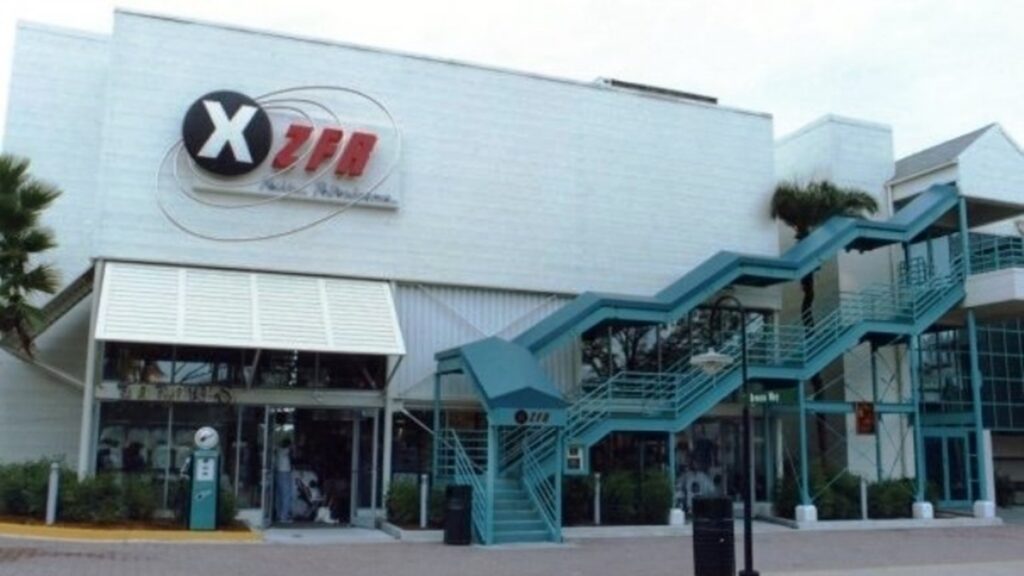
XZFR Rockin’ Rollerdrome was a short-lived roller-skating nightclub located on Pleasure Island at Walt Disney World, in the entertainment district now known as The Landing at Disney Springs. Opening on May 1, 1989, as one of Pleasure Island’s original entertainment venues, XZFR combined rock-and-roll music, live bands, dancing, alcoholic beverages, and roller skating inside a multi-level nightclub. Its most distinctive feature was an elevated skating track that circled a dance floor below, allowing guests to skate above the crowd while listening to music. The venue also incorporated a futuristic DJ booth suspended from an overhead crane. Safety concerns involving the combination of roller skating and nightclub activities led Disney to eliminate the skating concept less than a year after opening. The building was transformed into Rock ‘n’ Roll Beach Club in 1990, which operated until February 2008. The structure was demolished in early 2011.
XZFR was one of the most unusual entertainment concepts ever introduced at Walt Disney World.
Unlike conventional dance clubs, which provide a dance floor, music, and bars, XZFR encouraged visitors to participate in two different activities within the same space.
Guests could dance on the ground floor or strap on roller skates and travel around an elevated track overlooking the dancers.
The concept was ambitious, visually dramatic, and ultimately short-lived.
Its failure also demonstrated the challenges of combining physically demanding recreational activities with the atmosphere of an adult nightclub.
Pleasure Island opens in 1989
Pleasure Island officially opened on May 1, 1989, as a major expansion of the Walt Disney World Village shopping and dining district.
The new entertainment area was designed to provide nighttime activities for resort guests and Central Florida residents.
Its opening coincided with one of the busiest expansion periods in Walt Disney World history.
Disney-MGM Studios opened the same day, while Disney’s Typhoon Lagoon water park debuted a month later.
Pleasure Island introduced several distinct nightlife concepts.
Mannequins Dance Palace featured contemporary dance music and a revolving dance floor.
Neon Armadillo Music Saloon offered live country music.
Videopolis East catered primarily to teenagers with music videos and electronic effects.
The Adventurers Club presented interactive theatrical entertainment, while Comedy Warehouse specialized in comedy performances.
XZFR Rockin’ Rollerdrome was designed to combine elements of a roller rink, dance club, and rock-and-roll concert venue.
The establishment was among the most technologically ambitious of the original clubs.
Its unusual building design allowed multiple activities to take place simultaneously, with guests able to watch one another from different levels.
The development of the Rollerdrome
Disney’s plans for XZFR were publicly described before Pleasure Island opened.
A detailed article in the summer 1988 edition of Disney News magazine outlined the proposed nightclub.
At that stage, Disney referred to the establishment as the Zephyr Rockin’ RollerDrome.
The name Zephyr was pronounced similarly to the letters XZFR, which became the distinctive stylized name associated with the finished nightclub.
The article described the attraction as a three-level entertainment complex incorporating food, music, and roller skating.
Disney intended the venue to accommodate families, distinguishing it from the adult-only clubs elsewhere on the island.
The entrance was planned for the building’s upper level.
Guests would pass through a dining area called the Zephyr Grille before overlooking the activities on the floors below.
The proposed restaurant was described as a gourmet hamburger establishment.
Below the dining area, guests would encounter the roller-skating track and dance floor.
The design was intended to create a dramatic interior where music and activity could be observed from several levels.
Disney Imagineers were particularly interested in making the DJ an active part of the show.
Rather than positioning the DJ behind a conventional stationary booth, they developed an elaborate suspended capsule that could move within the building.
The multi-level skating rink
The Rollerdrome’s most distinctive architectural feature was its elevated skating area.
The ground level contained a large dance floor.
Above it, an oval skating track followed the perimeter of the building.
Skaters traveled around the second-floor track while looking down at the dancing taking place below.
Contemporary descriptions place the skating path approximately six feet above the dance floor.
The arrangement allowed guests to participate in different activities while remaining connected through the open interior.
It also created an unusual visual effect.
Visitors standing on the lower level could watch skaters passing overhead, while those on the upper levels could look down on the dance floor and live performances.
The skating surface was made of wood.
Guests could obtain roller skates and participate in the activity while music played throughout the club.
The concept was quite different from a conventional roller rink.
Rather than providing a large, uninterrupted skating floor, XZFR incorporated a relatively narrow elevated route around a nightclub.
The arrangement was intended to make roller skating part of a larger entertainment environment.
It also introduced operational challenges that would eventually contribute to the attraction’s disappearance.
The suspended DJ booth
One of the most ambitious features was the DJ’s elevated capsule.
John Kavelin, a show producer involved in Pleasure Island’s development, described the equipment in advance publicity.
The DJ operated from an electronic booth suspended from a bridge crane.
By using controls inside the capsule, the DJ could move between different areas of the building.
The arrangement allowed the DJ to appear above the dancers and skaters rather than remaining hidden behind a conventional console.
The DJ also served as an entertainment personality.
Responsibilities included announcing songs, introducing performers, and interacting with employees and guests.
The moving booth was intended to become one of the club’s most memorable visual elements.
Its design complemented the futuristic imagery associated with the building’s fictional history.
The concept also reflected Disney’s approach to nightclub entertainment during the late 1980s.
Rather than simply constructing bars with dance floors, Imagineers incorporated theatrical equipment, moving scenery, lighting effects, and elaborate sound systems.
XZFR’s suspended booth was one example of that philosophy.
Live rock-and-roll music
Music was central to the Rollerdrome experience.
The original plans called for live bands performing rock-and-roll hits associated with the 1950s and 1960s.
Disney’s summer 1988 publicity described groups consisting of approximately five to seven musicians.
Employees were to wear clothing inspired by the same period.
The result was intended to create an energetic environment recalling the heyday of American roller skating and rock-and-roll dancing.
The concept also incorporated a DJ, allowing recorded music to supplement the live performances.
The combination provided several entertainment possibilities.
Guests could skate to recorded music, dance while a band performed, or watch the activity from the surrounding levels.
A July 1989 newspaper account confirmed that the completed venue incorporated live music, roller skating, and a multi-level interior.
The reporter described skaters circling above the dance floor while a band performed from an elevated position.
The arrangement produced a more theatrical experience than a conventional skating rink.
Food and beverage service
Food service was part of the Rollerdrome’s original design.
Disney’s 1988 preview identified the Zephyr Grille as a gourmet hamburger restaurant on the upper level.
The proposed dining area overlooked the skating and dancing below.
The same preview identified two bars for adult guests.
These details establish that XZFR was conceived as a combined dining and entertainment facility rather than exclusively a roller rink.
However, the surviving advance publicity does not establish the exact menu eventually served when the nightclub opened.
The Zephyr Grille name and hamburger concept were part of Disney’s preopening plans, but a dated opening-period restaurant menu has not been located.
It would therefore be inappropriate to assign specific hamburgers, side dishes, prices, or specialty drinks to the completed venue without further documentation.
The availability of alcohol is better established.
Historical accounts confirm that guests could purchase alcoholic beverages while visiting the club.
This became particularly significant because roller skating was also permitted.
Unlike a conventional nightclub, where guests generally remained on foot, XZFR offered an activity requiring balance, coordination, and movement around an elevated track.
The combination created obvious safety concerns.
The fictional Building X
Like the other original Pleasure Island establishments, XZFR was given an elaborate fictional history.
Disney Imagineers presented Pleasure Island as the former industrial headquarters of Merriweather Adam Pleasure.
According to the story, Pleasure was an eccentric entrepreneur whose businesses included manufacturing, aviation, sailing, and experimental inventions.
The building occupied by XZFR was identified as Building X.
Its fictional history dated to 1937.
The structure was supposedly constructed to house Pleasure’s experiments with an unusual aircraft called the X-Thing.
Pleasure was presented as an enthusiast of unidentified flying objects and the possibility of extraterrestrial life.
He designed the X-Thing as an amphibious aircraft capable of harnessing wind power.
According to the historical plaque, the machine made its only flight on September 1, 1940.
Pleasure himself supposedly piloted the aircraft.
The circumstances of the flight were left deliberately mysterious.
After returning, Pleasure allegedly began transmitting messages into outer space.
The broadcasts originated from the roof of Building X.
Their message was a repeated Morse code welcome.
This fictional history gave the nightclub’s unusual mechanical features an explanation.
The suspended DJ capsule, overhead equipment, and futuristic atmosphere could be interpreted as remnants of Pleasure’s experimental aviation laboratory.
The story was entirely fictional, but it helped establish a connection between XZFR and the larger Pleasure Island narrative.
Safety concerns and closure
XZFR’s original roller-skating concept lasted less than a year.
Disney concluded that the combination of skating, dancing, alcohol, and elevated walkways created unacceptable safety concerns.
The company’s official historical encyclopedia specifically identifies the danger associated with roller skating as the reason the activity was eliminated.
The nightclub was redesigned in early 1990.
Although some retrospective chronologies identify April 4, 1990, as the opening of Rock ‘n’ Roll Beach Club, the exact final operating day under the XZFR name has not been firmly established.
The most reliable operating period is May 1, 1989, through early 1990.
It is important to distinguish the closure of the skating concept from the closure of the building.
Disney did not abandon the venue or immediately demolish it.
Instead, the company retained the multi-level nightclub and changed the entertainment format.
The roller-skating track was no longer used for skating, and the establishment adopted a more conventional rock-music nightclub identity.
The rapid conversion made XZFR one of the shortest-lived original Pleasure Island concepts.
Becoming Rock ‘n’ Roll Beach Club
The replacement venue was Rock ‘n’ Roll Beach Club.
Opening in 1990, it retained the building’s large interior and emphasis on rock music.
However, the skating component disappeared.
The new concept emphasized live bands and dancing rather than recreational skating.
Its beach-inspired decorations created a more relaxed atmosphere.
The club became known for live rock cover bands performing popular songs.
This gave it a different identity from the other Pleasure Island nightclubs.
Mannequins emphasized electronic and contemporary dance music, while 8TRAX later specialized in music from the 1970s and 1980s.
Rock ‘n’ Roll Beach Club offered an alternative for guests who preferred hearing live musicians.
The former Rollerdrome’s multi-level architecture continued to distinguish the building from conventional clubs.
Its large open interior provided views between different levels.
However, the roller rink’s unusual function was permanently eliminated.
Rock ‘n’ Roll Beach Club became a much longer-lived business than XZFR.
It operated for nearly eighteen years.
The final closure in 2008
Rock ‘n’ Roll Beach Club closed in February 2008.
Contemporary accounts identify Saturday, February 2, as its final operating night, while Disney’s historical encyclopedia records February 3 as its closing date.
These dates are consistent with a nightclub ending operations after its final Saturday evening.
The closure occurred several months before Disney announced that the remaining Pleasure Island nightclubs would also close.
Those establishments operated through September 27, 2008.
Rock ‘n’ Roll Beach Club therefore became the first major Pleasure Island nightclub to close during the district’s final transition away from adult nightlife.
At the time of its closure, Disney had not yet publicly announced the complete elimination of the nightclub district.
The building remained standing after the club closed.
However, it did not reopen as another permanent entertainment venue.
Demolition in 2011
Disney subsequently developed plans to transform Pleasure Island into a new waterfront dining and entertainment district.
In November 2010, the company announced a proposal called Hyperion Wharf.
The project envisioned additional restaurants, landscaped gathering areas, and waterfront entertainment.
Although Disney eventually abandoned the original Hyperion Wharf plans, demolition proceeded on several former nightclub buildings.
Rock ‘n’ Roll Beach Club was among them.
Construction work began in January 2011.
Contemporary photographs show the building being dismantled, including portions of the distinctive oval structure associated with the original skating rink.
By February 2011, the building had been demolished.
The demolition permanently eliminated the physical structure that had housed XZFR Rockin’ Rollerdrome.
The property was subsequently incorporated into the larger Disney Springs redevelopment.
In March 2013, Disney announced plans to transform Downtown Disney into Disney Springs.
The former Pleasure Island district became The Landing.
New pedestrian pathways, waterfront restaurants, and gathering areas replaced portions of the former nightclub district.
The former XZFR building stood near the area now occupied by the waterfront pedestrian corridor and nearby restaurants, including Paradiso 37 and The BOATHOUSE.
However, the original building was demolished rather than directly converted into a new restaurant.
The modern construction does not correspond precisely to the former nightclub’s original footprint.
Historical significance
XZFR Rockin’ Rollerdrome was one of the most unusual entertainment experiments in Walt Disney World history.
Opening with Pleasure Island in May 1989, it combined live rock music, roller skating, dancing, dining, and nightclub entertainment inside a multi-level building.
The elevated skating track and suspended DJ capsule made it a visually dramatic venue.
Its original design also reflected Disney’s interest in creating themed environments where guests participated in the entertainment.
The fictional history of Merriweather Pleasure’s experimental X-Thing provided an imaginative explanation for the nightclub’s unusual architecture and mechanical features.
However, XZFR’s most memorable distinction was also its principal weakness.
The combination of roller skating and alcoholic beverages created safety concerns that Disney ultimately considered unacceptable.
As a result, the original skating concept disappeared less than a year after opening.
The building’s subsequent transformation into Rock ‘n’ Roll Beach Club proved considerably more durable.
The replacement nightclub retained the emphasis on live music while eliminating the risks associated with the elevated skating track.
It remained in operation until February 2008, making it one of Pleasure Island’s longest-running entertainment establishments.
The building was demolished in early 2011, and its former location became part of the Disney Springs waterfront redevelopment.
As of November 2026, XZFR Rockin’ Rollerdrome remains permanently closed, and no portion of the original nightclub operates at Walt Disney World.
Its best-supported operating period is May 1, 1989, through early 1990.
Although it lasted less than a year, XZFR remains a memorable example of Disney Imagineering’s willingness to experiment with unconventional entertainment concepts.
For guests who experienced it, the opportunity to roller-skate above a crowded dance floor while live rock music played was unlike anything else offered at Walt Disney World.
That unusual combination makes XZFR Rockin’ Rollerdrome one of the most distinctive extinct attractions in Pleasure Island history.