For multiple generations, the words Disney and McDonald’s immediately bring one thing to mind: Happy Meal toys.
Mickey Mouse, Disney Princesses, Pixar characters, Marvel superheroes, Star Wars icons, and dozens of animated movie casts have all appeared inside those familiar cardboard boxes over the years.
But the relationship between the two companies became much bigger than Happy Meals.
During its peak, McDonald’s was one of Disney’s most important global promotional partners. The Golden Arches sponsored an entire land at Disney’s Animal Kingdom, McDonald’s French fries were sold inside all four Walt Disney World theme parks, full McDonald’s restaurants operated on Disney property, and major Disney movies were supported by enormous international restaurant promotions.
Then the relationship cooled, the fries disappeared from the parks, and Disney introduced new nutritional standards that fundamentally changed how it licensed its characters for children’s food.
More than a decade later, Disney and McDonald’s found their way back together.
The result is a partnership that has now stretched across portions of five decades—with some significant breaks, changes, and surprises along the way.

Disney and McDonald’s Timeline
| Year | What Happened |
|---|---|
| 1987 | Disney-branded McDonald’s promotions are documented by this point, including a Snow White promotion. |
| 1988 | Oliver & Company characters appear as McDonald’s Happy Meal toys. |
| 1990 | A disagreement surrounding the Dick Tracy promotion contributes to a cooling of Disney-McDonald’s relations. |
| 1996 | Disney and McDonald’s announce an enormous 10-year global promotional alliance. |
| 1997 | The global alliance begins, and McDonald’s French fry locations begin appearing inside Disney parks. |
| 1998 | A full McDonald’s opens at Downtown Disney, while McDonald’s becomes the presenting sponsor of DinoLand U.S.A. at the new Disney’s Animal Kingdom. |
| 2006 | The exclusive 10-year promotional agreement expires; Disney also introduces new nutritional guidelines for products marketed to children. |
| 2008–2009 | McDonald’s sponsorship ends at DinoLand U.S.A., and McDonald’s-branded food is phased out of the Walt Disney World theme parks. |
| 2010 | The McDonald’s at Downtown Disney Marketplace closes permanently. |
| 2018 | Disney and McDonald’s announce a new multi-year, non-exclusive Happy Meal promotional alliance. |
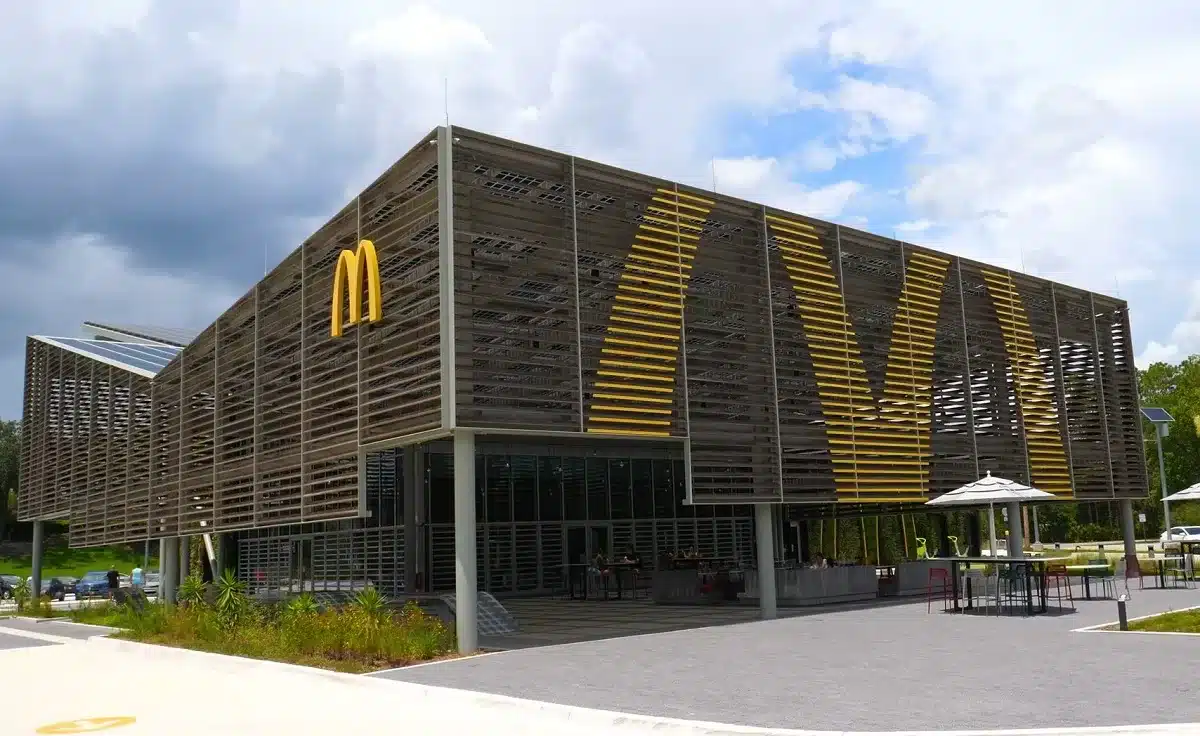
| 2020 | McDonald’s rebuilds its remaining Walt Disney World restaurant as a net-zero-energy-designed global flagship. |
| 2021–2026 | Periodic Disney Happy Meal promotions continue, including Walt Disney World’s 50th anniversary, The Little Mermaid, Pixar’s Elio, and Disneyland’s 70th anniversary. |
The Disney-McDonald’s Relationship Started Before the Famous 1996 Deal
The history is a little more complicated than the original version of this article suggested.
The first Disney-McDonald’s promotion was not a 1987 Happy Meal for The Great Mouse Detective. That movie actually opened in 1986.
Disney-branded McDonald’s promotions can be documented by 1987, including a promotion connected with Snow White and the Seven Dwarfs.
By 1988, Disney movie characters were unquestionably appearing as Happy Meal premiums. McDonald’s produced a set of four finger puppets featuring Oliver, Dodger, Georgette, and Francis for the theatrical release of Oliver & Company.
Those toys are historically significant enough that examples are now preserved in the collections of The Henry Ford museum.
Other Disney-related McDonald’s promotions followed as the companies recognized how naturally their audiences overlapped.
Disney made family entertainment. McDonald’s attracted enormous numbers of families with young children.
A collectible toy connected the two almost perfectly.
Then Came Dick Tracy—and a Falling Out
Disney’s relationship with McDonald’s was not continuously harmonious.
In 1990, Disney launched one of the most aggressive movie-marketing campaigns in its history for Dick Tracy.
The movie was supported by merchandise, television specials, park appearances, advertising tie-ins, and a McDonald’s promotion that included a nationwide Crimestoppers game.
But contemporary reports indicate that disagreements surrounding the promotion helped sour the relationship between the two companies.
For much of the first half of the 1990s, Disney turned more heavily toward McDonald’s biggest competitor.
Burger King became an important Disney promotional partner for movies including:
- Aladdin
- The Lion King
- Toy Story
- The Hunchback of Notre Dame
The Disney-McDonald’s story could have ended there.
Instead, the two companies came back together with a deal much larger than anything they had attempted before.
1996: The Beginning of the “McDisney” Era
On May 23, 1996, The Walt Disney Company and McDonald’s announced a massive 10-year global marketing alliance.
The deal would officially take effect in January 1997.
This was not simply an agreement to put the occasional Disney toy in a Happy Meal.
McDonald’s became Disney’s primary promotional partner in the restaurant industry, with marketing rights extending across more than 90 countries.
The companies could promote Disney theatrical movies, home-video releases, television programming, Disney theme parks, and other properties through McDonald’s enormous international restaurant network.
Contemporary reporting described it as one of the largest entertainment and restaurant promotional agreements ever created.
The deal was reportedly worth roughly $1 billion to Disney over its life, including approximately $100 million in royalties.
McDonald’s was expected to conduct numerous Disney promotions every year.
Then-Disney CEO Michael Eisner called it a true “McDisney production.”
McDonald’s Was Coming to Walt Disney World
One especially important element of the 1996 agreement went beyond marketing.
McDonald’s would physically enter Disney’s resort destinations.
The agreement included plans for McDonald’s restaurants at Walt Disney World and Disneyland Paris, while McDonald’s was also named the presenting sponsor of the new DinoLand area being created for Disney’s Animal Kingdom.
In 1997, McDonald’s French fry kiosks began appearing at Magic Kingdom and Disneyland.
For Walt Disney World guests accustomed to food being tightly connected to Disney’s themed environments, seeing the familiar McDonald’s fries inside the parks was unusual.
It would soon become extremely common.
January 1998: A Full McDonald’s Opens at Downtown Disney
On January 8, 1998, a full McDonald’s restaurant opened at Downtown Disney Marketplace.
This went well beyond a snack stand selling fries.
Guests could walk into an actual McDonald’s restaurant while visiting the Walt Disney World shopping and entertainment district.
The location stood near the LEGO store in what was then the Marketplace section of Downtown Disney.
For families looking for inexpensive and extremely familiar food, it became an obvious option—particularly during an era before Mobile Order and the enormous variety of Quick-Service dining available around today’s Disney Springs.
McDonald’s Takes Over DinoLand U.S.A.
The most extensive Disney-McDonald’s theme park relationship began when Disney’s Animal Kingdom opened on April 22, 1998.
McDonald’s became the presenting sponsor of DinoLand U.S.A.
The relationship could be seen throughout the land in signage and sponsorship references.
More importantly for hungry guests, actual McDonald’s food became part of the experience.
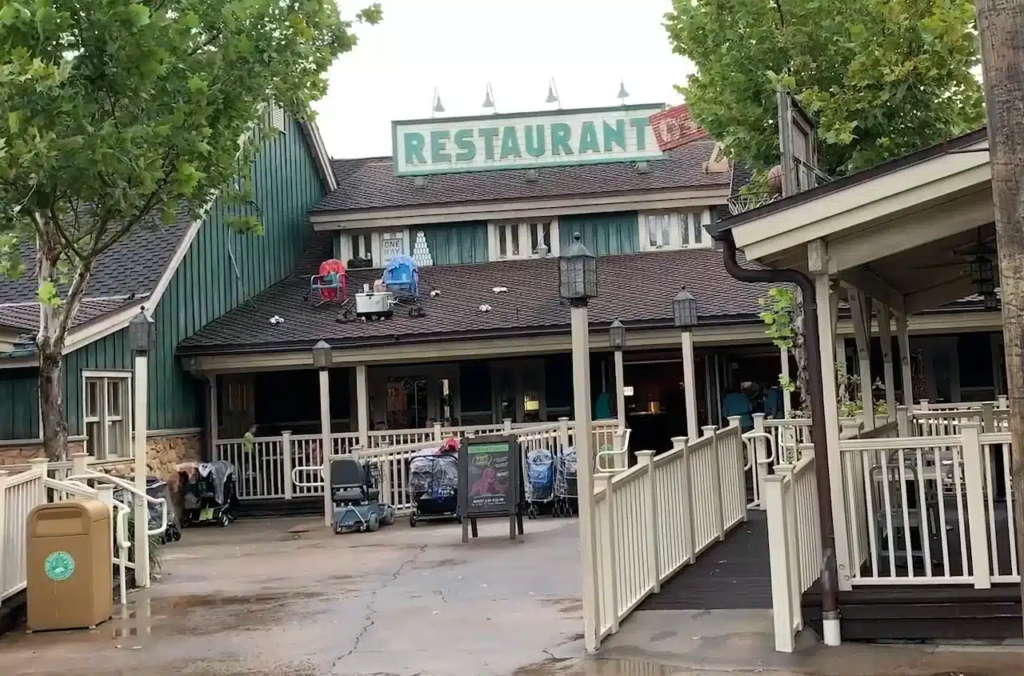
Restaurantosaurus
Restaurantosaurus served familiar McDonald’s products during the sponsorship period.
Its menu included items such as:
- McDonald’s French fries
- Chicken McNuggets
- Burgers
- Happy Meals
- Other familiar fast-food items
The restaurant itself remained fully themed to DinoLand’s fictional paleontology students and scientists, creating the somewhat surreal combination of detailed Disney Imagineering and familiar McDonald’s food.
Petrifries
Nearby was one of the greatest restaurant names produced by the partnership: Petrifries.
The small DinoLand kiosk specialized primarily in McDonald’s French fries.
The pun worked perfectly with the archaeological theme—although anyone ordering knew exactly what was inside the familiar fry container.
Petrifries later became Trilo-Bites after McDonald’s sponsorship ended.
Trilo-Bites itself permanently closed in 2025 during the transformation of DinoLand U.S.A. into Tropical Americas.
McDonald’s Fries Spread Across Walt Disney World
Animal Kingdom was only one part of the story.
During the height of the partnership, guests could find McDonald’s products throughout Walt Disney World.
Magic Kingdom – Frontierland Fries
One of the best-remembered locations was the McDonald’s fry stand in Frontierland near Splash Mountain and Pecos Bill Tall Tale Inn and Cafe.
Often referred to as Frontierland Fries or the Frontierland Fry Cart, the location essentially did one thing extremely well: sell McDonald’s French fries to theme park guests.
After the McDonald’s era ended, the location eventually reopened as Golden Oak Outpost.
Magic Kingdom – Village Fry Shoppe
Fantasyland eventually received its own McDonald’s location.
The Village Fry Shoppe opened on May 1, 2006 and served McDonald’s fries along with several other quick-service items.
It survived only a few years under that identity.
After the partnership ended, the location became The Friar’s Nook.
EPCOT – Refreshment Port
Refreshment Port, located near Canada at the entrance to World Showcase, became EPCOT’s primary McDonald’s location.
It went considerably beyond fries.
At various points guests could purchase McDonald’s French fries, Chicken McNuggets, McFlurry desserts, and beverages.
The name Refreshment Port survived long after McDonald’s disappeared, although its menu evolved completely.
Disney-MGM Studios – Fairfax Fries
On Sunset Boulevard, Fairfax Fries provided the McDonald’s fix at what is now Disney’s Hollywood Studios.
The small location at Sunset Ranch Market served McDonald’s fries and drinks while guests moved between Tower of Terror, Rock ‘n’ Roller Coaster, and the rest of the park.
As with the other fry stands, the McDonald’s identity ultimately disappeared when the corporate partnership wound down.
McDonald’s at Walt Disney World During the Partnership
| Location | Area | McDonald’s Connection | What Happened? |
|---|---|---|---|
| Frontierland Fries | Magic Kingdom | McDonald’s fries and beverages | Eventually became Golden Oak Outpost |
| Village Fry Shoppe | Magic Kingdom | McDonald’s fries and Quick-Service food | Closed in 2009; became The Friar’s Nook |
| Refreshment Port | EPCOT | Fries, Chicken McNuggets, McFlurrys and drinks | McDonald’s food removed; Refreshment Port continued with a Disney menu |
| Fairfax Fries | Disney-MGM Studios | McDonald’s fries and drinks | McDonald’s menu removed during the 2008–2009 phaseout |
| Restaurantosaurus | Disney’s Animal Kingdom | McDonald’s burgers, fries, Chicken McNuggets and Happy Meals | McDonald’s sponsorship ended in 2008 |
| Petrifries | Disney’s Animal Kingdom | McDonald’s fries | Became Trilo-Bites in 2008 |
| Downtown Disney McDonald’s | Downtown Disney Marketplace | Full McDonald’s restaurant | Closed April 30, 2010 |
| Buena Vista Drive McDonald’s | Near Disney’s All-Star Resorts | Full McDonald’s restaurant | Still operating in 2026; rebuilt in 2020 |
The McDonald’s Relationship Extended Beyond Walt Disney World
Disneyland received McDonald’s fry locations as well.
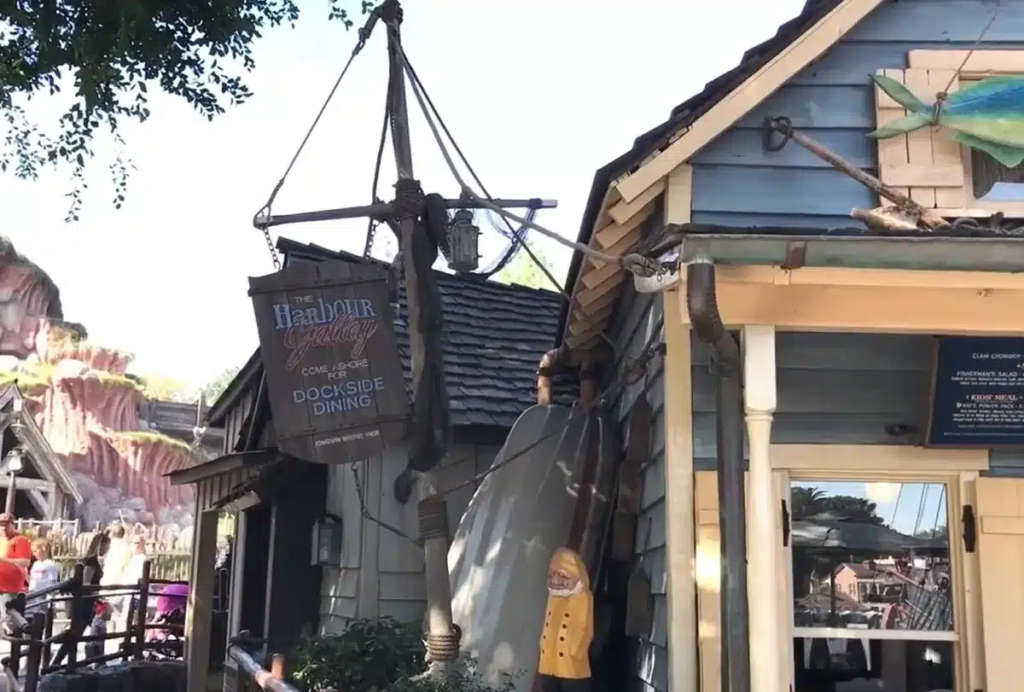
Harbour Galley at Disneyland was sponsored by McDonald’s from 2001 through 2008 and served McDonald’s-branded fries and beverages during that period.
Disney California Adventure went even further when it opened in 2001 with Burger Invasion, a McDonald’s restaurant in the original Paradise Pier.
Disneyland Paris also received a full McDonald’s restaurant at Disney Village.
For several years, the Golden Arches were therefore a surprisingly visible part of Disney’s global theme park portfolio.
Happy Meals During the 10-Year Alliance
While the theme park presence was memorable, Happy Meals remained the engine behind the partnership.
The 1996 agreement gave McDonald’s enormous access to Disney’s entertainment pipeline.
Promotions could support animated films, live-action releases, home video, Disney television properties, and the theme parks themselves.
A particularly ambitious example came in 1998, when McDonald’s used Disney’s Mulan for its first global children’s meal promotion.
Eight Mulan toys were offered across approximately 110 countries.
Other major Disney-era Happy Meal promotions included characters and properties connected with films such as:
- 101 Dalmatians
- Hercules
- Mulan
- Tarzan
- Toy Story 2
- Dinosaur
- Monsters, Inc.
- Lilo & Stitch
- Finding Nemo
- The Incredibles
- Cars
For children growing up during this period, a new Disney movie and a McDonald’s promotion often felt like two parts of the same event.
Disney’s Animal Kingdom Even Got Its Own Happy Meal
McDonald’s sponsorship of Animal Kingdom extended beyond the park itself.
When the new park opened in 1998, McDonald’s launched an Animal Kingdom promotion featuring a collection of animal and dinosaur toys.
The promotion reinforced something the 1996 agreement was designed to accomplish: McDonald’s restaurants around the country could effectively become enormous advertising outlets for Disney’s newest theme park.
Someone thousands of miles from Orlando could encounter the Animal Kingdom brand while ordering lunch.
2006: Why Did the Disney-McDonald’s Alliance End?
The original 10-year exclusive agreement was scheduled to expire at the end of 2006.
Disney and McDonald’s chose not to renew it in the same form.
The old version of this article attributed the decision entirely to concerns about childhood nutrition.
The actual situation was more complicated.
Both companies publicly described the decision as mutual and indicated that they intended to maintain a more flexible, non-exclusive relationship.
There were practical business reasons for doing so.
An exclusive decade-long agreement limited both companies’ ability to work with other partners. Disney’s movie slate also required McDonald’s to commit to promotions far in advance, while McDonald’s franchisees did not necessarily benefit equally from every Disney release.
At the same time, nutrition was undeniably becoming more important to Disney.
Contemporary reports said Disney executives were increasingly uncomfortable with connecting children’s characters too closely with fast food amid growing concern about childhood obesity.
Later in 2006, Disney formally introduced new nutrition standards governing the use of Disney characters and brands in foods marketed to children.
The new guidelines established limits involving calories, saturated fat, sugar, and other nutritional factors.
Disney also changed children’s meals in its own theme parks, making healthier sides and beverages the default options.
So the 2006 change was not simply “Disney dumped McDonald’s because fast food was unhealthy.”
It was the intersection of an expiring exclusive contract, changing marketing strategies, economics, and Disney’s increasingly formal approach to children’s nutrition.
McDonald’s Did Not Immediately Disappear From Walt Disney World
Another important distinction: the expiration of the global marketing agreement in 2006 did not immediately remove McDonald’s food from Disney World.
The theme park sponsorship and restaurant arrangements had their own timelines.
Restaurantosaurus remained sponsored by McDonald’s until 2008.
DinoLand sponsorship references began disappearing that year.
Petrifries became Trilo-Bites.
Other McDonald’s-branded fry locations throughout Walt Disney World were phased out through 2008 and 2009.
By the end of that transition, guests could no longer walk through Magic Kingdom, EPCOT, Hollywood Studios, or Animal Kingdom and order genuine McDonald’s French fries.
2010: McDonald’s Leaves Downtown Disney
The full McDonald’s restaurant at Downtown Disney survived longer.
It finally closed permanently on April 30, 2010.
The restaurant was replaced by Pollo Campero and Fresh A-Peel.
That replacement eventually disappeared as well during the massive redevelopment of Downtown Disney into Disney Springs.
With the Marketplace restaurant gone, only one full McDonald’s remained on Walt Disney World property.
The McDonald’s Near the All-Star Resorts
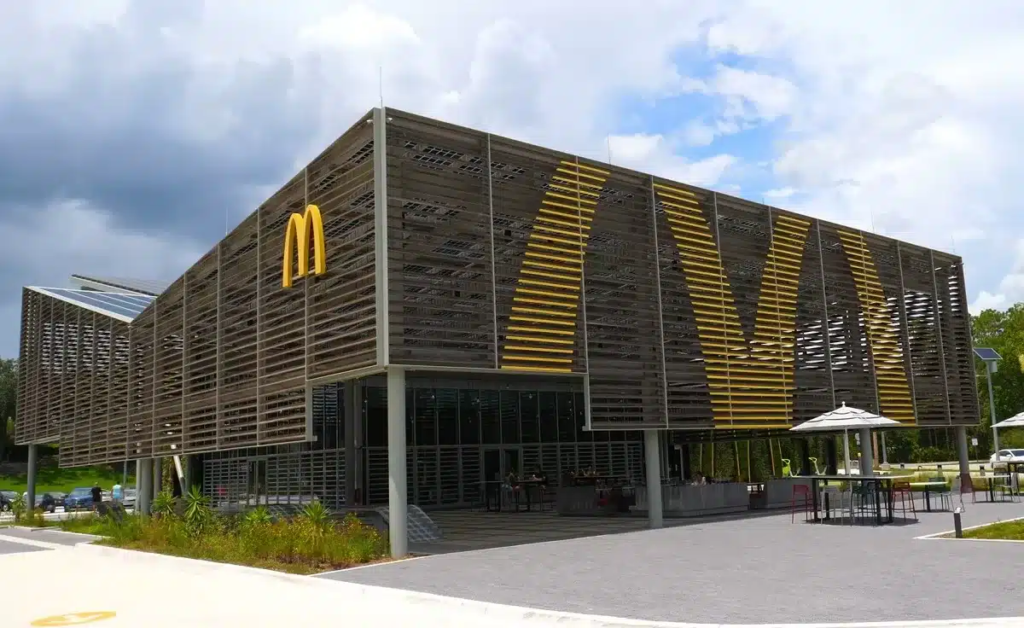
That surviving restaurant sits at 1596 West Buena Vista Drive, near Disney’s All-Star Resorts and not far from Blizzard Beach.
It is not a Disney-operated restaurant and does not represent a return of McDonald’s food to the theme parks.
It is simply a full McDonald’s restaurant located on Walt Disney World property.
And in 2020, it became one of the most unusual McDonald’s locations anywhere.
The Net-Zero-Energy-Designed McDonald’s at Walt Disney World
McDonald’s completely rebuilt the Buena Vista Drive location and unveiled the new restaurant in July 2020.
The company described it as its first-of-its-kind net-zero-energy-designed global flagship restaurant.
That wording is important.
Rather than simply claiming the building automatically achieved zero energy use, McDonald’s designed it with the goal of generating enough renewable energy on-site over a year to cover 100 percent of its annual energy needs and said it would pursue formal Zero Energy certification.
The roughly futuristic building became a laboratory for McDonald’s sustainability initiatives.
Its design incorporates extensive renewable-energy technology, including a large photovoltaic canopy and additional solar installations.
McDonald’s said lessons learned from the restaurant would help inform sustainability improvements at other locations around the world.
As of August 2026, the Buena Vista Drive restaurant remains open and is generally listed as operating 24 hours.
2018: Disney Returns to the Happy Meal
The absence of Disney characters from McDonald’s Happy Meals lasted more than a decade.
Then, on February 27, 2018, Disney and McDonald’s officially announced a new promotional alliance.
This agreement was fundamentally different from the giant 1996 contract.
It was:
- Multi-year
- U.S.-focused
- Non-exclusive
- Built specifically around qualifying Happy Meal promotions
The reunion was possible in large part because McDonald’s had changed the nutritional profile of its Happy Meals enough for them to comply with Disney’s standards.
The new era began with Incredibles 2 in June 2018.
Ralph Breaks the Internet followed later that year.
Unlike the 1990s agreement, the 2018 announcement specifically did not include a deal to put McDonald’s restaurants back inside Disney’s parks.
Disney Happy Meals Return in Force
The renewed relationship produced a new generation of Disney collectibles.
Examples have included:
- Incredibles 2
- Ralph Breaks the Internet
- Toy Story 4
- Frozen II
- Walt Disney World’s 50th Anniversary
- The Little Mermaid
- Disney100-related characters and promotions
- Pixar’s Elio
- Disneyland’s 70th Anniversary
The Walt Disney World 50th Anniversary Collection
One of the most ambitious modern promotions arrived in 2021.
To celebrate Walt Disney World’s 50th anniversary, McDonald’s released an enormous collection of 50 Disney character figures.
The collection included Mickey, Minnie, Donald, Daisy, Goofy, Pluto, Stitch, Figment-era favorites, Pixar characters, Star Wars characters, and many others spanning Disney history.
The toys stood on bases inspired by Walt Disney World’s four theme parks.
For collectors, the promotion felt like a deliberate throwback to the peak McDisney era.
The Little Mermaid Returns in 2023
The 2023 live-action The Little Mermaid received its own nationwide Happy Meal campaign, featuring characters including Ariel, Eric, Sebastian, and Flounder.
It was particularly appropriate given that the animated Little Mermaid had been part of the Disney-McDonald’s promotional history decades earlier.
Recent Promotions
The relationship has continued into the mid-2020s through periodic promotions rather than the nonstop exclusivity of the late 1990s.
Pixar’s Elio received a McDonald’s Happy Meal toy collection in 2025.
Later that year, McDonald’s celebrated Disneyland’s 70th anniversary with a massive promotion featuring 70 collectible figures drawn from Disney, Pixar, Marvel, and Star Wars.
The collection ran into January 2026, proving that nearly three decades after the original “McDisney” mega-deal, Disney characters in Happy Meals still carry considerable nostalgic power.
So Is McDonald’s Still at Walt Disney World in 2026?
Yes—but not inside the theme parks.
There are no McDonald’s-branded food locations currently operating inside Magic Kingdom, EPCOT, Disney’s Hollywood Studios, or Disney’s Animal Kingdom.
The surviving full McDonald’s at 1596 West Buena Vista Drive near Disney’s All-Star Resorts remains the primary Golden Arches location on Walt Disney World property.
That distinction makes today’s relationship very different from the late 1990s and early 2000s.
You can still eat a Big Mac at Walt Disney World.
You just cannot buy one in Frontierland.
Why the Disney-McDonald’s Partnership Was So Powerful
From a marketing perspective, the pairing made enormous sense.
Both companies built their businesses around recognizable family experiences.
Disney could expose a new movie or theme park to millions of McDonald’s customers without waiting for them to visit a theater or Disney property.
McDonald’s received toys and promotions connected with some of the world’s most valuable entertainment franchises.
And the Happy Meal created something television advertising could not:
It put the Disney character directly into a child’s hands.
For many people who grew up during the 1980s, 1990s, and early 2000s, those plastic toys became genuine Disney collectibles.
Some remain in collections decades later.
Why the Theme Park Fries Are Still Remembered
The actual food partnership occupies an unusual place in Walt Disney World nostalgia.
McDonald’s French fries were hardly rare outside the resort.
That was part of what made them strange inside Disney World.
Amid elaborately themed restaurants, futuristic architecture, fantasy castles, dinosaur dig sites, and carefully constructed lands, guests could suddenly encounter exactly the same fries they bought at home.
Some guests thought it broke the illusion.
Others loved having an inexpensive, predictable snack that even the pickiest child would recognize.
Either way, anyone who visited Walt Disney World frequently during that period probably remembers the smell.
Disney and McDonald’s FAQ
When did Disney and McDonald’s first partner?
Disney-branded McDonald’s promotions are documented by 1987, including a Snow White promotion, and McDonald’s offered Oliver & Company Happy Meal toys in 1988. The companies later entered a much larger 10-year global promotional alliance in 1996 that took effect in January 1997.
Was The Great Mouse Detective the first Disney McDonald’s Happy Meal?
No. The Great Mouse Detective was released in 1986, and the claim that a 1987 release promotion began the Disney-McDonald’s relationship is not supported by the historical record. Disney-branded McDonald’s promotions are documented in 1987, including Snow White, with Oliver & Company Happy Meal toys following in 1988.
Did McDonald’s really serve food inside Walt Disney World theme parks?
Yes. During the partnership era, guests could buy McDonald’s French fries and other products at locations including Frontierland Fries, Village Fry Shoppe, Refreshment Port, Fairfax Fries, Petrifries and Restaurantosaurus. McDonald’s also sponsored DinoLand U.S.A. at Disney’s Animal Kingdom.
Why did Disney and McDonald’s end their exclusive partnership?
The 10-year exclusive promotional agreement expired in 2006. The companies publicly described the decision as mutual and moved toward a more flexible, non-exclusive relationship. Contemporary reporting also cited Disney’s growing focus on children’s nutrition as one factor, and Disney introduced formal nutrition guidelines later in 2006.
Is there still a McDonald’s at Walt Disney World?
Yes. A full McDonald’s remains on Buena Vista Drive near Disney’s All-Star Resorts. The restaurant was rebuilt in 2020 as McDonald’s net-zero-energy-designed global flagship. McDonald’s food is no longer served inside the four Walt Disney World theme parks.
Do Disney and McDonald’s still work together?
Yes. Disney and McDonald’s resumed a multi-year, non-exclusive U.S. Happy Meal promotional relationship in 2018, and Disney-themed promotions have continued periodically since then, including campaigns tied to Walt Disney World’s 50th anniversary, The Little Mermaid, Pixar’s Elio and Disneyland’s 70th anniversary.
From Happy Meals to DinoLand—and Back Again
The history of Disney and McDonald’s is more complicated than a collection of plastic toys.
The companies began working together intermittently during the 1980s, fell out around the beginning of the 1990s, then reunited in 1996 for one of the most ambitious cross-promotional deals in entertainment history.
For the next decade, McDonald’s became unusually integrated into Disney.
Its food appeared inside the theme parks. Its logo appeared around DinoLand. Its restaurants opened on Disney property. And its Happy Meal boxes became miniature billboards for an extraordinary succession of Disney movies.
The exclusive relationship ended as both companies changed and Disney adopted stricter nutritional standards.
Yet neither company ever completely closed the door.
By 2018, Disney characters were back inside Happy Meals under a new model that better reflected both companies’ modern priorities.
And in 2026, the relationship has almost come full circle.
There are no Golden Arches inside Disney’s theme parks anymore, but Disney characters continue to periodically appear inside Happy Meals—and one of McDonald’s most technologically ambitious restaurants still sits on Walt Disney World property.
For anyone who remembers ordering McDonald’s fries next to Splash Mountain or collecting an entire Disney movie cast one Happy Meal at a time, the McDisney era remains a surprisingly memorable chapter of Disney history.