
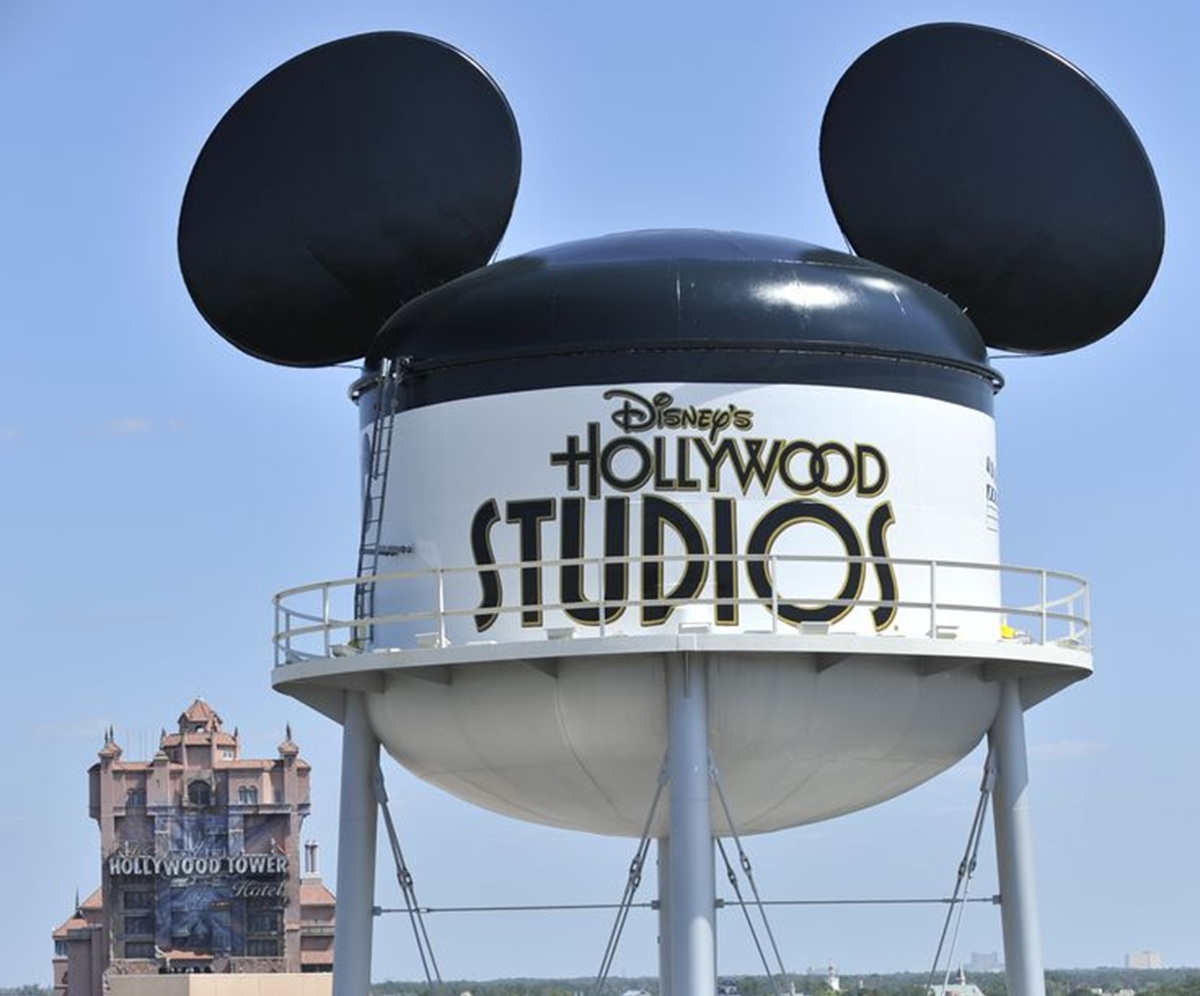
For more than a quarter century, a 130-foot water tower topped with an enormous pair of Mickey Mouse ears rose above the backlot of Disney-MGM Studios.
It was called the Earffel Tower, and although it never carried a single gallon of water, few structures better represented what Walt Disney World’s third theme park was originally supposed to be.
When Disney-MGM Studios opened on May 1, 1989, the park was not simply a place where guests could experience attractions inspired by movies. Disney presented it as both a theme park and a working production facility—a place where movies, television programs, and animated films could actually be made while guests watched the process unfold.
A giant studio water tower was therefore far more than decorative scenery. It was visual shorthand for a Hollywood backlot.
The Earffel Tower became one of the defining images of the original park, appearing on maps, postcards, merchandise, advertisements, and promotional materials for years. Its Mickey ears transformed a piece of utilitarian studio architecture into something unmistakably Disney.
Then, on the night of April 28 into April 29, 2016, the tower disappeared.
Its removal was originally reported here as breaking news. A decade later, it makes more sense to look back at what the Earffel Tower actually represented, why Disney chose a water tower as the symbol of its movie studio park, how the tower changed over the years, and why its demolition became one of the clearest dividing lines between the old Disney-MGM Studios and the Disney’s Hollywood Studios we know today.
Earffel Tower Fast Facts
- Opened: May 1, 1989
- Removed: April 29, 2016
- Location: Backstage production area of Disney-MGM Studios, later Disney’s Hollywood Studios
- Height: Approximately 130 feet
- Mickey ears: Approximately 10,000 pounds combined
- Purpose: Decorative studio landmark; it never actually contained water
- Original role: One of Disney-MGM Studios’ primary identifying icons
- Removed for: Redevelopment of the former studio backlot for Toy Story Land
- Current site: The area is now occupied by Toy Story Land, with Slinky Dog Dash extending through the former Earffel Tower site
Why Did Movie Studios Have Water Towers?
To understand the Earffel Tower, it helps to understand why water towers became such recognizable symbols of Hollywood in the first place.
During the early decades of the motion-picture industry, studios contained sprawling collections of soundstages, workshops, storage buildings, wooden exterior sets, and other structures vulnerable to fire. Early film stock itself could also be highly flammable.
Large elevated water tanks therefore provided an emergency water supply for studio firefighting systems.
Water towers became common sights on major studio lots and eventually became visual landmarks in their own right. Warner Bros., Paramount, Disney, and other studios became closely associated with the towers rising above their backlots.
Even after modern municipal water and fire-suppression systems made many of the original tanks unnecessary, the towers remained powerful symbols of the filmmaking business.
Put a water tower behind a group of soundstages and the setting immediately reads as a Hollywood studio.
The Real Disney Studio Water Tower
The Earffel Tower also had a direct Disney precedent.
When Walt Disney built his new studio campus in Burbank, California, a genuine water tower was constructed as part of the complex in 1939. Unlike the Florida Earffel Tower, the Burbank version originally served a practical purpose and held water for the studio.
Over time, the Burbank tower became one of the most recognizable landmarks on the Walt Disney Studios lot.
By the 1980s, Mickey Mouse imagery had been added to the tank, further strengthening its connection to the company.
When Walt Disney Imagineering began designing a movie studio theme park for Florida, a whimsical Disney version of the classic studio tower was therefore a natural choice.
The Earffel Tower Arrives at Disney-MGM Studios
Disney-MGM Studios opened on May 1, 1989.
The original park was very different from today’s Disney’s Hollywood Studios.
Hollywood Boulevard led guests toward a reproduction of Grauman’s Chinese Theatre containing The Great Movie Ride, but much of the park’s identity revolved around taking visitors behind the scenes.
The park included an extensive Backstage Studio Tour, working soundstages, production facilities, special-effects demonstrations, outdoor movie sets, costume and prop departments, and a functioning Disney animation studio.
Guests could watch animators at work through observation windows while actual Disney productions were underway. Television programs and films were produced in the Florida facilities, and Disney’s Florida animation studio eventually contributed extensively to major animated films before producing much of Mulan, Lilo & Stitch, and Brother Bear.
Against that backdrop, the Earffel Tower made perfect thematic sense.
It stood in the studio backlot rather than at the front entrance, creating the impression that guests had entered an authentic production facility.
What Did the Earffel Tower Look Like?
The Earffel Tower stood approximately 130 feet tall, supported by four long steel legs with a circular tank high above the backlot.
Its defining feature was impossible to miss: two enormous black Mickey Mouse ears mounted above the tank.
The pair weighed approximately 10,000 pounds.
The name itself was classic Disney wordplay—a combination of “ear” and “Eiffel Tower.”
Unlike the water towers it imitated, however, the Earffel Tower was completely theatrical. It never actually held water.
Its job was storytelling.
The Original Symbol of Disney-MGM Studios
Disney theme parks are closely associated with visual icons.
Magic Kingdom has Cinderella Castle. EPCOT has Spaceship Earth. Disney’s Animal Kingdom has the Tree of Life.
Disney-MGM Studios was a little more complicated.
The Chinese Theatre at the end of Hollywood Boulevard functioned as the park’s visual centerpiece and housed its signature attraction, The Great Movie Ride.
But the Earffel Tower became the park’s broader identifying symbol, especially in maps, merchandise, advertising, and promotional artwork.
The choice reinforced what separated Disney-MGM Studios from the other Walt Disney World parks. This was the studio park—the place where guests went backstage and learned how entertainment was created.
The water tower did not represent a fictional movie.
It represented the movie business itself.
The Earffel Tower Frequently Changed Costumes
Disney also treated the tower almost like an enormous character.
Its appearance was occasionally modified to celebrate holidays, movies, and new attractions.
Christmas at the Earffel Tower
During the park’s early years, the tower received an enormous Santa Claus hat for Christmas.
The hat reportedly measured approximately 28-and-a-half feet in diameter, large enough to fit around Mickey’s enormous ears.
101 Dalmatians
In 1996, the tower received black spots to promote Disney’s live-action 101 Dalmatians.
The temporary transformation made the giant water tank resemble one of the film’s spotted dogs and tied into the movie’s presence elsewhere in the studio park.
Fantasmic!
When Fantasmic! debuted at Disney-MGM Studios in 1998, the tower received another unusual makeover inspired by Sorcerer Mickey.
These temporary overlays made the Earffel Tower something more than a static skyline feature. For longtime guests, spotting whatever Disney had done to the tower became part of revisiting the park.
The Sorcerer’s Hat Takes Over
The Earffel Tower’s status began to change dramatically in 2001.
That year, Disney installed the enormous Sorcerer’s Hat directly in front of the Chinese Theatre as part of Walt Disney World’s 100 Years of Magic celebration honoring the 100th anniversary of Walt Disney’s birth.
The 122-foot structure was inspired by Mickey Mouse’s magical hat from “The Sorcerer’s Apprentice” sequence of Fantasia.
Unlike many temporary anniversary decorations, the hat stayed.
Beginning with its arrival in 2001, Disney increasingly used the Sorcerer’s Hat as the identifying image for Disney-MGM Studios, displacing the Earffel Tower from the icon role it had occupied since opening day.
The tower remained standing on the backlot, but it was no longer the public face of the park.
Disney-MGM Studios Stops Being a Working Studio
The bigger change was happening around the tower.
The production-studio concept that had defined Disney-MGM Studios in 1989 gradually faded away.
Disney closed its Florida feature-animation operation in 2004. Working production facilities became less important to the guest experience. Parts of the Backstage Studio Tour were removed or repurposed, and areas that had once demonstrated real filmmaking increasingly became conventional theme-park attractions.
On January 7, 2008, Disney-MGM Studios officially became Disney’s Hollywood Studios.
The Earffel Tower survived the name change and received updated Hollywood Studios branding.
But the world the tower had been designed to represent was slowly disappearing around it.
The Backlot Disappears
The most important moment came in 2014, when Disney permanently closed the Studio Backlot Tour.
The attraction had once been one of the defining experiences of Disney-MGM Studios, taking guests through production areas, outdoor sets, Catastrophe Canyon, prop storage, and other behind-the-scenes environments.
By the time it closed, however, it had already been drastically reduced from its original form.
The closure freed an enormous amount of land in the back of Hollywood Studios for redevelopment.
A year later, Disney announced two massive immersive lands that would fundamentally redefine the park: Toy Story Land and what would eventually become Star Wars: Galaxy’s Edge.
The Sorcerer’s Hat Comes Down
Interestingly, the Earffel Tower briefly outlived the structure that had replaced it as the park’s icon.
Disney began dismantling the Sorcerer’s Hat in January 2015, restoring the unobstructed view of the Chinese Theatre from Hollywood Boulevard.
For longtime Disney-MGM Studios fans, the change seemed to suggest that parts of the park’s older visual identity might be returning.
The Earffel Tower, however, had less than a year and a half left.
Disney Announces the Earffel Tower Will Be Removed
In January 2016, Disney confirmed that the Earffel Tower would be removed as part of the sweeping redevelopment of Hollywood Studios.
By then, much of the old backlot was preparing to close.
The final Osborne Family Spectacle of Dancing Lights season had ended. The Streets of America, Lights, Motors, Action! Extreme Stunt Show, Honey, I Shrunk the Kids Movie Set Adventure, and other locations permanently closed in early April.
The old studio park was being dismantled piece by piece.
April 29, 2016: The Earffel Tower Comes Down
The end came quietly.
During the overnight hours of April 28 into April 29, 2016, crews dismantled the Earffel Tower.
Guests who had seen it rising above the park one day returned to find it gone.
Disney confirmed that the 130-foot structure had been removed to make room for Toy Story Land and said at the time that there were no plans to relocate it elsewhere at Walt Disney World.
Earffel Tower: 1989–2016
What Replaced the Earffel Tower?
The land where the Earffel Tower once stood became part of Toy Story Land.
The new 11-acre land opened on June 30, 2018, with Slinky Dog Dash, Alien Swirling Saucers, a redesigned entrance to Toy Story Mania, and an elaborate premise in which guests have been reduced to toy size inside Andy’s backyard.
Slinky Dog Dash now occupies the portion of the former backlot where the Earffel Tower once stood.
That replacement is surprisingly symbolic.
The Earffel Tower belonged to a park where guests were supposed to stand outside the movies and learn how filmmakers created them.
Toy Story Land represents the philosophy that replaced it: guests now step inside the story itself.
From Making Movies to Living Inside Them
The removal of the Earffel Tower was therefore about much more than clearing space for a roller coaster.
It represented one of the biggest philosophical transformations of any Disney theme park.
The original Disney-MGM Studios was built around the idea of revealing the illusion.
The Backstage Studio Tour showed how effects were created. The Animation Tour let guests watch artists work. Soundstage attractions demonstrated production techniques. The Great Movie Ride moved through recreations of famous movies while Hollywood Boulevard celebrated the mythology of filmmaking.
The modern Disney’s Hollywood Studios increasingly does the opposite.
Toy Story Land does not show you how Pixar created Toy Story; it shrinks you to the size of a toy.
Star Wars: Galaxy’s Edge does not demonstrate how Lucasfilm built the Millennium Falcon; it places you on the planet Batuu and lets you pilot the ship yourself.
The transition traded the language of soundstages, backlots, sets, props, and production facilities for immersive fictional worlds.
Few structures represented the old philosophy as perfectly as the Earffel Tower.
Does Anything Remain of the Earffel Tower at Hollywood Studios?
The actual Florida tower is gone, but small visual references to it can still be found around Disney’s Hollywood Studios.
As of 2026, depictions of the old tower remain in several pieces of park artwork and signage, including:
- A decorative Hollywood Studios plaque above the Keystone Clothiers façade on Hollywood Boulevard
- Park imagery incorporated into directional signage near the Theater of the Stars area on Sunset Boulevard
- A Hollywood Studios mural inside ABC Commissary
They are modest remnants of something that once dominated the park’s skyline, but they preserve the Mickey-eared silhouette for guests who know what they are looking for.
The Earffel Tower Still Exists at Disneyland Paris
There is also one especially significant survivor.
A second Earffel Tower was constructed for the opening of Walt Disney Studios Park at Disneyland Paris in 2002.
That tower remains standing in 2026 even as the French park has undergone its own enormous transformation into Disney Adventure World.
In fact, the tower played a visible role in the park’s 2026 relaunch: during the opening celebration for Disney Adventure World, Spider-Man appeared atop the Earffel Tower as the park’s new name was revealed.
So while Walt Disney World’s version disappeared a decade ago, the idea itself has not vanished from Disney’s parks.
Why the Earffel Tower Mattered
It is easy to dismiss the Earffel Tower as little more than a large piece of decorative scenery.
It contained no attraction. Guests could not climb it. It did not hold water. There was no elaborate queue, ride system, or show inside.
But theme-park icons do not necessarily need to do anything.
The Earffel Tower told guests where they were.
Cinderella Castle says fairy tale.
Spaceship Earth says technology and human progress.
The Tree of Life says nature.
The Earffel Tower said movie studio.
The Mickey ears then added the second half of the message: this was not just Hollywood. This was Hollywood seen through Disney’s imagination.
That made it an unusually effective symbol for the park Disney created in 1989.
An Icon for a Disney Park That No Longer Exists
The strangest thing about remembering the Earffel Tower in 2026 is that almost everything surrounding it has changed.
Disney-MGM Studios is gone as a name.
The Backstage Studio Tour is gone.
The Streets of America are gone.
The working animation studio is gone.
The Great Movie Ride is gone.
The Sorcerer’s Hat is gone.
The Earffel Tower is gone.
In their place are Toy Story Land, Star Wars: Galaxy’s Edge, Mickey & Minnie’s Runaway Railway, expanded Pixar experiences, and other attractions designed around entering the worlds of Disney entertainment rather than observing how those worlds are manufactured.
Disney’s Hollywood Studios remains a park about movies and entertainment, but its definition of that idea has changed almost completely.
That may be why the Earffel Tower inspires so much nostalgia among longtime Walt Disney World visitors. It was not simply an old park icon.
It was the icon of an entirely different version of the park.
Earffel Tower Timeline
- 1939: The genuine Walt Disney Studios water tower is constructed on Disney’s new Burbank studio lot.
- May 1, 1989: Disney-MGM Studios opens at Walt Disney World with the 130-foot Earffel Tower rising above its studio backlot.
- December 1989: The tower receives an enormous Santa hat for the holiday season.
- 1996: Disney decorates the tank with Dalmatian spots for the release of the live-action 101 Dalmatians.
- 1998: The tower receives a Sorcerer Mickey-inspired treatment for the arrival of Fantasmic!.
- 2001: The Sorcerer’s Hat becomes the park’s primary marketing icon.
- 2002: A second Earffel Tower opens with Walt Disney Studios Park at Disneyland Paris.
- 2004: Disney closes its Florida feature-animation operation.
- January 7, 2008: Disney-MGM Studios becomes Disney’s Hollywood Studios.
- September 2014: The Studio Backlot Tour permanently closes.
- 2015: Disney removes the Sorcerer’s Hat.
- January 2016: Disney announces that the Earffel Tower will be removed for the park’s redevelopment.
- April 2, 2016: The Streets of America and several surrounding attractions permanently close.
- April 29, 2016: The Earffel Tower is removed overnight.
- June 30, 2018: Toy Story Land opens across the former studio-backlot area.
- August 29, 2019: Star Wars: Galaxy’s Edge opens, further cementing Hollywood Studios’ transition toward immersive fictional worlds.
- 2026: The surviving Earffel Tower at Disneyland Paris remains part of the newly renamed Disney Adventure World.
Earffel Tower FAQ
What was the Earffel Tower?
The Earffel Tower was a 130-foot faux studio water tower topped with giant Mickey Mouse ears. It opened with Disney-MGM Studios on May 1, 1989 and became one of the park’s primary symbols.
Did the Earffel Tower actually hold water?
No. The Earffel Tower was designed to resemble the functional water towers historically found on Hollywood studio lots, but the Walt Disney World tower was decorative and never contained water.
Why was it called the Earffel Tower?
The name was a Disney pun combining Mickey’s famous ears with the Eiffel Tower.
How tall was the Earffel Tower?
The Walt Disney World Earffel Tower stood approximately 130 feet tall.
Why did Disney remove the Earffel Tower?
The structure stood within the former production backlot that Disney was redeveloping for Toy Story Land. It was removed overnight on April 28–29, 2016.
What replaced the Earffel Tower?
The former Earffel Tower site became part of Toy Story Land. Slinky Dog Dash now occupies the area where the tower once stood.
Was the Earffel Tower the original icon of Disney’s Hollywood Studios?
Yes. The Earffel Tower served as one of the defining identifying icons of Disney-MGM Studios from its 1989 opening, while the Chinese Theatre served as the park’s central visual centerpiece. Beginning in 2001, Disney increasingly used the Sorcerer’s Hat as the park’s primary marketing icon.
Is there still an Earffel Tower somewhere?
Yes. A second Earffel Tower opened at Disneyland Paris in 2002 and remains part of Disney Adventure World in 2026.
Remembering the Earffel Tower
When the Earffel Tower came down in April 2016, its removal could easily have looked like just another demolition project inside a theme park undergoing construction.
With a decade of perspective, it feels more significant.
The tower had stood from the opening morning of Disney-MGM Studios through almost the entire lifespan of the park’s original studio concept. It watched the Backstage Studio Tour shrink and disappear, the Florida animation studio close, the MGM name vanish, the Sorcerer’s Hat rise and fall, and the Streets of America prepare for demolition.
By the time the Earffel Tower itself disappeared, the version of Hollywood Studios that had required a studio water tower was disappearing with it.
Toy Story Land now occupies the space, and Disney’s Hollywood Studios has moved firmly into a new era.
But for anyone who visited during the Disney-MGM Studios years, the silhouette remains instantly recognizable: four tall steel legs, a white studio water tank, and two gigantic black mouse ears rising over the Florida skyline.
