Pirates of the Caribbean is a classic boat attraction in Adventureland at Magic Kingdom that sends guests into a sprawling 17th-century Caribbean port overtaken by a band of rowdy buccaneers. Opening on December 15, 1973, a little more than two years after Magic Kingdom itself, the attraction combines elaborate physical sets, Audio-Animatronics figures, theatrical lighting, water effects, music, dark humor, and one memorable drop into an approximately eight-minute voyage through a pirate attack, a plundered town, a burning seaport, and the increasingly chaotic aftermath.
The Magic Kingdom attraction is especially interesting because it was not part of the park’s original 1971 lineup. Today, Pirates feels inseparable from Adventureland, but Walt Disney World actually opened without it.
That decision made a certain amount of sense during the park’s development. Disneyland’s Pirates of the Caribbean had opened in 1967, and Imagineers were already planning a massive Florida-exclusive boat attraction for Frontierland called the Western River Expedition. Designed largely by Marc Davis, Western River Expedition would have applied many of the same large-scale Audio-Animatronics storytelling techniques to the mythology of the American West.
Disney also believed that Florida visitors, geographically much closer to the actual Caribbean and its pirate history, might not find fictional pirates as exotic as California audiences did.
Guests disagreed.
Disney had spent years showing Disneyland attractions on television, and Pirates of the Caribbean had become one of the experiences viewers most wanted to see for themselves. Soon after Magic Kingdom opened, visitors were repeatedly asking at City Hall, “Where are the pirates?”
The reaction was strong enough that Disney changed course. Cast Members began wearing buttons announcing that “The Pirates Are Coming,” and Imagineers developed a Florida version on an accelerated schedule. The project contributed to the shelving of the much larger Western River Expedition, which was never built.
Pirates of the Caribbean opened at Magic Kingdom on December 15, 1973.
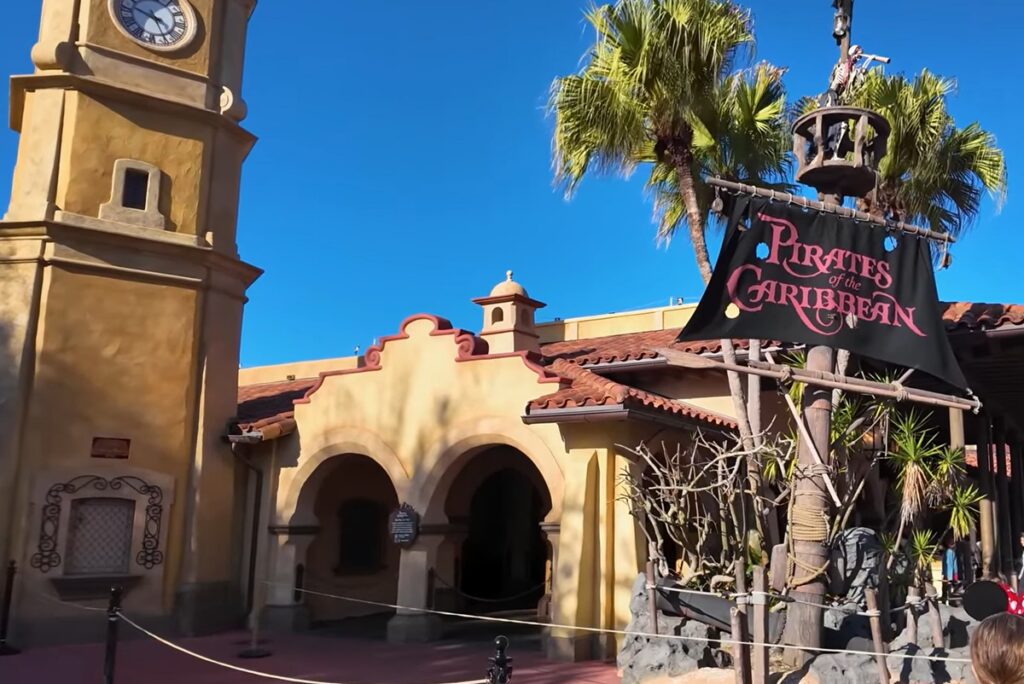
Because the attraction had not been part of the original Adventureland plan, Disney did more than simply construct a ride building. Imagineers extended the land westward and created an entire environment around it: Caribbean Plaza.
The architectural centerpiece is the enormous Spanish fortress housing the attraction. Commonly identified as Castillo del Morro, its design draws heavily from colonial Caribbean fortifications, particularly Castillo San Felipe del Morro in San Juan, Puerto Rico. Weathered stucco, heavy stone walls, arched passages, ironwork, wooden doors, battlements, cannons, and a prominent watchtower create the impression that the building has guarded the harbor for centuries.
That exterior establishes the attraction long before guests reach a boat.
Rather than entering through an obvious theme-park façade, visitors disappear into the cool corridors of a coastal fortress. Barrels, chains, weapons, dungeon spaces, military supplies, skeletons, and signs of pirate activity gradually replace the bright tropical atmosphere outside.
One of the best-known queue gags involves two skeletal prisoners sitting over a chessboard, apparently having continued their game until both players died. Marc Davis developed the scene specifically for the Florida attraction, giving the queue the same kind of visual humor that defines the ride itself.
The relatively elaborate queue is one of the Magic Kingdom version’s advantages over Disneyland’s original. Florida’s actual ride is considerably shorter, but its fortress approach provides an unusually strong transition from Adventureland into the story.
At the loading area, guests board broad, flat-bottomed boats and begin drifting into darkness.
The Florida version uses essentially the same fundamental ride technology that helped make the Disneyland attraction possible. Water currents carry the boats through the show building while underwater guidance and controlled channels keep them on their intended path.
Soon the cheerful Caribbean plaza has disappeared.
Skulls, caves, skeletons, distant voices, and the famous warning that “dead men tell no tales” establish a darker supernatural atmosphere. The boat then descends a roughly 14-foot drop, carrying guests into the main pirate attack.
Although Disney classifies Pirates of the Caribbean for any height, this drop gives the attraction considerably more physical movement than many traditional Disney dark rides. It is brief rather than intense, but first-time visitors may be surprised by its size in the darkness.
The story immediately expands in scale.
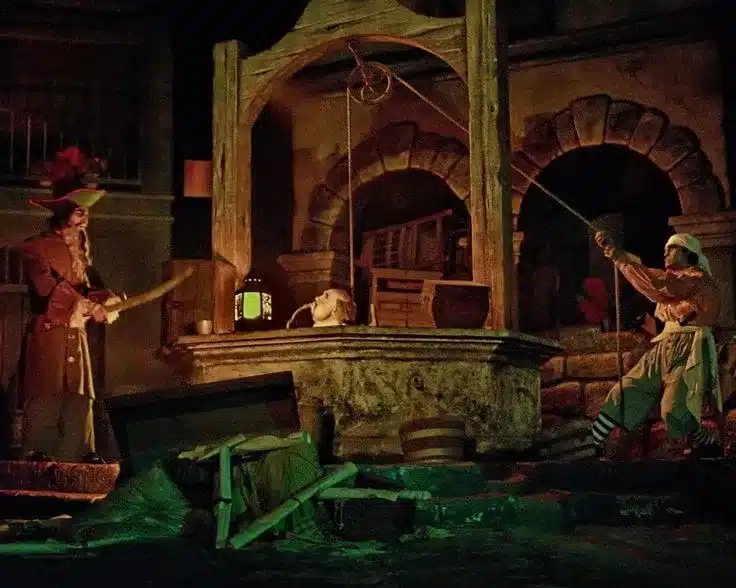
Guests emerge into the middle of a nighttime battle between a fortified Caribbean town and an enormous pirate galleon. Cannon blasts echo through the cavernous space while bursts of water simulate cannonballs landing dangerously close to the passing boats.
The pirate ship is commanded today by Captain Barbossa, while defenders fire back from the fortress.
This sequence remains one of the attraction’s greatest demonstrations of controlled perspective. The vessels and buildings are positioned so that a slow-moving theme-park boat suddenly feels as though it has drifted directly into a full naval engagement.
From the battle, guests enter the town itself.
The pirates have effectively won.
Buccaneers move through the streets searching for valuables and information while townspeople attempt to protect their possessions. One pirate repeatedly tries to discover the location of Captain Jack Sparrow, creating a storyline that was added decades after the original attraction opened.
Jack is hiding nearby, listening from inside a barrel while the other pirates search for him.
The next major scene is the famous auction, one of the attraction’s most extensively revised sequences.
Originally, a pirate auctioneer presented women from the captured town for sale while the surrounding pirates loudly demanded the red-haired woman who became popularly known simply as the Redhead. The scene was one of Marc Davis’ best-known visual compositions, but its subject inevitably became increasingly uncomfortable as social expectations changed.
Disney substantially revised the sequence in 2018.
The Redhead became Redd, now a pirate herself rather than a captive. Wearing a pirate hat and carrying a firearm, she participates in an auction of the townspeople’s stolen possessions, rum, livestock, and other goods. The famous cries demanding the Redhead disappeared, although Disney deliberately retained the character’s distinctive appearance and gave her a much more active role.
The change illustrates an important characteristic of Pirates of the Caribbean: despite its status as a classic attraction, it has never been completely frozen in 1973.
That becomes even clearer in the scenes that follow.
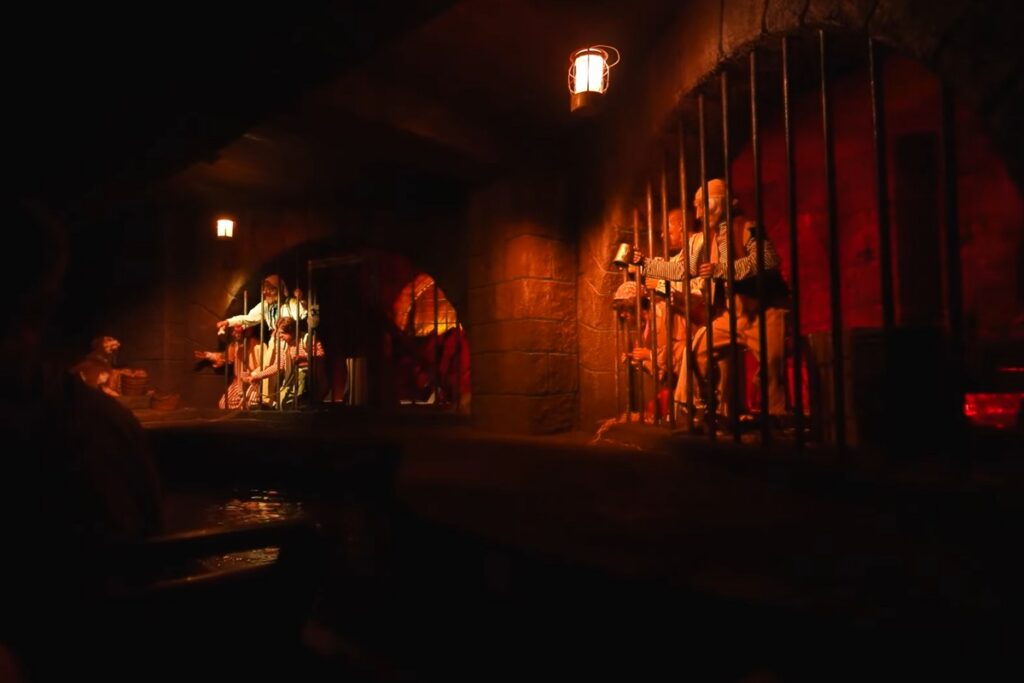
Pirates invade the town’s homes and streets, consuming enormous quantities of alcohol while the raid descends into chaos. One group sings and drinks amid barrels and stolen goods. Another group attempts to lure a dog carrying the keys to their jail cell.
That prison scene is one of the attraction’s most recognizable images.
Three imprisoned pirates stretch desperately toward a nearby dog holding the keys in its mouth. One offers a bone while the others attempt to coax the animal closer. Like many Marc Davis scenes, the entire joke can be understood without dialogue.
The dog, naturally, remains just far enough away.
Elsewhere, the pirates’ invasion becomes increasingly destructive. The town catches fire, but the intoxicated buccaneers seem far more interested in singing than escaping.
Flames flicker through windows and rooftops while pirates continue performing “Yo Ho (A Pirate’s Life for Me).” The illusion of a burning settlement is created through layered lighting, fabric, projection, theatrical effects, and moving elements rather than actual fire.
The music is inseparable from the experience.
Disney Legend X Atencio wrote the lyrics to “Yo Ho,” while longtime Disney composer George Bruns wrote the music. Atencio also developed much of the attraction’s dialogue and pirate dialect.
The assignment was remarkable because Atencio had spent much of his Disney career in animation before Walt personally moved him into Imagineering. He later recalled suggesting that Pirates needed a song and presenting Walt with an early version of the idea. Walt told him to work with Bruns, beginning an unexpected songwriting career that would later include “Grim Grinning Ghosts” for Haunted Mansion.
“Yo Ho” performs several jobs simultaneously.
It provides atmosphere, links otherwise separate scenes, establishes the pirates’ personalities, and turns the increasingly catastrophic destruction of the town into dark comedy. By the time flames surround the pirates, they are still cheerfully celebrating their chosen profession.
The attraction also features voices from some of Disney’s most recognizable performers. Paul Frees, perhaps best known to Magic Kingdom visitors as the Ghost Host in Haunted Mansion, voiced several pirates. Thurl Ravenscroft, whose unmistakably deep voice can be heard throughout numerous Disney attractions, contributed as well.
The ride eventually concludes with the pirates surrounded by treasure and the surviving evidence of their raid.
Today, Captain Jack Sparrow sits among the spoils, contentedly singing to himself and celebrating the treasure he has managed to acquire while nearly everyone else was distracted.
Jack was not part of Pirates of the Caribbean when the attraction opened. In fact, the relationship between the ride and the character demonstrates one of the strangest creative loops in Disney history.
The attraction inspired the 2003 film Pirates of the Caribbean: The Curse of the Black Pearl.
Rather than simply borrowing the name, filmmakers incorporated familiar attraction elements including the prison dog, skeletal pirates, references to the song, and other visual and thematic details. Johnny Depp’s performance as Jack Sparrow then became so enormously popular that Disney reversed the process and began bringing the movie characters back into the attraction that had inspired them.
Magic Kingdom’s Pirates closed for a substantial refurbishment in 2006.
When it returned that summer, several film characters had joined the original cast. Barbossa replaced the more generic pirate captain aboard the attacking ship. Jack Sparrow appeared multiple times as the pirates searched for him, eventually ending the experience surrounded by treasure.
The refurbishment also introduced Davy Jones as a supernatural projection appearing in a mist waterfall near the beginning of the voyage. That effect later changed to Blackbeard and eventually disappeared, but Jack and Barbossa remained.
The 2006 project was controversial among attraction purists because Pirates had originally been an independent Disney Parks story rather than an adaptation of a movie. Yet the additions were designed to fit around much of Marc Davis’ existing work rather than replace the attraction completely.
Jack is generally hiding in the margins of scenes rather than commanding them.
That approach allows the attraction to exist in an unusual hybrid state. It remains fundamentally the classic pirate invasion developed in the 1960s, but characters from the films now move through that older narrative.
Other updates have been more technical.
During the 1990s, Disney revised several scenes in which male pirates originally chased women through the town. The altered version changed the context so that some women pursued pirates who had stolen food, while other chase sequences were reworked.
A major 2015 refurbishment provided extensive maintenance to the attraction after years of wear, including significant work on the ride and show systems.
In 2017, Disney added on-ride photography near the drop. A skull effect flashes at the appropriate moment, allowing a camera to capture riders immediately before their descent. Attraction photos continue to be offered today.
The 2018 Redd transformation remains the most substantial recent storytelling change inside the ride itself.
For all those modifications, the basic experience remains remarkably recognizable.
Guests still board boats inside a fortress.
They still descend into a pirate-controlled Caribbean world.
The town is still attacked by cannon fire.
The pirates still drink too much.
The dog still refuses to surrender the jail keys.
The city still burns.
And “Yo Ho” still echoes through nearly every major scene.
The Magic Kingdom version is notably shorter than Disneyland’s Pirates of the Caribbean. Florida lacks the long opening bayou sequence, the extensive underground caverns, multiple drops, and several scenes found in California.
That difference is partly a product of its unusually rapid development.
Disneyland’s attraction evolved over years under Walt Disney’s personal supervision. Magic Kingdom’s version was designed after the park had already opened and needed to fit into an existing Adventureland footprint. Imagineers concentrated on the strongest pirate-town scenes and created the elaborate Caribbean Plaza and fortress queue to compensate for the shorter voyage.
As a result, Florida’s Pirates has its own personality rather than functioning as a precise duplicate.
Even the attraction’s relationship with Adventureland is distinctive.
Before 1973, the western side of the land essentially ended near Jungle Cruise and Tropical Serenade. Pirates expanded Adventureland physically and thematically, introducing Spanish-Caribbean architecture that would influence this corner of Magic Kingdom for decades.
Its presence continues to shape the surrounding area.
The attraction exits into Plaza del Sol Caribe Bazaar, where pirate merchandise has long extended the experience beyond the unload platform. Nearby, Disney opened The Beak and Barrel in August 2025, a pirate tavern that expands the mythology of the attraction and includes Rummy, a talking parrot deliberately designed to evoke the famous Barker Bird that once promoted Pirates outside the attraction.
The original Barker Bird was one of the most memorable elements of early Caribbean Plaza.
Like the Barker Bird outside Disneyland’s Enchanted Tiki Room, the Audio-Animatronics parrot called out to passing guests and encouraged them to enter the attraction. It originally appeared near the exit before being relocated closer to the entrance, where crowds frequently gathered to listen.
The figure was removed during the 2006 refurbishment, but its spiritual successor inside The Beak and Barrel gives the character concept a new presence in Adventureland more than half a century later.
As of 2026, Pirates of the Caribbean remains an operating Magic Kingdom attraction, offered to guests of any height and still described by Disney as a voyage to the 17th-century Caribbean. Captain Jack Sparrow, Barbossa, Redd, the jailhouse pirates, skeletons, burning town, cannon battle, and “Yo Ho” all remain part of the experience.
Its longevity is particularly remarkable considering that Magic Kingdom was originally supposed to do without it.
Had guests in 1971 been less persistent, Adventureland might look radically different today. Western River Expedition could conceivably have become Florida’s great Audio-Animatronics boat adventure, and Caribbean Plaza might never have existed.
Instead, Disney discovered almost immediately that guests did not merely want something similar to Pirates of the Caribbean.
They wanted Pirates of the Caribbean.
More than five decades later, they still do.