
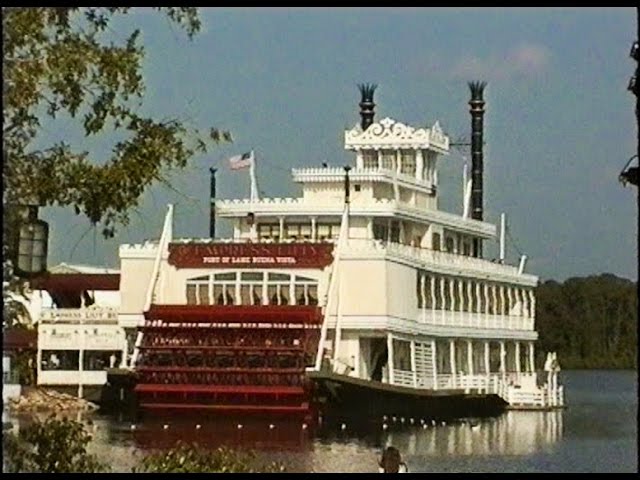
The Empress Lilly—officially spelled with two Ls—was one of the most distinctive dining destinations of early Walt Disney World and an important landmark in the development of what is now Disney Springs. Designed to resemble an ornate late-19th-century Mississippi River paddlewheel steamer, the massive structure opened on May 1, 1977, along the shore of Village Lake at the Walt Disney World Village. It was named in honor of Lillian “Lilly” Disney, Walt Disney’s widow, who personally christened the vessel when it opened. For nearly 18 years, the Empress Lilly housed three separate restaurants, a lively lounge, character breakfasts, and some of the most sophisticated dining available anywhere at Walt Disney World.
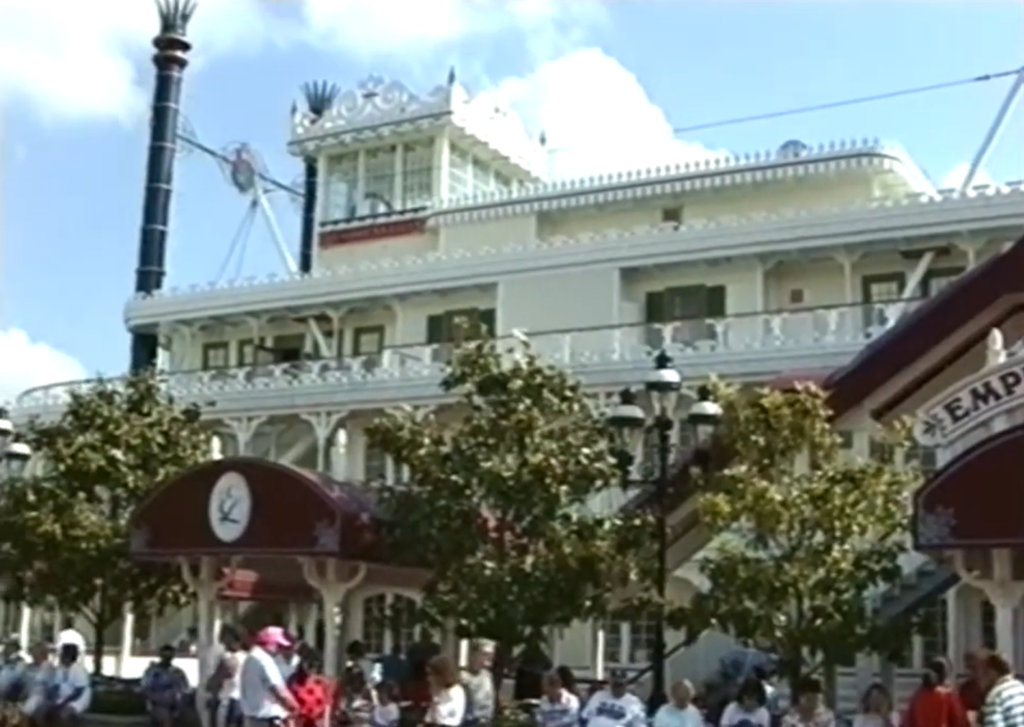
Despite its convincing appearance, the Empress Lilly was never an operating riverboat. The roughly 220-foot-long, 62-foot-wide structure was permanently constructed on a submerged concrete foundation. It could not sail anywhere, although Disney went to considerable lengths to maintain the illusion that guests were boarding a genuine paddle steamer. Ornamental railings, gingerbread trim, tall smokestacks, nautical details, multiple decks, and an enormous stern paddlewheel gave the building an imposing profile on the water. The paddlewheel actually turned, further strengthening the illusion even though the “ship” never moved.
Its arrival coincided with a broader transformation of the shopping district. The Lake Buena Vista Shopping Village had opened in 1975 as a relatively quiet collection of specialty shops and restaurants. In 1977, the district became the Walt Disney World Village, and the Empress Lilly served as an unmistakable visual centerpiece for the newly expanded destination. Long before Pleasure Island, Downtown Disney, or Disney Springs existed, the glowing riverboat helped establish the Village as somewhere guests might visit for an entire evening rather than simply stopping by to shop.
The Empress Lilly was really several restaurants under one roof, each with a different personality. Steerman’s Quarters, located on the main deck toward the stern, functioned as the ship’s steakhouse. The name was a deliberate play on both steering a riverboat and cattle “steers,” and the dining room incorporated imagery inspired by America’s cattle and ranching traditions. Certified Angus beef became a specialty, while large windows near the back of the restaurant provided views of the enormous paddlewheel turning just beyond the glass.
Fisherman’s Deck, positioned on the forward portion of the Promenade Deck, concentrated on seafood. Large windows wrapped around the dining area, providing expansive views across Lake Buena Vista. Its lighter nautical atmosphere contrasted with the heavier steakhouse character of Steerman’s Quarters, giving guests a distinctly different experience without leaving the ship.
The crown jewel, however, was the Empress Room. Located toward the stern on the Promenade Deck, it was Walt Disney World’s premier fine-dining restaurant for much of its existence. Disney’s own historical record describes it as the resort’s most elegant dining experience until Victoria & Albert’s opened at the Grand Floridian. The room embraced an elaborate European style with gold accents, chandeliers, richly decorated walls, carefully presented food, and highly attentive service. Its menu leaned toward sophisticated Continental cuisine prepared by accomplished chefs rather than the more casual fare that dominated many early Walt Disney World restaurants.
The Empress Room is particularly significant when looking at the evolution of Disney dining. Modern Walt Disney World has numerous signature restaurants, celebrity-chef concepts, extensive wine programs, and elaborate tasting menus, but those options were far more limited during the 1970s and early 1980s. The Empress Room demonstrated very early that Disney intended the Florida resort to include serious adult dining alongside theme-park attractions and family restaurants. For guests celebrating an anniversary or looking for a formal evening away from the parks, it served much the same role that Victoria & Albert’s would later assume.
Entertainment was concentrated in the Baton Rouge Lounge on the main deck. Rather than being merely a waiting area for the restaurants, the lounge became a destination of its own, offering cocktails alongside live Dixieland-style jazz and comedy. The Riverboat Rascals became closely associated with the room, with musicians performing ragtime, traditional jazz, banjo-driven numbers, and other music appropriate to the romanticized riverboat setting. The live entertainment gave the Empress Lilly an energy that continued well after dinner and helped make the vessel feel like a functioning entertainment complex rather than simply a themed building.
For a generation of Disney World visitors, however, some of the strongest memories of the Empress Lilly came from breakfast rather than evening dining. By the early 1980s, the ship was hosting one of Walt Disney World’s early character breakfasts. Mickey Mouse, Minnie Mouse, Goofy, Pluto, Donald Duck, and other Disney characters appeared at various times, often dressed to complement the nautical environment. Long before character dining became available throughout the parks and resorts, eating breakfast aboard the Empress Lilly offered families a relatively unusual opportunity for prolonged interaction with Disney characters.
Children attending the breakfast could receive commemorative items such as certificates or pennants, adding to the feeling that boarding the ship was a special occasion. The character breakfast remained part of the Empress Lilly experience well into the 1990s and became one of its most remembered traditions.
One of the reasons the Empress Lilly remains so strongly associated with early Walt Disney World is the amount of atmosphere packed into a single structure. Guests could have a steak dinner while watching a giant paddlewheel turn outside the window, eat seafood overlooking the lake, dress for an elaborate meal in the Empress Room, listen to live jazz over drinks, or return the next morning to meet Disney characters. Each space had its own visual and culinary identity, yet all were tied together by the fiction of traveling aboard an elegant riverboat.
The surrounding environment changed dramatically during the restaurant’s lifetime. Pleasure Island opened immediately adjacent to the Empress Lilly in 1989, transforming the once relatively quiet Village area into a major nighttime entertainment district. Disney incorporated the riverboat into the developing Pleasure Island environment, and the ship remained one of the district’s most recognizable landmarks even as nightclubs, restaurants, and shops multiplied around it.
The Empress Lilly’s Disney-operated era ended on April 22, 1995. Its closure was not the result of the structure being demolished; instead, Disney shifted operation of the property to Chicago-based Levy Restaurants, which signed a long-term agreement to redevelop it. The change reflected a broader trend toward bringing outside restaurant operators into Walt Disney World’s shopping and entertainment districts.
The transformation was extensive. Much of the original interior layout was removed and consolidated into a much larger single seafood restaurant. The aging decorative smokestacks and famous paddlewheel were also removed during the conversion, significantly changing the exterior silhouette. On March 10, 1996, the former Empress Lilly reopened as Fulton’s Crab House, a roughly 700-seat seafood restaurant operated by Levy Restaurants.
Fulton’s remained aboard the structure for two decades, but another major renovation began in 2016 as Downtown Disney completed its transformation into Disney Springs. The building reopened on February 4, 2017, as Paddlefish. That project dramatically modernized the interior while also restoring two important elements of the building’s riverboat appearance: prominent smokestacks and a stern paddlewheel once again became part of the exterior design.
The vessel visible at Disney Springs today is therefore the same fundamental structure that opened as the Empress Lilly in 1977, even though decades of renovations have altered nearly everything inside it. Paddlefish bears little resemblance to the Empress Room, Steerman’s Quarters, Fisherman’s Deck, or Baton Rouge Lounge, but the riverboat form remains one of the clearest surviving physical links to the earliest years of the Walt Disney World Village.
The Empress Lilly occupies a particularly important place in Disney dining history because it combined elaborate placemaking with genuine culinary ambition. It was not simply a novelty restaurant shaped like a boat. Its multiple dining rooms were deliberately distinct, its signature restaurant established an unusually high standard for Walt Disney World cuisine, its lounge offered live entertainment, and its character breakfast helped develop a format that would eventually become a major component of Disney vacation dining.
More than that, the Empress Lilly gave the original Walt Disney World Village a landmark. Decades before the district became Disney Springs, the illuminated white riverboat and its turning paddlewheel reflected across Village Lake at night, immediately identifying the area to arriving guests. The name has been absent from Disney maps since 1995, but the structure survives more than half a century after it was built, making the former Empress Lilly one of the oldest and most recognizable pieces of present-day Disney Springs history.