
Disney’s River Country was Walt Disney World’s first water park and one of the resort’s most distinctive early experiments—an attraction that felt less like a conventional theme park and more like an idealized summer swimming hole pulled from the pages of an old American adventure story. Located on the shore of Bay Lake beside Disney’s Fort Wilderness Resort & Campground, River Country opened on June 20, 1976, and operated for approximately 25 years before ending its final season in September 2001. Long before Typhoon Lagoon and Blizzard Beach established the modern Disney water-park formula, River Country demonstrated that swimming pools and water slides could receive the same kind of environmental storytelling Disney applied to its theme parks.
The concept was deliberately rustic. Disney described River Country as an old-fashioned swimming hole, with its design drawing on the imagery of Mark Twain, The Adventures of Tom Sawyer, Adventures of Huckleberry Finn, rural swimming spots, rocky riverbanks, and the kind of loosely supervised outdoor recreation associated with an earlier version of American summer. Instead of brightly colored fiberglass slides rising from exposed steel towers, guests encountered weathered wood, sandy beaches, artificial rock formations, winding waterways, rope swings, and slides disguised within a rugged landscape.
That aesthetic made River Country a particularly natural companion to Fort Wilderness. The campground had opened in 1971 as one of Walt Disney World’s original resort areas, and River Country expanded its outdoors-oriented recreation complex rather than feeling like a completely separate destination dropped beside it. Guests reached the water park near the Settlement area of Fort Wilderness, not far from Pioneer Hall and the shores of Bay Lake.
River Country’s signature environment was Bay Cove, a large sand-bottom swimming area that visually blended into Bay Lake. Although it appeared to be an open section of the lake, Disney engineered the area so that water drawn from Bay Lake could be filtered and circulated through the attraction. A barrier separated the swimming area from the larger lake while allowing the entire setting to retain the appearance of a natural waterfront swimming hole.
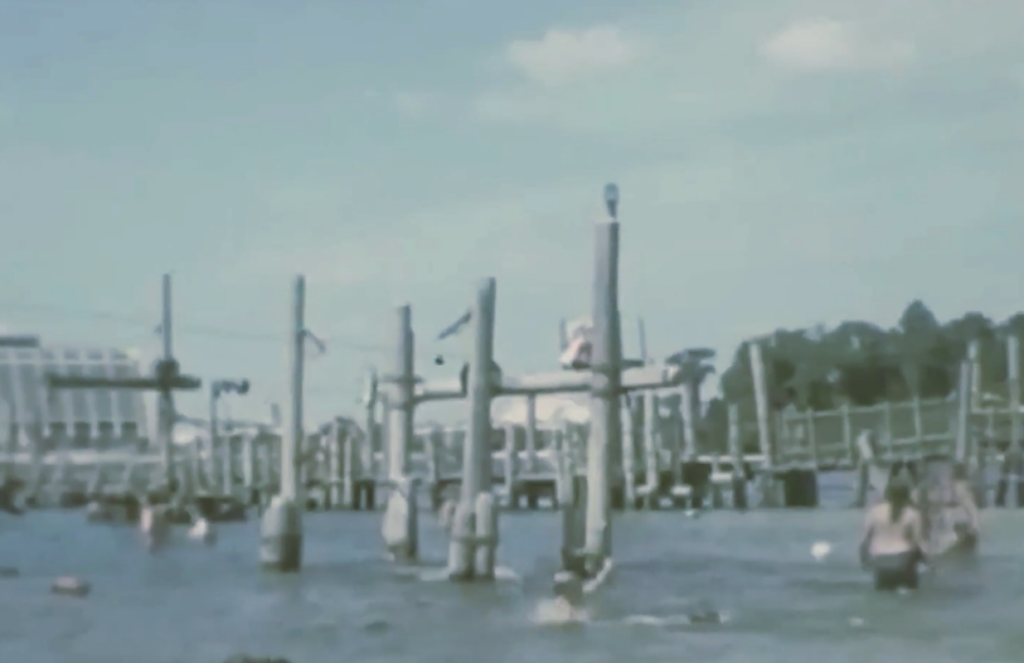
Bay Cove offered much more than ordinary swimming. Guests could climb ropes, swing out over the water, navigate floating or suspended elements, and launch themselves from structures that would seem unusually adventurous by contemporary Disney standards. The Boom Swing, Cable Ride, tire swing, and T-bar drops turned the cove into a giant aquatic playground where the guest rather than a ride vehicle provided most of the motion.
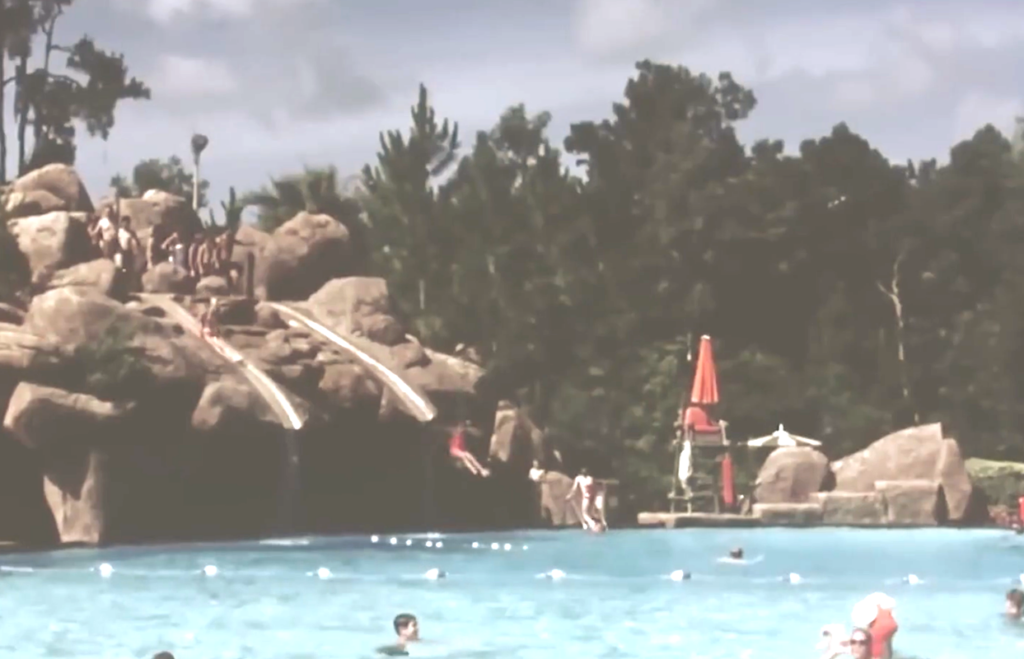
Two of River Country’s best-remembered attractions were the slides of Whoop ’n’ Holler Hollow. Built into the park’s artificial rocky landscape, the winding body slides twisted downhill before depositing swimmers directly into Bay Cove. Their integration into the terrain reinforced one of River Country’s strongest design ideas: slides were supposed to feel like something discovered within the wilderness rather than equipment installed on top of it.
Nearby, White Water Rapids offered a different experience, sending guests through a winding water course aboard inner tubes. It was not the enormous lazy river that would later become a standard feature of Disney water parks, but its succession of channels, pools, and moving water helped create the illusion that guests were floating along a naturally turbulent country stream.
River Country also contained a separate conventional swimming pool known as Upstream Plunge. This large, heated pool was home to Slippery Slide Falls, a pair of short but memorable slides descending from a rocky structure. Rather than continuing all the way into the water, the slides ended several feet above the surface, dropping riders through the air before they splashed into the pool. Disney’s own historical account describes the slides as approximately 16 feet long with a seven-foot drop into the water—an uncomplicated attraction that became one of River Country’s signature thrills.
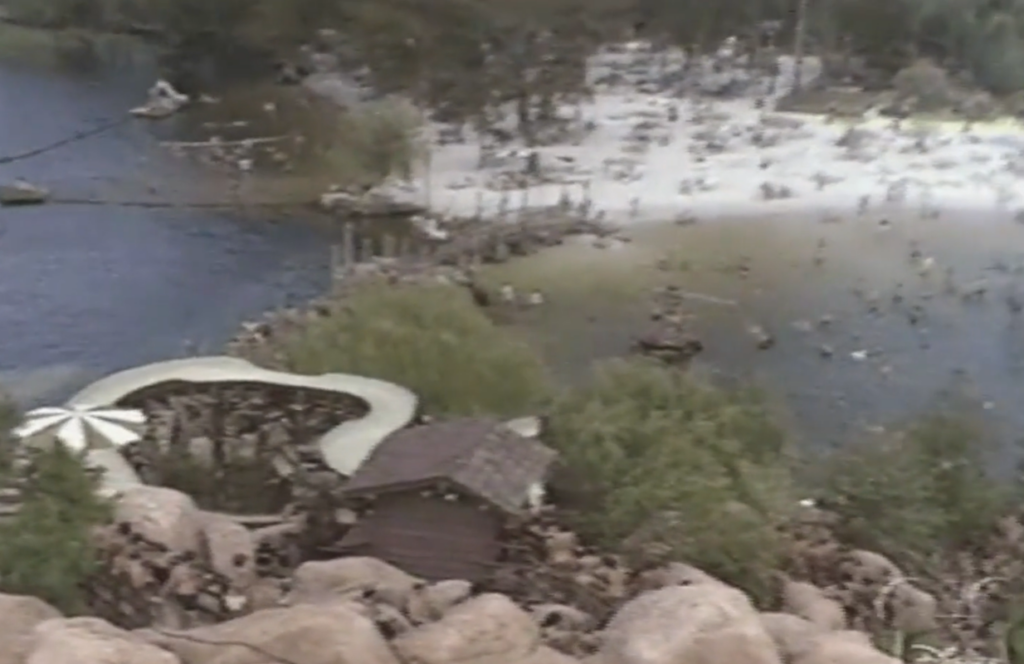
Young visitors had their own areas as well. Kiddie Cove featured smaller slides and water activities, while Indian Springs provided fountains and spraying water for younger children. Away from the aquatic attractions, guests could explore the Cypress Point Nature Trail, which extended the park’s wilderness atmosphere along Bay Lake.
River Country debuted during Walt Disney World’s Bicentennial celebrations in 1976. Susan Ford, daughter of President Gerald Ford, participated in the June 20 opening festivities, which drew hundreds of members of the press and their families. The water park soon became a substantial success. Disney’s historical records note that roughly 4,000 guests per day visited during its operating years, an impressive number considering River Country was much smaller than the water parks Disney would later construct.
Its popularity helped demonstrate that a highly themed water park could work as a major Walt Disney World attraction. In 1989, Disney opened Typhoon Lagoon, a far larger water park built around an elaborate tropical-resort-after-a-storm storyline. Blizzard Beach followed in 1995 with its melting ski-resort theme. Both parks offered larger capacities, more elaborate slides, extensive food and retail operations, and infrastructure designed specifically for high-volume modern water-park operation.
River Country increasingly became the intimate alternative. It was considerably smaller, operated seasonally, and retained a distinctly 1970s character that differed greatly from its newer siblings. For many returning guests, that was precisely its appeal. River Country did not feel like a collection of major water rides. It felt like a place to spend a summer afternoon swimming, climbing, floating, and exploring.
Its eventual closure has accumulated a considerable amount of mythology. River Country did experience serious incidents during its history, including a widely reported 1980 case in which a child contracted a fatal infection associated with Naegleria fowleri after swimming there. That tragedy has sometimes been presented online as the reason Disney eventually closed River Country, but the chronology does not support that simplified explanation: the park continued operating for more than two decades afterward.
River Country completed its normal seasonal operation in September 2001 and simply never reopened for the 2002 season. At the time, Disney did not initially describe the closure as permanent. In 2002, a Disney spokesperson told the Orlando Sentinel that River Country could potentially return if there were sufficient guest demand. By January 2005, however, Disney confirmed that the water park would remain closed permanently.
The broader circumstances provide a more convincing explanation than any single sensational event. By then, Walt Disney World already had two much larger purpose-built water parks, both capable of accommodating more guests and offering substantially more attractions. River Country’s seasonal operation, smaller capacity, aging infrastructure, lake-water-based design, and proximity to Fort Wilderness made continued investment increasingly difficult to justify. Disney itself has never publicly reduced the closure to one dramatic cause.
What happened next made River Country almost as famous in death as it had been during its operating life.
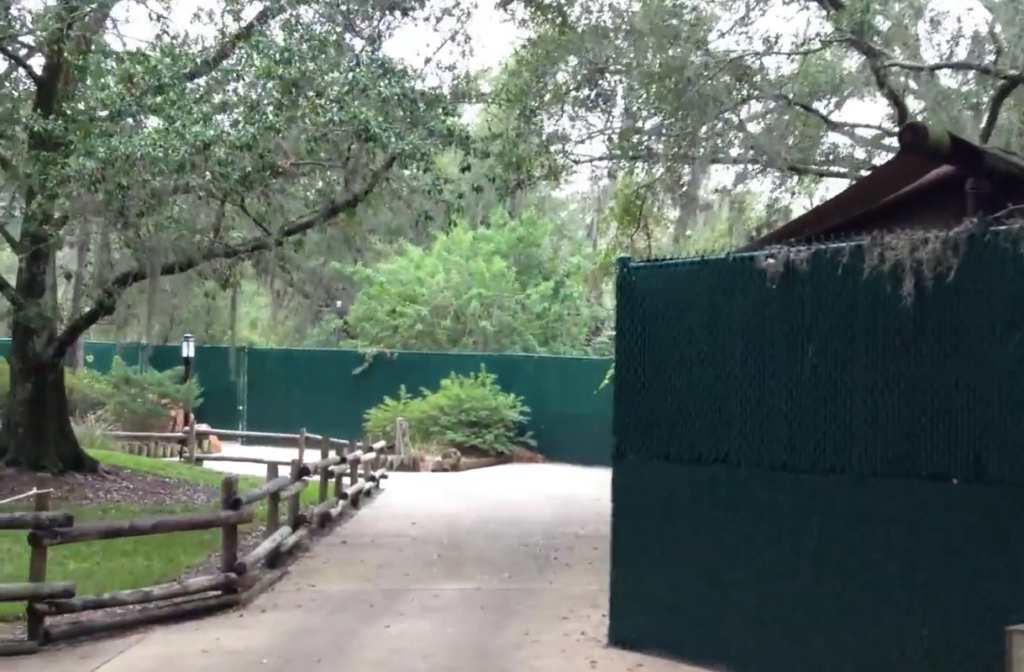
Instead of immediately demolishing the park, Disney fenced it off and left much of it standing. Slides faded in the Florida sun, pools collected stagnant water, vegetation swallowed pathways, and trees gradually concealed structures that had once been filled with thousands of swimmers. Boats traveling across Bay Lake could still catch glimpses of the abandoned property. Over time, photographs of the decaying water park spread online, giving River Country an almost legendary reputation as an abandoned Disney park hidden in plain sight.
For years, it existed beside another famous abandoned Disney property: Discovery Island, located in Bay Lake just offshore. Together, the two locations created an unusual pocket of visible Walt Disney World history in an otherwise carefully maintained resort.
That era finally ended in 2019. Disney had announced plans for a new nature-inspired resort known as Reflections – A Disney Lakeside Lodge, and the remaining River Country structures were demolished as the property was cleared for development. Construction on Reflections began but was interrupted during the COVID-19 pandemic, leaving the former water-park site facing another period of uncertainty.
Disney eventually revived development of the property under a new name. Disney’s Lakeshore Lodge is now under construction on the former River Country site and is officially scheduled to open on July 1, 2027. The 967-room resort will sit between Fort Wilderness and Disney’s Wilderness Lodge, bringing hotel rooms, Disney Vacation Club villas, restaurants, waterfront accommodations, pools, and extensive recreation back to this stretch of Bay Lake.
There is an especially fitting historical echo in Disney’s plans for the new resort. Lakeshore Lodge will feature a large recreation complex called The Wetlands, including the Lakeshore Lagoon feature pool and the Daydream River lazy river. More than half a century after Disney transformed this shoreline into its first water park, water recreation will once again become a defining element of the property.
River Country therefore occupies an unusually important place in Walt Disney World history. It was the resort’s first attempt at a fully themed water park, a product of the experimental expansion years that followed Walt Disney World’s 1971 opening, and the direct ancestor of the far more elaborate water parks that followed. Its artificial rocks, sand-bottom swimming hole, rope swings, drop slides, and filtered lake water would be difficult to reproduce exactly within a modern Disney resort, but that rough-edged quality was central to its appeal.
For the generations who experienced it, River Country was not simply an obsolete predecessor to Typhoon Lagoon and Blizzard Beach. It was one of the few places at Walt Disney World designed to feel deliberately informal—a little messy, a little adventurous, and genuinely connected to the natural environment around it. The physical park is now gone, but its location is beginning another chapter, making River Country one of the clearest examples of how Walt Disney World continually builds its future directly on top of its past.